

What is a fixed-price home building contract if the final amount can still change? The phrase suggests certainty, but the agreed price applies to a defined scope of work, not every possible decision or site condition. If the plans are incomplete or key details are left open, additions and changes can affect the total.
A single agreed amount can make budgeting feel more manageable, and it’s reasonable to want clarity before building. The key is knowing exactly what the amount covers, what it excludes, and how adjustments must be approved. This guide explains how fixed-price contracts work in BC, what can affect the final amount, and how to compare one fairly with a cost-plus proposal.
We’ll walk through the scope, allowances, exclusions, payment terms, and change-order rules to review before signing. For a project in Metro Vancouver, resolving design decisions early can also support clearer pricing discussions. Detailed plans and 3D VR walkthroughs can help you review a design before construction, while a project management portal can make progress and milestones easier to follow.
Key Takeaways
- To understand what is a fixed-price home building contract, identify the defined work the agreed amount covers instead of assuming it includes every possible project cost.
- Review allowances for specified selections or work, and understand how scope changes may affect the price, schedule, or both.
- Compare fixed-price and cost-plus proposals by looking at how each sets the price, shows costs, allows flexibility, and handles changes.
- Before signing, check that drawings, specifications, inclusions, exclusions, allowances, and payment milestones are clearly identified.
- Use coordinated design, 3D VR walkthroughs, and project progress tools to make decisions easier to visualize and follow through the build.
What Is a Fixed-Price Home Building Contract, and What Does It Fix?
A fixed-price home building contract sets an agreed amount for a defined scope of work. If you’re asking what is a fixed-price home building contract, the key is the word “defined”: the price applies to the work described in the signed agreement and its attachments, not automatically to every cost a project might involve. The Fixed-price contract model sets an agreed price for specified work, while the contract documents establish what that means for a particular build.
Price certainty means knowing the amount assigned to defined work; scope certainty means knowing exactly what that work includes. The two are connected, but they aren’t interchangeable. A stated contract amount doesn’t, by itself, promise that every selection, condition, or possible extra is covered.
Which parts of the home build are included in the agreed amount?
Drawings, material specifications, and written descriptions help establish the price boundary. Together, they can identify the labour and project work included, along with the materials, finishes, and other details the agreed amount is based on. For example, a specification that names a particular flooring material gives the selection a clear reference point. If the flooring choice is undecided, the agreement should explain how that open decision is treated. Don’t assume any eventual choice is included.
Review the signed agreement and its attachments as one package. A drawing may show the intended layout, while a specification describes the materials. Written inclusions and exclusions help clarify what the price covers and what falls outside it. If documents appear inconsistent or leave an item unclear, the price boundary may be unclear too.
Why do project definition and Metro Vancouver site conditions matter?
Every lot and design brings its own requirements. Access for equipment and materials, known site conditions, and design choices can affect the work required. The important distinction is between requirements already identified in the project documents and assumptions that still need to be addressed in writing. If an assumption later differs from the actual condition, the agreement’s terms determine how that difference is handled.
Early design decisions make the scope easier to describe. In-house custom home design tailored to the project and lot, supported by 3D VR walkthroughs, can help clients visualize layouts and resolve choices before construction. That creates a clearer basis for discussing the work included, though it doesn’t guarantee a particular contract amount. For broader context on planning a build, see this custom home construction guide.
How Do Fixed-Price Home Building Contracts Handle Allowances and Changes?
A fixed price applies to the work defined in the agreement, but selections may still be open and project decisions can change. That’s why understanding what is a fixed-price home building contract also means understanding the terms for allowances, exclusions, contingencies, and changes. These details show where the agreed amount has boundaries and what process applies when something shifts.
How do allowances, exclusions, and contingencies affect the price?
An allowance is a provisional amount in the contract for a specified selection or piece of work that hasn’t been finalized. For example, the agreement may include an allowance for a finish the homeowner will choose later. The allowance doesn’t necessarily mean every possible selection costs the same. Check how the agreement treats a final choice that costs more or less than the allowance, including how any difference is calculated and recorded.
An exclusion identifies work or costs outside the stated scope. If an item isn’t included, its cost may need separate treatment if it becomes part of the project. A contingency is different: it generally refers to an amount set aside for uncertain or unforeseen costs, rather than a provisional amount tied to a specified selection. The contract’s wording determines what an allowance or contingency covers, who can authorize its use, and how unused or exceeded amounts are handled. Don’t assume the terms are interchangeable.
What should a written change order explain?
A change to defined work can affect the price, the schedule, or both. A written change order should describe the requested change clearly, state the price adjustment or how it will be determined, and identify any effect on timing or project milestones. It should also explain how the change fits with the existing drawings and specifications.
Every change should be described and approved in writing before the changed work proceeds, so everyone has a shared record of its cost and schedule impact. The agreement should set out how changes are submitted, reviewed, approved, and recorded. This gives both parties a consistent process instead of relying on informal conversations or assumptions, and creates a reference if questions arise later.
Before signing, look for clear answers to practical questions: Who can request a change? What information must the request include? How is the price adjustment documented? When must approval happen? Clear answers help you understand how the contract works in real situations, not just what its headline price says. For a build shaped around your lot and design decisions, learn about custom home construction in Metro Vancouver.
Fixed-Price vs. Cost-Plus Home Building Contracts: What Is the Difference?
Both structures set out how a custom-home project will be priced, but they allocate cost visibility and uncertainty differently. A fixed-price agreement generally sets an amount for defined work. A cost-plus agreement generally charges project costs plus a fee determined by the contract. To understand what is a fixed-price home building contract compared with cost-plus, look beyond the label and examine the written pricing, reporting, and change terms.
| Comparison | Fixed-price | Cost-plus |
|---|---|---|
| Pricing basis | An agreed amount for the work defined in the contract. | Actual project costs plus an agreed fee structure. |
| Cost visibility | The contract amount is clear, but the detail behind costs may vary by agreement. | Can show actual costs, subject to the contract’s reporting requirements. |
| Flexibility | Changes to defined work may require adjustments to the price or schedule. | Can accommodate evolving decisions, with costs reflected under the agreed terms. |
| Change handling | Follow the contract’s process for documenting and approving scope changes. | Confirm how changes affect project costs, the fee, and approvals. |
When might a fixed-price structure suit a custom-home project?
A fixed-price structure may suit a project with a well-developed design and clearly described scope, especially when the owner values an agreed amount for that work. The more decisions that remain open, the harder it can be to define what the price covers. Frequent revisions can require adjustments and complicate planning. A fixed price doesn’t remove exposure to costs outside the defined scope or terms.
When might a cost-plus structure be considered instead?
Cost-plus may be considered when flexibility and visibility into actual project costs are priorities. That visibility depends on the agreement’s reporting terms, so review what costs are tracked, how often they’re reported, and how the fee is calculated. Understand which decisions require approval and how a change affects the total. Neither structure is automatically better; the right fit depends on project definition and the owner’s preferences.
For a fair comparison, assess both proposals against the same project information. Check the drawings, specifications, inclusions, exclusions, allowances, fee basis, reporting approach, and change process. Contract labels alone don’t establish each party’s obligations; the written terms do. Clear design decisions help define the scope under either model. This custom home design guide explores how design choices connect a homeowner’s vision with the build.
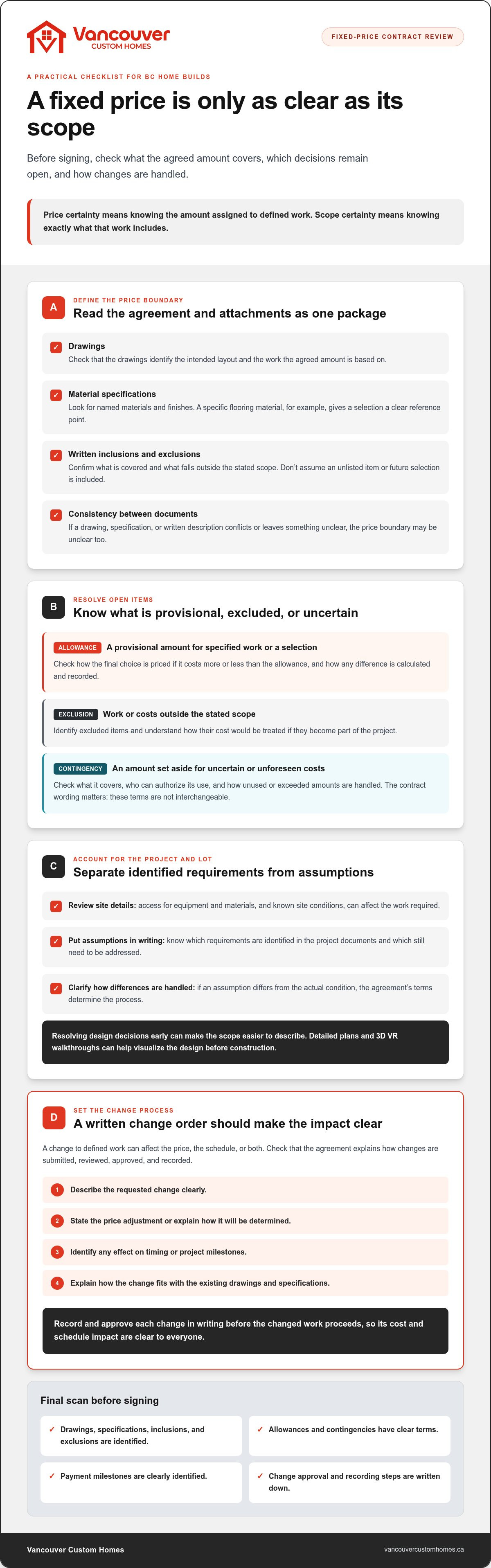
How to Review a Fixed-Price Home Building Contract in BC
A careful review turns a headline amount into a clearer picture of the work, payment process, and responsibilities it covers. Use this sequence to organize your questions before signing. It’s practical guidance, not legal advice or a substitute for independent professional review.
- Match the documents. Check that the agreement identifies the current project drawings and written specifications. Make sure the referenced versions are the ones you intend to build from, and look for a clear way to identify later revisions.
- Trace the scope. Review the stated inclusions and exclusions alongside the plans. Check that expected work and materials are described, and note any gaps, assumptions, or items that appear in one document but not another.
- Identify allowances. For each allowance, note what selection or work it relates to and how the agreement treats an amount that is unused or exceeded. Don’t rely on a general label if the specific treatment matters to your budget.
- Follow the payment milestones. Identify what each payment corresponds to, when it becomes due, and what records or approvals document the milestone. Compare proposals against the same scope and payment stages, not just their headline amounts.
- Read the change and schedule terms. Find how a change is requested, priced, approved, and recorded. Check whether the agreement explains how a change can affect timing, and how schedule adjustments are communicated and documented.
- Look at unforeseen conditions. Review the wording for site conditions or other circumstances that may not be known when the agreement is signed. Note how the contract describes notice, assessment, approval, and any resulting price or schedule adjustment.
- Review legal and dispute terms. Read the provisions on responsibilities, remedies, and dispute resolution. Their meaning depends on the agreement’s facts and current BC law, so have a lawyer review terms you don’t understand before committing.
Keep a record of the exact documents reviewed and any revisions made during discussions. If a proposal and its attachments don’t make the scope easy to identify, resolve the discrepancy before relying on the stated amount. An organized design and construction process can help keep project decisions and milestones visible. Read more about custom home construction in Metro Vancouver.
How Vancouver Custom Homes Makes a Complex Build Easier to Follow
A well-organized project connects design decisions with the work that follows. It doesn’t guarantee a fixed contract type or final cost. Coordinated design and construction can give homeowners a clearer view of what’s planned, which choices are still open, and how the build is progressing.
How can integrated design clarify the project before construction?
Vancouver Custom Homes develops custom designs around each project and lot. As plans take shape, decisions about layout, materials, and finishes can be considered together. This gives the homeowner and project team a more complete basis for drawings and specifications, supporting clearer discussions about the intended scope before construction begins.
A 3D VR walkthrough offers a practical way to experience the proposed layout. Rather than reviewing a plan only on a page, clients can preview the design and consider how spaces connect. They can raise questions about the planned arrangement while decisions are still part of the design conversation. The walkthrough supports visualization, but it doesn’t replace the written drawings and specifications that describe the project.
For a broader overview of planning a residential build, explore the custom home construction guide. Clearer early decisions can make scope discussions more grounded, whether the project is a custom home, laneway home, or multiplex.
How does project visibility support informed decisions?
Once construction is underway, a consistent way to follow progress and milestones can help homeowners stay oriented. Vancouver Custom Homes provides clients with access to a dedicated project management portal to track project progress and milestones as the build moves through its stages.
Visibility supports informed conversations. If a question comes up about a decision or upcoming milestone, clear records and timely communication can help everyone refer to the same project information. The portal complements direct project discussions; it doesn’t replace the contract or change its terms. For more on how digital project tracking can help homeowners follow a build, read the home builder client portal guide.
Understanding what is a fixed-price home building contract starts with the agreement’s defined work, but following a complex build also depends on organized decisions and visible progress. Learn how design, construction, and project tracking can come together for your residential project by visiting Vancouver Custom Homes.
Build With Clearer Decisions and a Stronger Plan
So, what is a fixed-price home building contract? It’s an agreed amount for defined work, not an automatic promise that every possible project cost is covered. The drawings, specifications, allowances, exclusions, and change terms show where that price begins and ends. To compare fixed-price and cost-plus proposals fairly, look at the scope and written terms, not just the headline amount.
Good project visibility starts before construction. Vancouver Custom Homes brings custom design and residential construction together in a coordinated process. 3D VR walkthroughs help you visualize the planned design, while project management portal access lets you follow progress and milestones. These tools support informed decisions, but the contract itself sets the agreed scope and obligations.
Discuss your residential project with Vancouver Custom Homes and plan your custom home, laneway home, or multiplex in Metro Vancouver.
Frequently Asked Questions
What is a fixed-price home building contract?
A fixed-price home building contract sets an agreed amount for a clearly described scope of construction work. The price applies to the work identified in the signed agreement and its attachments, not automatically to every possible project cost. For residential builds in Vancouver, Burnaby, West Vancouver, North Vancouver, Richmond, New Westminster, Coquitlam, Port Moody, Port Coquitlam, Maple Ridge, Pitt Meadows, Langley, Surrey, and Delta, the project drawings and specifications help define that scope.
Does a fixed-price contract mean the final amount cannot change?
Not necessarily. The agreed amount generally applies to the defined scope, while the contract may allow adjustments for approved changes, exceeded allowances, or conditions treated separately in its terms. A design revision, for example, could add work or affect the schedule. Read how the agreement requires changes to be priced and approved, and how it addresses site assumptions. Don’t treat the headline amount as covering every possible project cost.
What is the difference between fixed-price and cost-plus construction contracts?
A fixed-price contract generally sets an amount for defined work. A cost-plus contract generally charges actual project costs plus an agreed fee structure. Fixed-price can make the amount for the specified scope easier to identify, while cost-plus can provide visibility into actual costs, depending on reporting terms. Compare how each proposal handles fees, approvals, changes, and cost records. Neither structure is automatically better; the right fit depends on the project and your priorities.
Are allowances included in a fixed-price home building contract?
An allowance may be included as a provisional amount for a specified selection or piece of work that hasn’t been finalized. It doesn’t necessarily mean every possible choice is covered at the same amount. Check what the allowance applies to and how the agreement treats a final selection that costs more or less. The contract wording should explain how any difference is calculated and documented.
What should I check before signing a fixed-price building contract in BC?
Check that the agreement identifies the project drawings and specifications, inclusions, exclusions, allowances, and payment milestones. Then review how it handles change approvals, schedule adjustments, and unforeseen conditions. Compare proposals using equivalent project scope, not headline amounts alone. BC legal obligations depend on current law and the agreement’s facts, so consider independent legal review of obligations, remedies, and dispute terms before signing.
Can I change the design after signing a fixed-price contract?
Design changes may be possible, but they can affect the price, schedule, or both. Follow the change process set out in the agreement. It should explain how a proposed revision is submitted, assessed, approved, and recorded. Get the change and its cost and timing implications documented before the revised work proceeds. Early design decisions, supported by drawings and 3D VR walkthroughs, can help clarify choices before construction begins.


