

What if a construction change could be a considered project decision, not a surprise bill? A revised layout or material choice may affect more than appearance. It can influence labour, procurement, inspections, and the sequence of work. That’s why managing change orders during construction starts with understanding the full impact before you approve anything.
It’s reasonable to want flexibility as your home takes shape while also expecting clear costs, timing, and accountability. Vague estimates, verbal requests, and decisions scattered across messages can make it hard to know what’s actually been agreed. A written change order brings the details together so you can make an informed choice and keep the project record clear.
This guide explains what a change order should record, what to review before giving written approval, and how to track updates to scope, budget, schedule, and design intent. For homeowners planning a custom home in Vancouver or Metro Vancouver, design and construction decisions need to stay coordinated. 3D VR walkthroughs can help you visualize choices before work proceeds, while a project management portal can make progress and milestones easier to follow.
Key Takeaways
- A change order records an agreed revision to the project. Clear documentation helps keep everyone aligned; it doesn’t automatically mean something has gone wrong.
- Managing change orders during construction means reviewing the written scope, cost basis, schedule impact, assumptions, and exclusions before approving the change.
- Look beyond the stated change for dependencies, such as procurement, trade coordination, or other work that may be affected.
- On a Vancouver-area build, coordinate design updates with construction sequencing and applicable municipal processes.
- Integrated design and construction coordination, 3D VR walkthroughs, and project portal access can connect decisions with project updates and milestones.
What Is a Construction Change Order and When Is It Needed?
A construction change order is a documented revision to the project’s agreed scope, selections, drawings, cost, or schedule. It describes what is changing and records the decision so the homeowner and project team share the same understanding. Its effects depend on the specific revision. A change order doesn’t automatically mean the project has a problem, and not every change affects cost and timing in the same way.
For a neutral overview of the term and its role in project management, see What is a change order. On a residential build, the project agreement and the work already defined in the scope help determine whether a request calls for a change order. A clarification explains or confirms what the existing documents already say. A scope change revises what was agreed, such as selecting a different finish or adjusting a layout. If the distinction isn’t clear, document the question and resolve it with the project team before treating it as an approved revision.
Which construction changes should be documented?
Record proposed revisions that may alter the agreed work, including finish changes, layout adjustments, added work, or material substitutions. The project agreement and actual scope determine the appropriate documentation process. Describe what prompted the request, too: a homeowner-requested change differs from a design coordination issue or a site condition that needs a response. These situations may call for different decisions, so explaining the reason helps the team assess the revision accurately.
A clear record gives the homeowner and project team a shared reference for the decision. It keeps details from being scattered across conversations or assumed from a drawing update.
Why can a small change affect more than the visible work?
A selection can connect to drawings, procurement, sequencing, and dependent work. For example, changing a fixture after related work has been planned may require the team to check whether the revised selection fits the design, whether ordering needs to change, and whether another task depends on its specifications. The visible difference may be small, but the coordination questions still deserve attention.
That doesn’t mean every revision creates extra cost or delays. The impact depends on the project stage, the work involved, and connected decisions. Managing change orders during construction means identifying those links before the revision is treated as settled. On a custom home, coordinated design and construction review can connect the request to its practical build implications and help preserve the design intent.
How to Manage Change Orders During Construction, Step by Step
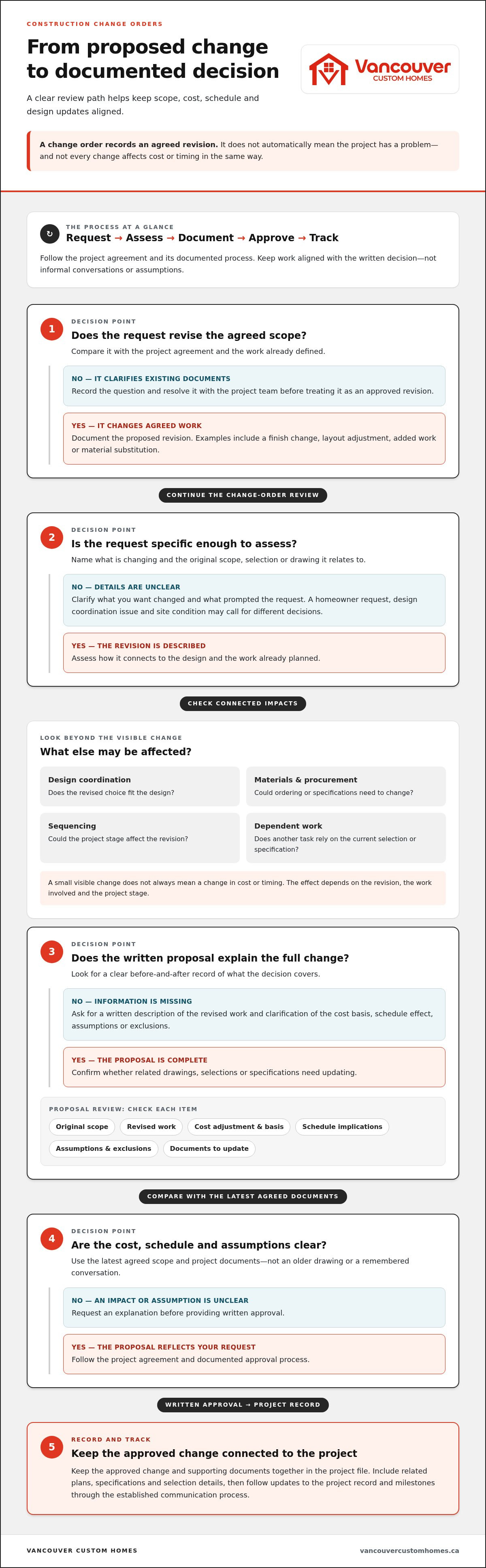
A clear process turns a proposed revision into a considered project decision. Follow the project agreement and documented process for submitting, reviewing, and approving changes. Keep the work aligned with the written decision, not informal conversations or assumptions.
Request, assess, document, approve, track. This sequence keeps the change and its effects visible from the first discussion through the project record. The Associated General Contractors of America also describes change orders as part of construction project management, underscoring the value of a consistent process.
- Describe the request. State what you want changed and identify the original scope, selection, or drawing it relates to. Be specific enough that the proposed revision can be assessed against the current project documents.
- Assess the implications. Review how the request may affect design coordination, materials, sequencing, and dependent work. The impact varies by project and timing, so don’t assume a change has no consequences simply because it appears small.
- Get the proposal in writing. Ask for a clear description of the revised work, its cost basis, schedule effect, assumptions, and exclusions. Confirm whether related drawings, selections, or specifications need updating.
- Review before approval. Compare the proposal with the latest agreed scope and project documentation. If a cost item, schedule effect, or assumption is unclear, request an explanation before providing written approval.
- Record and track the decision. Keep the approved change and supporting documents together in the project file. Follow updates to the project record and milestones through the established communication process.
What should a complete change-order proposal explain?
The proposal should make the before and after clear: identify the original scope, describe the revision precisely, and show the cost adjustment and schedule implications. It should also state the assumptions and exclusions behind the assessment, and identify any drawings, selections, or specifications that need updating. This gives you a clear record of what the decision covers and what remains unchanged.
How should clients review and approve a proposed change?
Use the latest agreed documents as your reference, not an older drawing or a remembered conversation. Check that the written proposal reflects your request and explains its impacts. Approval should follow the project agreement and documented process. Once approved, keep the record with the related plans, specifications, and selection details so the team can refer to one consistent decision.
For a custom home, connecting design choices with build coordination can help keep revisions aligned with the overall plan. Explore custom home design and construction as part of a coordinated project approach.
How to Compare a Change Order’s Cost, Schedule, and Project Impact
A proposal can describe the requested work and still leave important questions unanswered. To compare it properly, separate the direct change from any coordination it may trigger. A revised selection, for example, may have a stated cost adjustment, while ordering or connections to other planned work create separate dependencies to review.
Approve a change only after reviewing its scope, cost, schedule effect, and assumptions in writing. A change order doesn’t automatically mean the original plan was poorly managed. Homeowners may make new design choices as a project develops, and site or coordination information can also lead to revisions. The key is understanding what prompted the change and what its documented impacts are.
Compare these four parts of the proposal:
| Scope of review | What to look for |
|---|---|
| Direct scope cost | The cost adjustment for the revised work, with relevant labour, materials, revised drawings, or related work itemized where applicable. |
| Schedule effect | Any change to the sequence of work or a project milestone, including the stated reason and the activities affected. |
| Dependencies | Connected decisions or tasks, such as procurement, trade coordination, or work that relies on the revised selection or drawing. |
| Documented assumptions | What the assessment relies on, what is included or excluded, and any points that remain subject to a stated assumption. |
This comparison helps distinguish the direct change from possible downstream coordination needs. The direct scope describes what is being added, removed, or revised. Dependencies explain what else may need attention so the change can be carried through the project consistently. They don’t automatically mean extra work or delay; they’re items to clarify and document.
What cost details should clients look for?
Check whether the written cost adjustment explains the components relevant to the revision, such as labour, materials, drawing updates, and related work. Then review what’s included, what’s excluded, and whether any amount or scope depends on an assumption. If a line is unclear, ask for its basis to be explained before deciding. Don’t rely on a single total if the proposal doesn’t show what it covers.
How can a change affect the construction schedule?
Timing may depend on procurement, work sequencing, approvals, and tasks that rely on the revised item. A proposal might identify an affected milestone without stating that the overall completion date will change. Treat those as distinct points. Record the schedule effect alongside the approved scope revision, then track updates through the project record. This gives everyone a clearer view of the decision and its practical implications.
How to Keep Change Orders Clear on a Vancouver-Area Residential Build
On a residential build in Vancouver or Metro Vancouver, a design revision can connect to several parts of the project. Updated drawings may affect selections; a revised selection may influence procurement; and changes to the work sequence can affect other trades. Managing change orders during construction means keeping those moving parts aligned, not just recording the visible adjustment.
Use the project record to connect the proposed revision with related drawings, selections, procurement decisions, and sequencing updates. The wider context of a custom home construction guide can help homeowners understand how decisions fit into the overall build.
Which local project details may need to be revisited?
For each proposed change, consider whether the latest drawings and selections reflect the decision, whether materials or other items need coordination, and whether the work sequence depends on the revision. Permit or inspection implications can vary by project and municipality. Check the applicable municipal requirements for the specific change rather than assuming every design revision requires an update, permit, or inspection.
How can design visualization reduce decision uncertainty?
A 3D VR walkthrough can help homeowners see layouts and interior design choices before construction decisions are finalized. This makes it easier to discuss how a proposed adjustment may look and fit within the design, though visualization can’t eliminate every change or guarantee a particular final outcome. For more on connecting design decisions with the build, read about custom home design and visualization.
Keep client communication and project updates connected to the documented decision. A project management portal can provide visibility into progress and milestones, helping homeowners follow the build as coordinated updates are recorded.
For a residential project in Metro Vancouver, coordinated design and construction can connect a requested change to its practical build implications. Explore Vancouver Custom Homes to learn about an integrated approach to custom home projects.
How an Integrated Project Process Keeps Change Orders on Track
A change order is easier to manage when design decisions, construction coordination, and client communication stay connected. An integrated process helps the team assess a requested revision in the context of the home, rather than treating it as an isolated instruction. That shared view supports clear decisions and keeps the project record aligned as work progresses.
How do design and construction coordination support decisions?
When design and construction teams coordinate, they can consider how a proposed revision relates to drawings, selections, procurement, and planned work. Updated drawings or visualizations can help clients understand what a design adjustment means before they decide. Clear information makes the discussion more concrete and ties the decision to both the intended design and the build.
What should clients expect after approving a change?
Once a change is approved through the project’s documented process, the project record can be updated to reflect the decision. Related drawings, selections, and schedule notes may also need to be brought into alignment. This gives the team a consistent reference as the revised work moves forward, rather than relying on separate messages or outdated documents.
Portal access gives clients a place to follow project progress and milestones. It supports visibility into how the project is advancing without replacing the approved change record. For more on this kind of project visibility, read about home builder client portal benefits.
Managing change orders during construction is more straightforward when the decision process is clear and the project team keeps design and build information coordinated. If you’re planning a custom home, laneway home, or multiplex in Metro Vancouver, discuss your residential project with Vancouver Custom Homes.
Keep Your Project Decisions Clear and Connected
Construction changes don’t have to create confusion. A clear written record helps keep the agreed scope, cost, schedule, and design intent aligned. Before approving a revision, understand what’s changing, what assumptions shape the proposal, and whether related project details need updating. That’s the foundation of managing change orders during construction with confidence.
For a custom home, laneway home, or multiplex, coordinated design and construction can connect a decision to its build implications. Vancouver Custom Homes provides in-house design and construction, 3D VR walkthroughs to help you visualize designs before construction, and a project management portal for progress and milestone visibility. These tools support informed decisions and a clearer view of the project as it moves forward.
Start your residential project with a process built around clear communication and thoughtful coordination. Discuss your residential project with Vancouver Custom Homes to take the next step.
Frequently Asked Questions
What is a change order in construction?
A construction change order is a written record of a revision to the work previously agreed for a project. It may update the scope, selections, drawings, cost, or schedule. For example, changing a specified finish or adjusting a room layout may call for a documented revision if it changes the agreed work. The record helps the homeowner and project team refer to the same decision and understand its effects.
When should a change order be used during construction?
Use a change order when a proposed decision changes the agreed work, rather than simply clarifying what the existing project documents already say. Examples may include adding work, substituting a material, or revising a layout or finish. The project agreement and documented process help determine how to record a specific revision. If it’s unclear whether a request changes scope or clarifies it, resolve that distinction before proceeding.
What should be included in a construction change order?
A change order should identify the original scope and describe the proposed revision clearly. It should set out the cost adjustment and its basis, schedule implications, assumptions, and exclusions. Note any related drawings, selections, or specifications that need updating, too. The level of detail depends on the change, but the written record should make clear what’s included, what remains unchanged, and how the decision connects to the project documents.
Can a change order increase the construction timeline?
Yes, a change may affect timing, but it doesn’t always do so. The impact can depend on procurement, approvals, work sequencing, or tasks that rely on the revised item. Review the proposal for any affected milestone and the reason for the change. A milestone adjustment isn’t automatically a guaranteed change to the overall completion date. Record the schedule effect alongside the approved scope revision and track updates in the project file.
Do change orders mean a construction project was poorly planned?
No. A change order records a revision; by itself, it doesn’t show that the original plan was poorly managed. Homeowners may refine design choices as a project takes shape, and coordination or site information may prompt a review. What matters is understanding why the change is proposed, assessing its effects, and keeping the decision documented. A clear process helps the team manage revisions without confusing them with the original agreed scope.
Should I approve construction change-order work before the details are final?
It’s prudent to wait until the written proposal explains the revision and its known cost and schedule effects. Review the assumptions, exclusions, and related project details, such as updated drawings or selections. If an impact is unclear, ask for it to be explained before giving written approval. Follow the project agreement and documented process, and keep the approved record with its supporting documents so the decision is clear to everyone involved.
How should change orders be tracked on a custom home project?
Keep each proposed and approved change with the relevant project documents, including updated drawings, selections, and schedule notes. Record the decision and any stated assumptions so the current scope is easy to follow. During a custom home build, managing change orders during construction also means tracking progress against affected milestones. A project management portal can give clients visibility into project progress and milestones, while the project record preserves the details of each decision.
Do Vancouver building permits need to be updated for a construction change?
It depends on the proposed change and the project’s circumstances, so don’t assume every design revision requires a permit or inspection update. Requirements can vary by municipality. Check the applicable requirements with the relevant local authority for the project location. This matters for projects in Vancouver, Burnaby, West Vancouver, North Vancouver, Richmond, New Westminster, Coquitlam, Port Moody, Port Coquitlam, Maple Ridge, Pitt Meadows, Langley, Surrey, and Delta. Keep any confirmed direction with the project record.


