

Choosing a fixed price vs cost plus builder vancouver is a false dilemma that often leads to the same destination: unexpected budget bloat and missed deadlines. You shouldn't have to choose between the anxiety of hidden fees in a cost-plus model and the fear of low-ball quotes that inevitably lead to corner-cutting. In 2026, with the Vancouver Building By-law 2025 and new provincial density mandates under Bill 25 now in full effect, these traditional contract structures often fail to account for the complexity of modern builds. Relying on outdated paper quotes in a market where material costs remain 15% to 35% above pre-pandemic levels is a risk you don't need to take.
It's understandable to feel overwhelmed by the financial stakes of a custom home, laneway house, or multiplex project. You want a transparent budget framework and a partner who's incentivized to finish on time. This article will clarify the critical differences between these two models and show you how an integrated approach protects your investment. We'll explore how 3D VR walkthroughs and unified project management provide the predictable cash flow you need for a successful 2026 build cycle. By the end, you'll see why the most secure contract isn't just about the numbers on the page; it's about the technology and strategy behind them.
Key Takeaways
- Understand the core mechanics of each contract type to determine which structure offers the most security for your specific financial situation.
- Discover how to compare a fixed price vs cost plus builder vancouver to insulate your project from material price volatility and shifting labour costs.
- Identify the hidden risks of cost-plus models, including the "flexibility trap" that often leads to significant budget overruns.
- Access a comprehensive 15-point checklist designed to help you spot proposal red flags and navigate complex BC-specific building regulations.
- Explore how integrating 3D VR technology and a unified design-build process helps you realize the certainty needed for a true, transparent fixed-price agreement.
Navigating the Vancouver Custom Home Contract: Fixed Price vs. Cost-Plus Explained
Choosing how to pay for your build is the most consequential decision you'll make before the first shovel hits the dirt. In British Columbia, the debate over a fixed price vs cost plus builder vancouver remains the primary source of friction between homeowners and contractors. It's a clash of priorities. One side craves the security of a hard ceiling. The other values the freedom to refine the vision as the walls go up. This choice dictates who carries the financial risk when Vancouver's unpredictable weather or supply chain ripples interfere with the timeline.
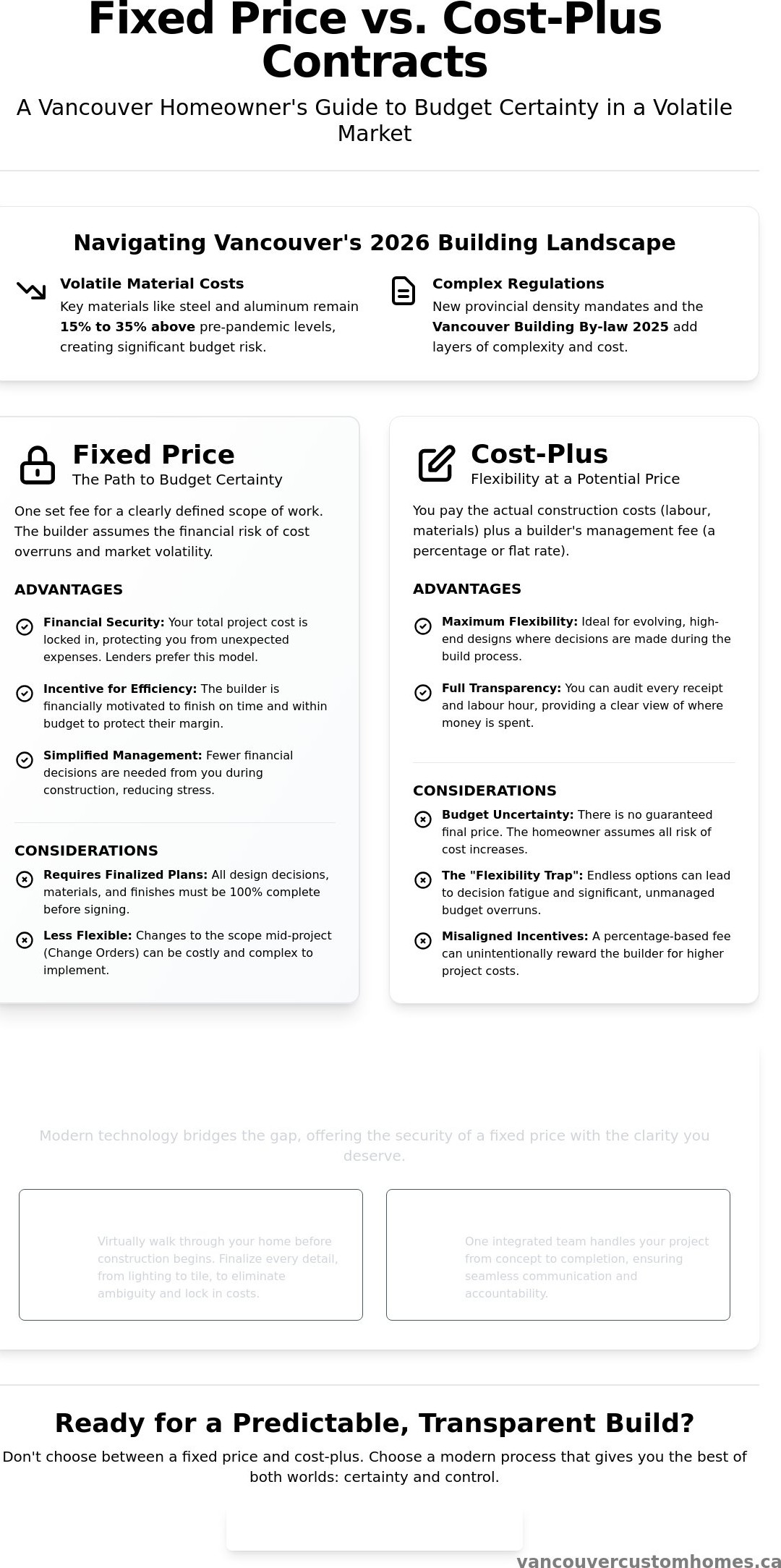
At its simplest, a fixed price contract establishes one set fee for a clearly defined scope of work. Conversely, a cost-plus agreement requires you to pay the actual construction costs plus a management fee, usually a percentage or a flat monthly rate. Understanding different construction contract types is essential because the wrong choice can turn a dream project into a source of constant financial anxiety. The stakes are high. You're balancing the comfort of budget certainty against the potential for total design flexibility.
The Core Mechanics of Fixed Price Contracts
Builders don't just guess at numbers. In a volatile market where material costs are still 15% to 35% higher than pre-pandemic levels, a fixed-price builder must meticulously calculate margins and contingencies. They often include "Allowances" for variable items like Italian tile or custom lighting to keep the quote realistic. This model demands 100% completed drawings before signing. If you haven't finalized your Multiplex or Custom Home Design, a fixed price is impossible to guarantee without significant risk to the builder's bottom line. It's a model built on discipline and foresight.
The Core Mechanics of Cost-Plus Contracts
This model is the standard for high-end projects where the design evolves during excavation. You get total transparency, with the right to audit every receipt and labour hour. However, the lack of a financial "ceiling" is the trade-off. Fees are structured as either a percentage of total spend or a flat monthly management fee. While this offers flexibility, it places the risk of market fluctuations squarely on your shoulders. It's a partnership built on trust rather than a strictly bound financial outcome. If your vision isn't fully realized yet, this path allows you to start while you decide on the details.
The Fixed Price Advantage: Achieving Budget Certainty in the Lower Mainland
Why do savvy homeowners prioritize a fixed price vs cost plus builder vancouver when planning a custom build? It comes down to financial insulation. While material costs for lumber have stabilized, metals like steel and aluminum remain significant cost pressures, sitting 15% to 35% above pre-pandemic levels. A fixed-price contract acts as a shield. It locks in your costs for the 2026 build cycle, ensuring that a sudden spike in glazing prices doesn't derail your project. This model creates a powerful "Incentive Alignment" where the builder is financially motivated to be efficient and organized. If they waste material or mismanage labour, it's their margin on the line, not your bank account.
Vancouver lenders and major banks often prefer this model for construction financing. They want to see predictable cash flow and a final number that won't shift. This certainty is especially critical when accounting for the BC Energy Step Code. With Vancouver mandating Step 3 for most residential buildings and Level 1 of the Zero Carbon Step Code now in effect, compliance can add $15 to $40 per square foot to your project. In a cost-plus model, you're on the hook if the builder struggles to meet these airtightness targets. A fixed-price agreement ensures the builder owns the performance requirement from day one. You can follow these official contract guidelines to see how risk is traditionally allocated in these professional agreements.
Managing the "Unknowns" in a Fixed Price Model
What happens when you find a buried oil tank in Burnaby or encounter the notoriously soft soil of Richmond? These are "Unforeseen Conditions." While a fixed price covers the known scope, you must still maintain a robust contingency fund of 5% to 10%. Some owners prefer a "Guaranteed Maximum Price" (GMP) hybrid. This sets a hard ceiling but allows you to share in the savings if the project comes in under budget. It's a strategic way to maintain control while benefiting from builder efficiency. If you're ready to see how this looks in practice, you can explore our Custom Home Construction options to find the right fit for your lot.
Why Fixed Price Demands Upfront Decision Making
The "Price Lock" concept for 2026 material procurement is a massive advantage, but it requires discipline. Indecision is the primary enemy of the fixed-price model. If you change your mind about a Multiplex layout or a kitchen finish after the contract is signed, you'll face change orders that erode your savings. This contract is designed for a "Turnkey" experience. It moves you from design to move-in with one clear number, but it only works if you've done the work to finalize your vision during the pre-construction phase. When the data is solid, the price stays solid.
Decoding Cost-Plus Contracts: Flexibility vs. Financial Risk in BC Construction
Flexibility is a double-edged sword in the Vancouver construction market; it offers creative freedom while simultaneously exposing you to uncapped financial liability. When evaluating a fixed price vs cost plus builder vancouver, many homeowners are drawn to the perceived transparency of paying "actual costs." This model sounds fair in theory. You pay for the materials and labour used, plus a management fee. However, this often becomes a "flexibility trap." The ability to change your mind mid-build is expensive. Without the discipline of a pre-set price, a project with an initial $2 million estimate can quietly balloon to $2.5 million as small decisions compound into massive overruns.
The administrative burden of a cost-plus contract is often underestimated. You aren't just a homeowner; you essentially become a part-time auditor. You'll need to review hundreds of monthly invoices, verify labour hours, and track material deliveries to ensure you aren't overpaying. This is where Project Management Portal Access becomes indispensable, providing the digital trail needed to keep a builder accountable. Without a singular, unified system to track these variables, scope creep becomes inevitable. When comparing contract pros and cons, the lack of a financial ceiling remains the most significant risk for anyone without an unlimited budget.
When Cost-Plus Actually Makes Sense
There are specific scenarios where this model is the only logical path. If you're restoring a heritage estate in Shaughnessy, for example, the extent of structural rot or outdated wiring is often unquantifiable until the walls are opened. Similarly, highly experimental architectural designs may lack the historical data required for a firm quote. In these cases, you prioritize the finest craft over a final bill. You're paying for a specialized process where the building method itself is being refined in real-time.
The Hidden Risks for Vancouver Homeowners
The "Percentage Fee" structure creates an inherent conflict of interest; the more you spend, the more the builder earns. This removes the incentive to negotiate aggressively with trades or find cost-saving alternatives. In a market where Lower Mainland labour costs have increased by 12% to 18% since 2024, an uncapped labour bill can be devastating. To mitigate this, savvy clients insist on "Cost-Plus with a Cap" clauses. This hybrid approach allows for some flexibility while establishing a "do not exceed" price. It's a necessary safeguard if your Custom Home Design involves complex elements that aren't fully finalized before excavation begins.
The Ultimate Builder Contract Checklist: 15 Red Flags and Must-Haves
Signing a contract is the point of no return. Whether you choose a fixed price vs cost plus builder vancouver, the document must function as a clear roadmap rather than a financial riddle. A professional agreement replaces ambiguity with accountability. It ensures your 2026 build stays on track despite the regulatory complexity of the Vancouver Building By-law 2025. Your contract's primary job is to protect your budget, but it must also protect your time. Punctuality is just as vital as the final price tag.
Contract Essentials: The "Must-Haves"
Your builder's proposal should be exhaustive. A detailed scope of work is non-negotiable; it must explicitly state if landscaping, appliances, or infrastructure upgrades are included. In Metro Vancouver, city fees and Development Cost Charges (DCCs) for a multiplex or laneway home can exceed $45,000. You need to know who is paying that bill. Ensure the contract includes these critical elements:
- Change Order Protocol: The markup on any changes should be clearly defined, typically between 10% and 15%.
- Payment Schedule: Draws must be tied to verified milestones, such as "foundation poured" or "roof dried-in," rather than arbitrary calendar dates.
- BC Lien Act Holdbacks: The document must explicitly mention the mandatory 10% statutory holdback to protect you from potential subcontractor claims.
- Firm Timeline: A start date and a substantial completion date are essential to prevent your project from lingering indefinitely.
Red Flags: What to Avoid
Vague allowances are a common trap in the Lower Mainland. If a builder provides a $20,000 cabinetry allowance for a 5,000 square foot luxury home, they're intentionally underquoting the reality of the market. You'll inevitably pay the difference later through expensive change orders. Another major red flag is the absence of insurance details. A reputable builder will provide proof of Course of Construction insurance and active WorkSafeBC coverage without being asked. If these are missing, you're assuming massive personal liability.
Watch out for contracts that skip dispute resolution clauses. Without a clear mediation process, a simple disagreement over a cost can halt your project for months. Finally, avoid any agreement that lacks a "Time is of the Essence" clause. Without it, the builder has little legal pressure to maintain the schedule you discussed. To see how we maintain this level of transparency and keep every detail organized, explore our Project Management Portal Access for real-time updates on your build.
Beyond the Contract: How Integrated Design-Build Eliminates Construction Chaos
The perpetual debate over a fixed price vs cost plus builder vancouver often ignores a fundamental truth: a contract is only as good as the data behind it. If your architect and builder operate in separate silos, the risk of budget misalignment is high regardless of the agreement you sign. We solve this by providing a "one-roof" solution. By integrating Custom Home Design directly with our construction team, we eliminate the friction that typically leads to delays. This unified approach creates a feedback loop where cost is considered at every design stage; it allows us to provide a firm, reliable price based on reality rather than estimates.
Transparency shouldn't be a luxury. Whether you choose a fixed-price or cost-plus model, you deserve total visibility into your project's progress. Our Project Management Portal Access ensures you have a real-time window into every schedule update, material selection, and budget milestone. This digital oversight replaces the typical construction chaos with a sense of controlled, predictable excitement. You're never left wondering about the status of your build because the data is always at your fingertips.
Visualizing Success with 3D VR
How do you prevent expensive change orders before they happen? You build the home digitally first. Our 3D VR Walkthroughs allow you to step inside your future space before the first nail is driven. This technology closes the "Expectation Gap" that often exists between a 2D floor plan and the finished product. You can realize the flow of your kitchen or the impact of natural light in your living room while adjustments are still free. By finalizing these details in a virtual environment, we secure the certainty needed to maintain a strict budget throughout the construction phase.
The Vancouver Custom Homes Promise
We prioritize accountability over the industry-standard ambiguity that often plagues large-scale projects. In the 2026 Vancouver market, interpreting new density legislation for Multiplex and Laneway Homes requires a disciplined, proactive lead strategist. Our team takes full responsibility for every detail, from initial vision to final realization. We value your emotional well-being as much as the physical build, ensuring the process is as refined as the final product itself. Don't leave your investment to chance with fragmented services.
Book your 3D VR Walkthrough and get a transparent quote today.
Secure Your Vancouver Build with Data-Driven Certainty
Why settle for a contract that leaves your budget to chance? The choice between a fixed price vs cost plus builder vancouver is a strategic decision that depends on the precision of your pre-construction data. You've seen that while a fixed price offers insulation from material spikes, cost-plus provides the agility for complex, evolving designs. However, true budget protection comes from a unified "one-roof" process. Navigating the 2026 mandates for multiplex and laneway homes requires a lead strategist who understands the regulatory fine print and respects your financial boundaries.
We replace construction chaos with professional reassurance. Our in-house 3D VR visualization and dedicated Project Management Portal ensure you're never left in the dark. It's about creating a sequence of benefits with minimal friction, moving you from initial vision to final realization with total transparency. You deserve a partner who values your time and peace of mind as much as the physical build itself.
Download our Custom Home Budgeting Guide or Book a VR Walkthrough to start your project with total confidence. Your vision is unique, and we're ready to help you build it with the certainty you deserve.
Frequently Asked Questions
Is fixed price or cost-plus better for a Vancouver laneway home?
Fixed price is usually the superior choice for a laneway home because these projects involve a high concentration of expensive mechanical systems within a small footprint. Since the scope is relatively predictable, a fixed price protects you from the volatility of local labour markets. It ensures your budget stays within the range required for these high-value builds without the risk of uncapped management fees.
What is the typical builder’s fee for a cost-plus contract in BC?
In the British Columbia market, cost-plus management fees generally range from 10% to 20% of the total construction costs. Some builders prefer a flat monthly management fee to avoid the conflict of interest inherent in percentage-based models. This fee covers the overhead and project management expertise required to coordinate specialized trades and municipal inspections throughout the build cycle.
Can a fixed price contract increase after I sign it?
Yes, a fixed price can increase if you request changes to the original scope or if the builder encounters "unforeseen conditions" like buried oil tanks. When deciding between a fixed price vs cost plus builder vancouver, it's vital to understand that change orders are the primary cause of budget shifts. Any deviation from the finalized design will trigger a cost adjustment to reflect the new labour and material requirements.
How do builders handle inflation in a fixed price model?
Professional builders manage inflation by including a contingency percentage and securing "price locks" with their supply chain early in the process. They often purchase long-lead items like glazing or high-end appliances months in advance to insulate the project from market fluctuations. This proactive strategy is what allows a builder to stand behind a firm price even during volatile economic cycles where material costs remain elevated.
What is a "Guaranteed Maximum Price" contract?
A Guaranteed Maximum Price (GMP) is a hybrid contract that sets a hard ceiling on your total expenditure while allowing you to share in any savings if the project comes in under budget. It combines the security of a fixed price with the transparency of a cost-plus model. If the costs exceed the cap, the builder absorbs the loss; if they stay below it, the savings are split between you and the contractor.
Why do Vancouver banks prefer fixed price contracts for construction loans?
Banks prioritize fixed price contracts because they represent a lower risk profile for the lender. Financial institutions want to ensure the loan amount is sufficient to reach substantial completion without the need for emergency funding. This predictability makes the appraisal and draw process much smoother, as the bank can verify costs against a pre-approved budget that won't shift due to builder inefficiency.
What happens if the builder goes over budget in a cost-plus agreement?
In a standard cost-plus agreement, you are responsible for paying the actual costs regardless of the initial estimate. The builder has no legal obligation to stay within the original projection unless a "cap" or GMP clause is included in the document. This is why a cost-plus model requires a disciplined lead strategist and total transparency through a digital portal to track spending in real-time.
How does the BC Energy Step Code affect my construction contract?
The BC Energy Step Code requires specific airtightness and efficiency targets that can add $15 to $40 per square foot to your build. When comparing a fixed price vs cost plus builder vancouver, remember that a fixed-price builder assumes the financial risk of meeting these performance standards. In a cost-plus model, you pay for the additional labour and materials required to pass the mandatory blower door tests, making the final cost less predictable.


