
Predictability in the Vancouver construction market isn't a matter of luck; it's the direct result of disciplined, integrated design. Most homeowners start their journey asking exactly how long to build a custom home Vancouver requires in the current 2026 landscape. While you might hear horror stories of three-year wait times, the reality is that a structured, one-roof approach can bring you home much sooner. It's about replacing the typical anxiety of a large-scale project with a sense of controlled, predictable excitement.
We know you're tired of vague estimates and municipal bottlenecks that feel like a black hole. You deserve a move-in date you can actually plan your life around, not a series of excuses about permit delays. This guide provides a definitive breakdown of the 2026 timeline, from the first 3D VR walkthrough to the final occupancy permit. We'll examine why the pre-construction phase typically takes 6 to 12 months, how to manage the current 12-week benchmark for complex permit reviews, and show you how a unified strategy eliminates the hidden delays that often plague fragmented projects.
Key Takeaways
- Establish the 18 to 24-month benchmark for how long to build a custom home Vancouver by distinguishing between the paperwork and construction phases.
- Learn the five-step pre-construction sequence required to submit a complete application and bypass typical City of Vancouver backlogs.
- Identify the "Lock-up" stage as a critical logistical turning point that secures your structure and shifts the focus to interior finishing.
- Understand how modern regulatory requirements, including BC Energy Step Code Level 4 and 5, impact your technical schedule and air-tightness testing.
- Discover how an integrated design-build approach and 3D VR walkthroughs remove ambiguity to accelerate your path to a final occupancy permit.
The Vancouver Custom Home Timeline: What to Expect in 2026
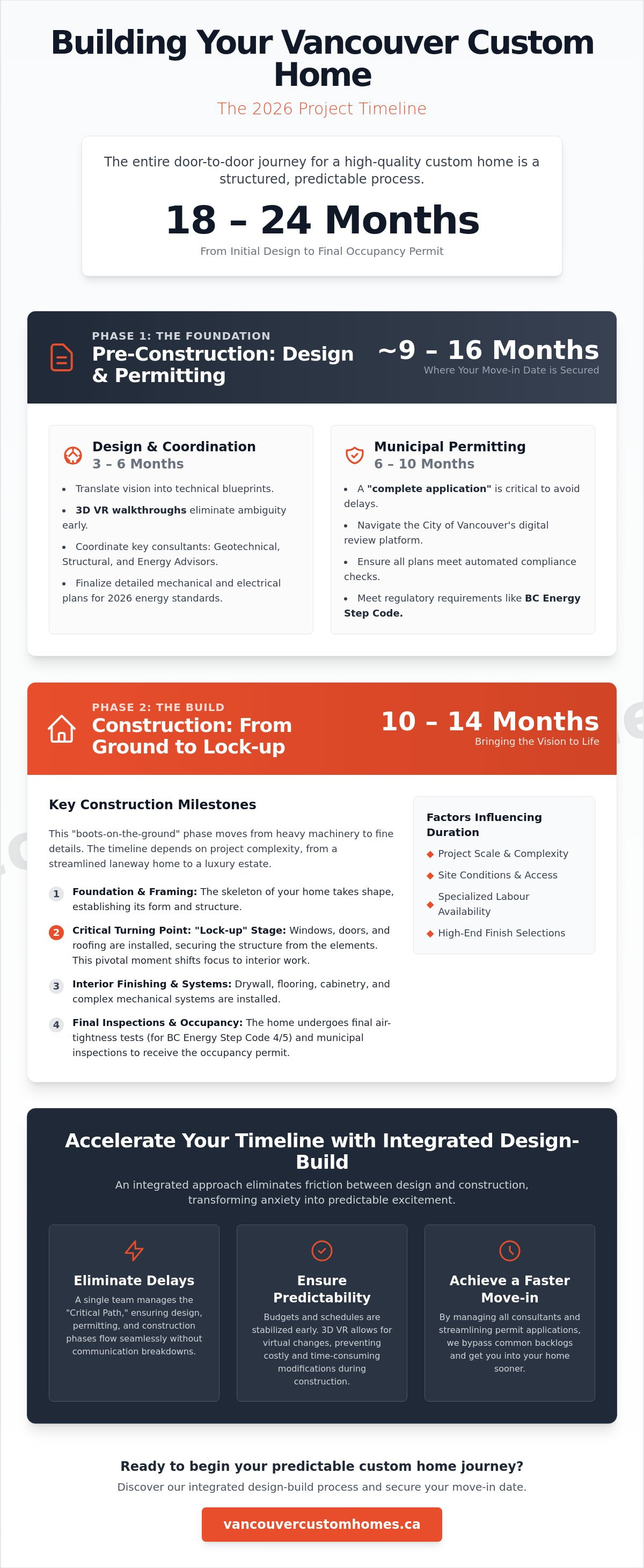
Predictability is the rarest commodity in Vancouver real estate. You want a date, not a guess. When asking how long to build a custom home Vancouver requires, the answer for most high-quality projects in 2026 is between 18 and 24 months. This door-to-door timeline encompasses every step from the initial design consultation to the final occupancy permit. It's helpful to view this journey as two distinct halves: the paperwork phase and the boots-on-the-ground phase. While the physical build is more visible, the success of your move-in date is decided months before a shovel touches the dirt.
The 2026 regulatory environment in British Columbia demands more front-loaded planning than ever before. Recent shifts in zoning and energy requirements mean that "winging it" is a recipe for multi-year delays. We utilize a "Critical Path" strategy to manage your project. This is the specific sequence of events that determines the final move-in date. If one task on this path stalls, the entire project shifts. By identifying these milestones early, we transform a chaotic process into a structured, manageable experience.
The Door-to-Door Estimate: 18 to 24 Months
We break the 2026 timeline into three primary blocks. The design phase typically spans 3 to 6 months. This is where your vision is translated into technical reality. Next, the permitting phase generally takes 6 to 10 months. This duration is heavily influenced by the complexity of your site and current municipal workloads. Finally, the physical process of constructing a house takes between 10 and 14 months. While a streamlined laneway home might sit at the 12-month mark, a complex multiplex or a luxury custom estate will naturally require the full 24-month window to realize the necessary level of craft and technical precision.
Why "Average" Timelines Often Fail Homeowners
Custom architectural projects are not production builds. You cannot compare a bespoke home to a cookie-cutter subdivision. High-end finishes, specialized labour, and unique site conditions require precise, individualized scheduling. Many homeowners fall into the trap of believing "production builder" estimates, only to see their projects stall for months. Bespoke projects involve intricate details that "average" timelines simply don't account for. We avoid this by creating a stabilized schedule through integrated project management. By housing design and construction under one roof, we ensure that the technical requirements of how long to build a custom home Vancouver demands are met without the friction of fragmented communication. This unified approach replaces typical construction anxiety with a sense of controlled, predictable excitement.
Navigating the Pre-Construction Phase: Design and Permitting
The pre-construction phase is where the most significant time is either won or lost. It's a rigorous five-step sequence: initial concept, consultant coordination, detailed permit drafting, application submission, and municipal review. If you want to master how long to build a custom home Vancouver requires in 2026, you must prioritize a "complete application" from day one. An incomplete file is the fastest way to trigger a cycle of revisions that can add months to your schedule. The City of Vancouver's digital permitting platform now uses automated compliance checks; if your documents don't align, the system rejects them before a human even sees them.
Success depends on the early integration of specialized consultants. You aren't just hiring a designer; you're managing a team that includes Geotechnical engineers for soil stability, Structural engineers for seismic integrity, and Energy Advisors to ensure compliance with BC Step Code 3 or 4. Coordinating these professionals takes time, but it's the only way to ensure your plans are "permit-ready." To see how this unified approach looks in practice, you can explore our custom home design process which integrates these experts from the first sketch.
Designing for Approval: 3 to 6 Months
This phase moves your project from a dream to a technical blueprint. We use 3D VR walkthroughs to identify design flaws and mechanical clashes long before they reach a city desk. This digital foresight is a major time-saver. It allows you to realize the final product and make changes in a virtual environment rather than during an expensive construction delay. Modern mechanical and electrical plans now require higher levels of detail to meet 2026 energy standards, so expect this coordination to take the full six-month window for complex architectural projects.
Municipal Permitting: The Metro Vancouver Variable
Permit wait times vary significantly across the Lower Mainland. While the City of Vancouver has implemented "3-3-3-1" targets, the 2026 reality for complex custom builds is often a 12-week benchmark for review. This is a massive improvement from previous years, but it still requires a perfect submission. You can review the official Steps to getting a building permit to understand the documentation burden. In contrast, standard sites in Richmond might see approvals in 4 months, while North Vancouver projects often take 6 months or more due to steep grades and Environmental Development Permit Areas (DPAs). Understanding these regional bottlenecks is essential for setting a realistic move-in date.
Breaking Ground: The Construction Schedule and Milestones
Groundbreaking marks the transition from theoretical planning to physical reality. While the paperwork phase is about negotiation, the construction phase is about momentum. To accurately gauge how long to build a custom home Vancouver takes, you must account for the specific sequence of Site Prep, Lock-up, Rough-ins, and Finishing. Missing a single milestone in this chain doesn't just delay one trade; it creates a cascade effect that pushes back your move-in date by weeks or months. We don't guess on these dates; we manage them through a disciplined, proactive schedule.
Foundation and Framing: Establishing the Structure
This initial 2 to 4-month window covers site excavation, forming, and structural framing. Vancouver's climate is a constant factor. We account for rain and seasonal snow in our scheduling to ensure the transition from concrete foundation to wood-frame or steel-hybrid structure remains on track. Proactive procurement is vital here. If high-performance windows or specialized steel components aren't ordered months in advance, your framing will stand exposed while you wait for a delivery truck. We eliminate this risk by securing long-lead items long before the first shovel hits the dirt.
Rough-ins to Lock-up: The Technical Core
The 3 to 5-month technical phase is where the home's internal systems are installed. This includes plumbing, HVAC, and electrical rough-ins. This period is defined by the "Inspection Gauntlet." Multiple city sign-offs are required before we can close the walls. Achieving "Lock-up" is the most critical psychological and logistical turning point. Once the roof is on and windows are installed, the building is weather-tight. Interior trades can finally begin their work regardless of the Vancouver rain outside. This stage represents the moment the project shifts from an outdoor site to a controlled indoor environment.
Interior Finishes and Occupancy
The final 4 to 6 months focus on the details you'll actually touch and see. Drywall, custom millwork, flooring, and paint require a dust-free, climate-controlled space. As we approach the finish line, we manage the final municipal walkthrough to secure your Occupancy Permit. This isn't the end of the journey. We dedicate a specific period to the "Deficiency List" to ensure every detail is polished and perfect before you receive the keys. Our Project Management Portal Access keeps you informed of these milestones in real-time, replacing typical construction anxiety with controlled, predictable excitement.
Why Some Vancouver Builds Take Longer: Risks and Variables
Why do some projects stall for months while others proceed with clockwork precision? It is rarely a single catastrophic event. Instead, it is usually a series of communication gaps caused by fragmented teams. When an architect and a builder work in silos, technical details often get lost in translation. This friction is the primary reason why how long to build a custom home Vancouver requires can suddenly balloon beyond the initial estimate. Choosing a "one-roof" solution ensures that the person designing the home understands exactly how it will be built, eliminating the finger-pointing that delays so many Metro Vancouver projects.
Site Conditions and Topography
Topography is the first major variable. If you are building on the steep slopes of West Vancouver or North Vancouver, you must account for rock blasting and complex shoring. These tasks are highly dependent on specialized equipment and can add four to eight weeks to your excavation schedule. Conversely, sites in Richmond often face high water tables that require specific drainage and foundation strategies. Even narrow city streets in Kitsilano or East Vancouver can slow down material deliveries, as large trucks require precise timing and permits to avoid blocking traffic. These logistical hurdles require a proactive strategy to maintain momentum.
The BC Energy Step Code and Modern Regulations
The 2026 BC Energy Step Code requirements have fundamentally changed the inspection timeline. For high-performance custom homes aiming for Step 4 or 5, mid-build testing is mandatory. You cannot simply move from framing to drywall without a successful "blower door" test. This specialized air-tightness testing requires an Energy Advisor to verify that the building envelope meets Net Zero Ready standards. If the home fails this test, the resulting repairs and re-testing can add weeks to the schedule. We manage this by integrating energy modelling from the very first sketch to ensure compliance is a certainty, not a gamble.
The Impact of Mid-Project Design Changes
Mid-project design changes are the most common cause of self-inflicted delays. A seemingly small decision, like moving a kitchen island or changing a window size after framing has begun, creates a massive ripple effect. A one-week delay in your decision-making can lead to a four-week delay in sub-trade availability. To protect your move-in date, we implement a strict "Design Freeze" before construction begins. You can see how we manage these details in real-time through our Project Management Portal Access, which provides total transparency throughout the build. By making all major decisions during the 3D VR walkthrough phase, you ensure the physical build remains on its critical path.
Accelerating Your Move-in Date with Integrated Design-Build
Why settle for a fragmented process that invites delays? The traditional model of hiring an architect and then bidding out to a contractor is inherently slow. It creates a "blame game" where the designer blames the builder for execution errors and the builder blames the designer for impractical plans. This friction is the primary reason projects stall. By housing custom home design and construction under one roof, we eliminate these communication gaps. Efficiency is a choice. When the team drafting your blueprints is the same team pouring your foundation, technical hurdles are resolved in minutes rather than weeks. This integrated approach is the only way to truly master how long to build a custom home Vancouver requires in a competitive market.
Our "One-Roof" strategy ensures that every design choice is vetted for buildability and lead-time before it ever reaches the city desk. If a specific structural steel component has a 20-week wait time, we know it during the schematic phase. We don't wait until the framing stage to discover a supply chain bottleneck. This foresight allows us to maintain a stabilized schedule, replacing the typical chaos of construction with a sense of controlled, predictable excitement for our clients.
Visualizing Success with 3D VR Walkthroughs
Most construction delays are self-inflicted through mid-build change orders. These usually happen because a homeowner stands in a half-framed room and says, "I didn't realize the window would be that small." These moments are timeline killers. We solve this problem before ground is even broken. Our 3D VR Walkthroughs allow you to step inside your future home while it is still a digital model. You can realize the true scale of your vaulted ceilings or the flow of your kitchen layout in a virtual environment. Making these decisions digitally prevents the "ripple effect" of changes during the physical build. By the time we file for permits, your vision is locked in, and the construction path is clear.
Real-time Accountability via the Project Management Portal
Momentum is maintained through total transparency. We provide all clients with Project Management Portal Access, which serves as the single source of truth for the entire build. You don't have to chase down your project manager for an update. Instead, you can track daily progress, view site photos, and monitor milestones directly from your phone. This portal is also where we manage "Selections," such as tiles, fixtures, and finishes. By centralizing these decisions, we ensure that every item is ordered and staged well before the sub-trades arrive on site. Seeing your schedule update in real-time provides the peace of mind that your move-in date is being protected by a proactive, disciplined team.
Realize Your Vision on a Predictable Schedule
Navigating the complexities of municipal permits and energy regulations doesn't have to be a source of anxiety. You now understand that how long to build a custom home Vancouver requires is largely determined by the integration of your design and construction teams. By prioritizing a "one-roof" solution, you eliminate the communication gaps that lead to costly stalls. Our deep expertise in 2026 BC Energy Step Code compliance ensures your technical inspections proceed without friction, keeping your timeline secure and your move-in date realistic.
Peace of mind comes from seeing your project move forward every day. Through our transparent project management portal, you maintain total control over your schedule and selections. You don't have to guess when you'll be moving in; you can track it in real-time from your phone. It's time to replace the chaos of traditional building with a structured, visionary experience that respects both your time and your investment. We are here to transform the logistical weight of construction into a journey of controlled, predictable excitement.
Start your journey with a 3D VR walkthrough of your future home
Your dream home is closer than you think, and we are ready to act as your visionary guide every step of the way.
Frequently Asked Questions
How long does it take to get a building permit in Vancouver in 2026?
Current 2026 benchmarks show that complex single-family builds and laneway homes typically receive permits within 12 weeks of a complete application submission. Standard single-family homes and duplexes generally require 5 to 6 months for full approval. These timelines are significantly faster than in previous years thanks to the city's new digital permitting platform and automated compliance checks.
Can I build a custom home in Vancouver in under 12 months?
Completing a full custom project in under 12 months is generally not realistic when you factor in the mandatory design and permitting phases. While the physical construction phase might take 10 to 14 months, the total door-to-door timeline for how long to build a custom home Vancouver requires is typically 18 to 24 months. Attempting to rush this process often leads to technical errors that cause longer municipal delays later.
What is the fastest way to build a laneway house in the Lower Mainland?
The most efficient path is using an integrated design-build approach that prioritizes a "permit-ready" digital submission. Since Vancouver reduced median laneway permit times to 13 weeks by late 2024, the primary bottleneck is no longer the city, but rather the coordination between separate designers and builders. A unified team ensures that technical plans are finalized and long-lead materials are ordered before the permit even arrives.
Does the BC Energy Step Code add time to the building process?
The BC Energy Step Code adds critical inspection milestones, specifically for blower door testing and energy modelling verification. In 2026, mandated Step 3 and Step 4 requirements mean you cannot move from framing to interior finishing without a successful air-tightness test. We manage this by integrating an Energy Advisor into the design phase to ensure the structure passes these tests on the first attempt without pausing the schedule.
Why do custom homes in North Vancouver take longer to build than in Richmond?
North Vancouver projects often involve steep grades, rock blasting, and Environmental Development Permit Areas that require specialized engineering reports and slower excavation. Richmond sites are typically flat and easier to access, which simplifies the early stages of construction. While Richmond faces high water table challenges, the time required for mountain-side shoring in North Vancouver generally adds several weeks to the foundation phase.
How does a design-build firm differ from a general contractor regarding timelines?
A design-build firm controls the entire schedule under one roof, whereas a general contractor often inherits plans with unresolved technical conflicts. This "one-roof" model saves months by identifying buildability issues during the drafting stage rather than discovering them on-site. This proactive management is essential for accurately predicting how long to build a custom home Vancouver takes, as it eliminates the communication gaps that plague fragmented teams.
What happens if the city requests changes to my architectural plans?
If the city requests revisions, your design team must update the digital drawings and resubmit them for a secondary compliance review. This process can add three to six weeks to your pre-construction phase depending on the complexity of the request. To prevent this, we use 3D VR walkthroughs and internal audits to ensure our initial applications are as complete and accurate as possible before they reach a municipal desk.
Is it possible to live in the house while building an addition or multiplex?
Living on-site during a multiplex conversion or major custom build is rarely feasible due to utility interruptions and safety regulations. Most projects require the home to be vacant so that structural work and mechanical rough-ins can proceed without the constraints of an occupied space. Maintaining a clear, unoccupied site allows the trades to work more efficiently, which ultimately protects your move-in date and reduces the total construction duration.


