
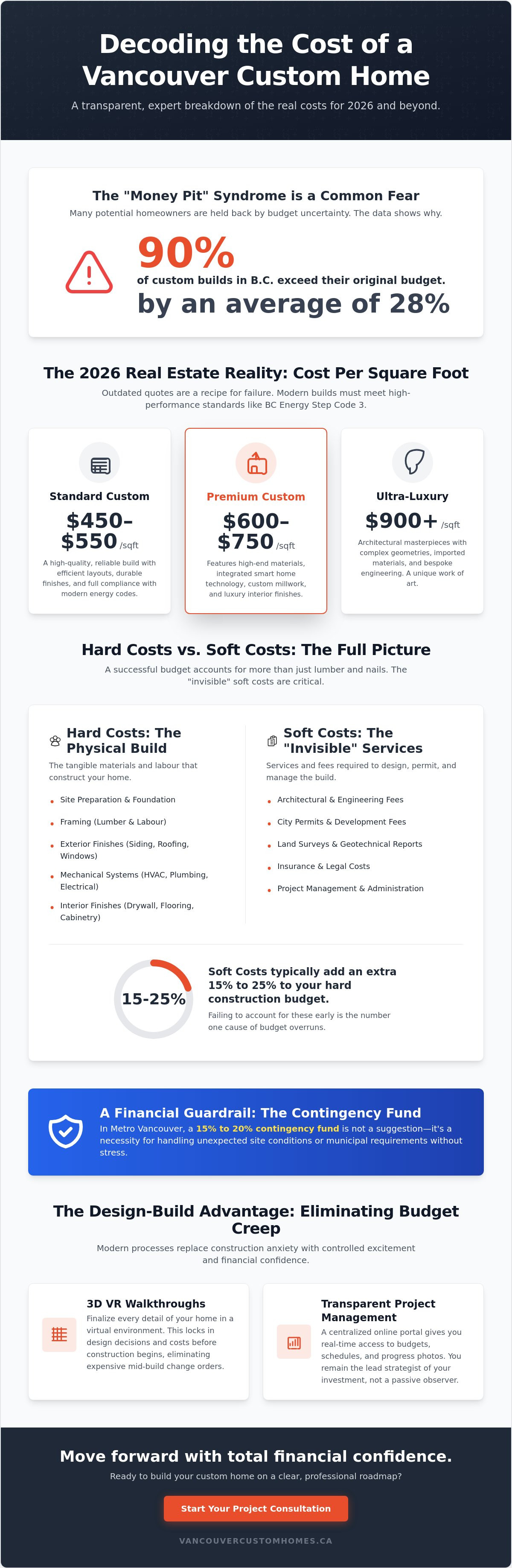
Did you know that 90% of custom home builds in British Columbia exceed their original budget by an average of 28%? This staggering figure is exactly why many homeowners fear the "money pit" syndrome before they even begin. You are likely facing conflicting square footage quotes and growing stress over City of Vancouver permit timelines. It is difficult to feel secure when the most important question, how much does a custom home cost in Vancouver, often receives a vague or non-committal answer.
We believe that a simple price per square foot is a dangerous myth that ignores the logistical realities of 2026. This guide provides a transparent, expert breakdown of the real costs involved in building a custom home today. You will gain a reliable budget framework and learn the vital difference between hard and soft costs. We will show you how integrated design and 3D VR walkthroughs can replace construction anxiety with controlled excitement. It is time to move toward your new home with total financial confidence and a clear, professional roadmap.
Key Takeaways
- Establish the 2026 baseline and learn why relying on outdated square footage quotes is a recipe for financial failure.
- Categorize expenses properly to identify the invisible soft costs that typically add 15 to 25 percent to your total investment.
- Determine exactly how much does a custom home cost in Vancouver by analyzing the impact of complex terrain and new Multiplex zoning rules.
- Eliminate budget creep and the stress of mid-construction change orders through a transparent project management portal.
- Use 3D VR walkthroughs to realize your home's potential and lock in cost certainty before the first shovel hits the ground.
The 2026 Real Estate Reality: Average Cost per Square Foot in Vancouver
If you are looking at construction quotes from even two years ago, you are already behind the curve. Building a home in the current market requires a firm grasp of the 2026 baseline. The old industry standard of $200 or $300 per square foot has become a dangerous myth. In reality, determining how much does a custom home cost in Vancouver now starts with the understanding that hard construction costs for a mid-range build typically sit between $450 and $800 per square foot. These figures reflect the complex intersection of high-performance building requirements and a competitive labour market.
One primary driver of these costs is the BC Energy Step Code. Vancouver now mandates Step Code 3, which requires superior insulation, airtight envelopes, and advanced mechanical systems. These aren't optional luxuries; they are legal requirements that ensure your home is energy-efficient and future-proof. While these standards increase the initial investment, they provide long-term value and comfort that "spec" homes simply cannot match. A speculative home is built for a quick sale using builder-grade materials. A true custom build is an architectural project designed for longevity and specific lifestyle needs, which naturally commands a higher price point. Understanding Vancouver's economic landscape helps clarify why these costs remain high, as the region's unique geography and demand for skilled trades keep pricing firm.
Defining the 2026 Price Tiers
- Standard Custom ($450–$550/sqft): This tier provides a high-quality, reliable build. It includes efficient layouts, durable finishes, and full compliance with modern energy codes without excessive ornamentation.
- Premium Custom ($600–$750/sqft): Here, you'll see a shift toward high-end materials, integrated smart home technology, and custom millwork. This tier often includes specialized exterior cladding and luxury interior finishes.
- Ultra-Luxury ($900+/sqft): These are architectural masterpieces. Expect complex geometries, imported materials, and bespoke engineering. At this level, the home is a unique work of art.
Why Square Foot Pricing Can Be Misleading
Relying solely on a square foot average is a mistake that leads to budget overruns. For example, a large garage or a covered patio can lower your average cost per square foot because they are cheaper to build than living space. However, they don't reflect the cost of the actual house. The real price driver is "density" in high-cost areas like kitchens and bathrooms. A small home with three bathrooms will always cost more per square foot than a large home with the same three bathrooms. The "economy of scale" often fails in custom residential projects because smaller builds still require the same expensive permits, site preparation, and utility connections as larger ones. You aren't just paying for space; you're paying for the complexity of the systems within that space.
Hard Costs vs. Soft Costs: A Comprehensive Budget Breakdown
If you want to understand how much does a custom home cost in Vancouver, you must look beyond the lumber and nails. Most homeowners focus exclusively on the physical structure; however, the "invisible" expenses often dictate your financial peace of mind. Soft costs typically add another 15% to 25% to your hard construction budget. Failing to account for these early is the fastest way to hit a budget wall. We categorize these expenses clearly so you can see exactly where every dollar of your investment is allocated.
A professional approach to budgeting requires a 15% to 20% contingency fund. This is not a suggestion; it is a necessity in the Metro Vancouver market. Unexpected site conditions or municipal requirements can arise at any stage. Professional project management acts as your financial guardrail during these moments. By utilizing a centralized project management portal, you can track every expense in real-time. This level of transparency ensures that you remain the lead strategist of your own budget rather than a passive observer of rising costs.
Hard Costs: The Physical Build
Hard costs represent the tangible elements of your build. In 2026, foundation and framing remain significant variables due to concrete and lumber market shifts. Mechanical systems have also evolved significantly. With the BC Step Code requirements mentioned earlier, high-efficiency heat pumps and advanced electrical grids are now standard. Interior finishing is where budgets often fluctuate most. Cabinetry, flooring, and fixtures can account for 30% to 50% of your total hard costs. This is frequently where "choice paralysis" leads to expensive mid-project pivots that drive up the final price.
Soft Costs: The Pre-Construction Phase
Soft costs cover the essential work that happens before a shovel hits the dirt. This includes architectural design, structural engineering, and geotechnical reports required for BC's varied soil conditions. You must also account for Development Cost Charges (DCCs) and permit fees. In the City of Vancouver, DCCs for a single-family home can exceed $80,000. These regulatory expenses are detailed in Vancouver's Housing Needs Report, which highlights the fees impacting new residential builds. Budgeting $40,000 to $120,000 for pre-construction and design is a realistic starting point for most projects in the region.
Variables That Shift the Price: Location, Terrain, and Zoning
Where you build is just as critical as what you build. In Metro Vancouver, two identical floor plans can have drastically different price tags based on the soil beneath them. If you are asking how much does a custom home cost in Vancouver, you must first evaluate the topography of your specific lot. Site preparation is a highly variable factor that many preliminary quotes ignore. Costs can range from $50,000 for a flat, accessible lot to over $200,000 for complex sites requiring blasting or specialized foundations. We act as your visionary guide to ensure these variables are identified before they become financial burdens.
Geographic Cost Nuances in Metro Vancouver
North Vancouver and West Vancouver present unique engineering hurdles. Steep grades and granite outcroppings often necessitate rock blasting and extensive retaining walls. These requirements don't just add to the hard costs; they extend your construction timeline and increase engineering fees. Conversely, Richmond and Delta face high water tables and soft soil. This requires specialized seismic foundations, such as pile driving or raft slabs, to meet modern safety codes. Even Burnaby and Coquitlam have their own complexities. Navigating specific municipal bylaws and setback requirements requires a lead strategist who understands how local regulations impact your building envelope and total investment.
Zoning Changes: Multiplexes and Density
The introduction of new Multiplex zoning rules in Vancouver has shifted the financial landscape for homeowners. Are you building a legacy single-family home, or are you looking to maximize your property's density? A multiplex build involves higher utility connection costs and more complex site services than a standard home. However, the trade-off is significant. Integrating a laneway home or a legal suite into your initial custom home design provides long-term financial flexibility. These additions increase the initial project cost but often pay for themselves through rental income or increased property valuation. We view these projects as integrated components of your land's total potential rather than fragmented steps.
Integrating a laneway house on an existing property also carries its own set of logistical challenges. From managing utility tie-ins to ensuring architectural harmony between both dwellings, the process requires foresight. By addressing these variables during the custom home design phase, we replace the typical anxiety of hidden site costs with a structured, predictable experience. You deserve a partnership that accounts for every rock and regulation before the first excavator arrives on site. This proactive discipline is what ensures your project remains as refined as the final product.
Avoiding the "Budget Creep": How to Maintain Financial Control
Budget overruns are not an inevitable part of construction. They are the result of fragmented planning and reactive decision-making. The primary cause of financial creep is the mid-construction change order. When you modify your vision after the framing has begun, you aren't just paying for new materials. You're paying for labour delays, structural adjustments, and administrative overhead. Understanding how much does a custom home cost in Vancouver requires more than just an initial quote; it demands a strategy to keep that number from growing.
We advocate for a transparent management model that prioritizes a detailed Scope of Work before the first shovel hits the dirt. This document serves as the final word on every finish, fixture, and structural detail. By locking in these decisions early, you eliminate the ambiguity that builders often use to justify price hikes. A fixed-fee model ensures our interests are aligned with yours. We succeed when the project stays on budget and on time. We help you realize your vision without the financial chaos. You deserve a partner who takes full responsibility for the financial health of your project from day one.
The Danger of Incomplete Design
Starting construction before you have decided on your flooring or tiles leads to an average cost increase of 20%. These allowances in a contract are often placeholders that don't reflect the true price of the premium materials you actually want. Finalizing your interior design package during the pre-construction phase is the only way to achieve true cost certainty. Fragmented planning is the enemy of the budget.
Transparent Project Management
Chaos thrives in the absence of information. We replace this uncertainty with absolute accountability through real-time project tracking. Our Project Management Portal Access gives you a daily window into every dollar spent. You can view milestone approvals and track your contingency fund from your phone. When you can see the data, the question of how much does a custom home cost in Vancouver becomes a manageable reality rather than a source of stress. Scheduled site meetings provide a structured environment for updates. They aren't just for walk-throughs; they are for verifying that the physical build matches the financial records. This level of discipline ensures that the contingency fund remains a safety net rather than a standard spending category.
The Design-Build Advantage: Stabilizing Costs with 3D Visualization
The traditional construction model is often fragmented and prone to miscommunication. When you hire an architect and a builder separately, you risk creating a design that is beautiful on paper but impossible to build within your budget. We solve this problem by acting as a "one-roof" solution. By integrating custom home design with the construction phase, we ensure that every architectural choice is grounded in financial reality. This unified approach is the most effective way to answer the question of how much does a custom home cost in Vancouver with absolute certainty. We take full responsibility for the entire journey, replacing the typical chaos of construction with a structured and enjoyable experience.
Our process relies on modern digital visualization tools to eliminate the guesswork that leads to budget overruns. We don't just show you floor plans; we provide an immersive experience that allows you to realize your home's potential before a single board is cut. This proactive discipline ensures that the final product is as refined as the initial vision. When the designer and builder are on the same team, you benefit from continuous value engineering. We identify cost-saving opportunities during the design phase rather than discovering them when it's too late to make changes without a penalty.
Visualizing Success with 3D VR
One of the greatest risks in custom home construction is "buyer’s remorse" caused by a layout that doesn't feel right once it's built. Our 3D VR walkthroughs allow you to step inside your future home while it is still in the design stage. You can experience the flow of the rooms, the height of the ceilings, and the placement of the windows. This immersive technology helps identify design flaws that would cost thousands of dollars to fix during the physical build. There is a profound psychological benefit to knowing exactly what you are paying for. When you can see the finished result in high definition, the anxiety of the "money pit" disappears. You gain the confidence to move forward, knowing your investment is secure.
Integrated Design-Build vs. Fragmented Hiring
Fragmented hiring is often the root cause of the budget creep discussed in previous sections. Separate entities often lack the incentive to collaborate on cost control. In contrast, our integrated model prioritizes efficiency and punctuality. We use our expertise to align your aesthetic desires with the 2026 labour and material realities of Metro Vancouver. This synergy allows us to provide a transparent quote that remains stable throughout the project. Whether you are planning a primary residence, a multiplex, or a laneway home, our goal is to provide a seamless journey from initial vision to final realization.
The path to your new home begins with a clear understanding of the logistics and expenses involved. We invite you to move beyond the myths of square foot pricing and toward a reliable budget framework. Your next step is to book a consultation for a comprehensive feasibility study. We will help you establish a realistic 202 project budget and provide a transparent roadmap for your build. It is time to replace uncertainty with a controlled, predictable excitement for your future home.
Build Your Future with Financial Certainty
Your journey to a custom home shouldn't be defined by the "money pit" syndrome or municipal confusion. We've established that the real answer to how much does a custom home cost in Vancouver depends on proactive design and a firm grasp of both hard and soft costs. By prioritizing a "one-roof" solution, you eliminate the friction between architectural vision and construction reality. Our immersive 3D VR walkthroughs allow you to realize every detail before we break ground, while our project management portal provides real-time accountability for every dollar spent.
Whether you are navigating complex zoning in Vancouver, Burnaby, or Richmond, we act as your visionary guide. You deserve a build process that is as refined as the final product itself. It's time to replace construction anxiety with a sense of controlled, predictable excitement for your new home. Request a Transparent Budget Consultation with Vancouver Custom Homes today and take command of your project's financial roadmap. We look forward to helping you build with total confidence.
Frequently Asked Questions
Is it cheaper to renovate an existing home or build a custom one in Vancouver?
Building a new custom home often provides superior cost certainty compared to major renovations. Older homes in Metro Vancouver frequently hide structural issues or hazardous materials that don't appear until demolition begins. While a renovation might seem less expensive initially, a custom build allows you to integrate modern energy standards and efficient layouts from the start. This proactive approach eliminates the "money pit" syndrome common in complex residential remodels.
How long does the permitting process take in Vancouver for a custom home?
Permitting timelines in the City of Vancouver typically range from several months to over a year. The duration depends heavily on project complexity and specific site factors like heritage designations or protected trees. We recommend starting the design phase as early as possible to navigate these municipal lead times. Our team manages the logistics of the permit process to ensure your timeline remains as predictable as possible.
Does the cost per square foot include the price of the land?
No, the quoted cost per square foot typically refers only to the hard costs of physical construction. When you are calculating how much does a custom home cost in Vancouver, you must factor in land acquisition and soft costs as separate line items. In areas like Vancouver West, the land value often represents the largest portion of the total investment, followed by construction and municipal fees.
What is the BC Energy Step Code and how does it affect my building budget?
The BC Energy Step Code is a provincial regulation that mandates specific energy efficiency targets for new buildings. Vancouver currently requires Step Code 3, which necessitates high-performance insulation, airtight envelopes, and advanced mechanical systems. These requirements increase the initial building budget due to the need for premium materials and specialized labour. However, they significantly lower your long-term utility bills and increase the overall resale value of the property.
Can I save money by acting as my own owner-builder in BC?
Acting as an owner-builder rarely results in true savings for those without professional construction experience. BC Housing has strict licensing and warranty requirements that are difficult for individuals to navigate alone. Mistakes in scheduling or code compliance can lead to expensive delays that far exceed a professional management fee. Most homeowners find that the trade discounts and streamlined workflow of an integrated builder provide better financial results.
How much should I set aside for a construction contingency fund?
Are laneway homes more expensive per square foot than the main house?
Yes, laneway homes generally command a higher cost per square foot because they lack the economy of scale found in larger residences. They require their own foundations, utility tie-ins, and high-density areas like kitchens and bathrooms within a very small footprint. Despite the higher relative cost, they offer excellent return on investment through rental income or by providing independent living space for family members.
What are the typical architectural fees for a custom home in Metro Vancouver?
Architectural and design fees in the region typically range from $40,000 to $120,000 depending on the project's size and complexity. These fees cover the essential pre-construction work, including structural engineering and geotechnical reports. Investing in a comprehensive design package is the most effective way to realize how much does a custom home cost in Vancouver before you commit to the physical build. Clear plans lead to accurate quotes and fewer surprises.


