
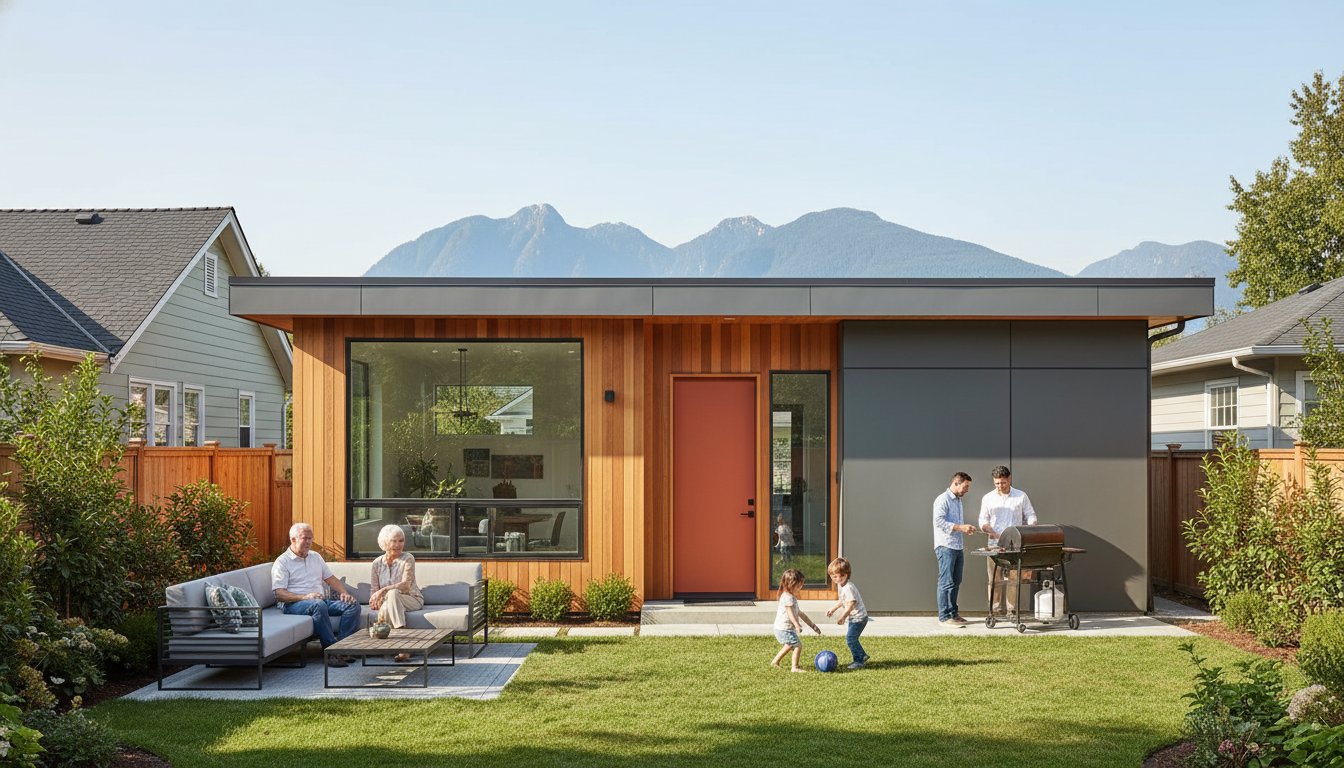
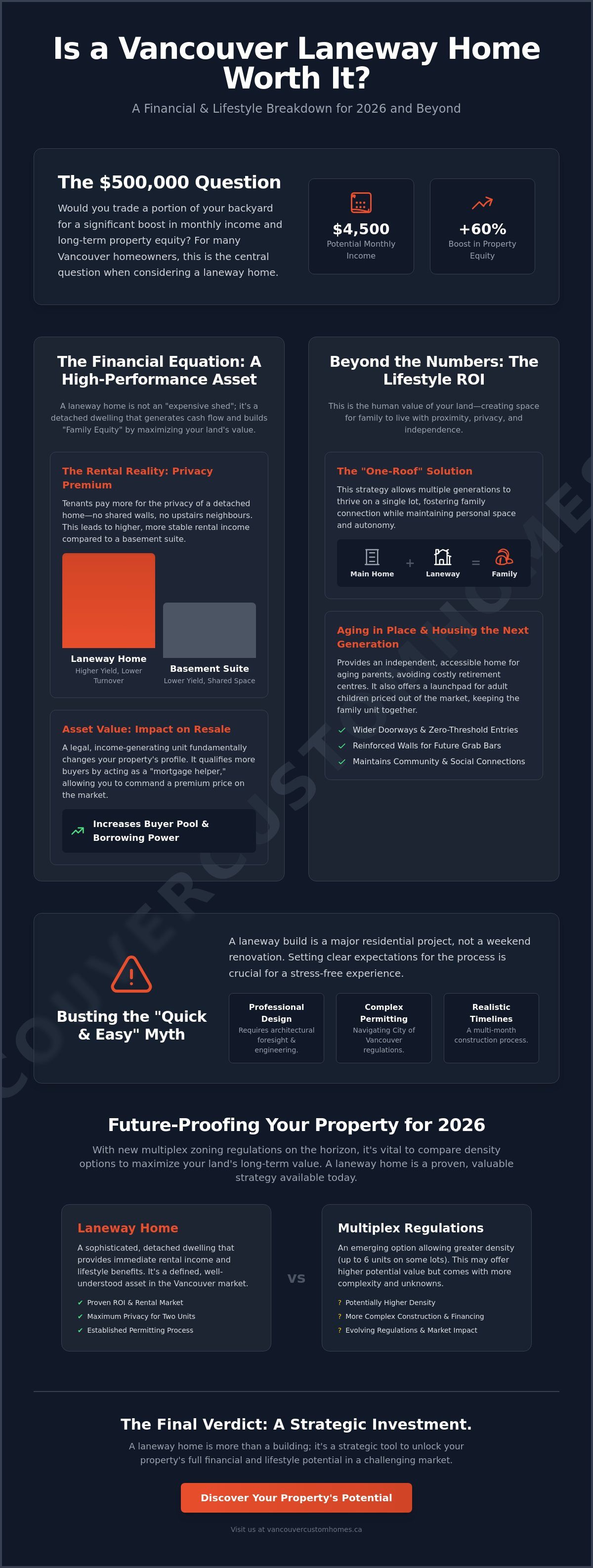
If you could trade a portion of your backyard for a $4,500 monthly cheque and a 60% boost in property equity, would you take the deal? You likely already know that building in this city is a massive undertaking. It's natural to feel hesitant about the high cost of construction and the logistical maze of city permits. When faced with a $500,000 budget, many Vancouver homeowners naturally ask: "Is a laneway home truly worth it?" This becomes a critical question for long-term financial security in a volatile market.
At Vancouver Custom Homes, we're here to provide the clarity you need to move forward with confidence. You'll discover the true financial and lifestyle value of these builds, moving beyond simple rental math to see how they function as a stabilizing asset for your family. We'll break down the current ROI for 2026, analyze the impact of new zoning laws, and compare laneway houses to the rising multiplex trend. This guide ensures you understand the reality of the build before you break ground, helping you decide if this "missing middle" housing strategy fits your specific lot and your future goals.
Key Takeaways
- Stop viewing these builds as mere sheds. A laneway house is a sophisticated, permanent detached dwelling that acts as a stabilizing asset for your property's equity.
- Analyze current rental yields and construction costs to determine if is a laneway home worth it Vancouver for your specific financial goals in 2026.
- Discover the "One-Roof" living strategy. This approach creates a private, multi-generational housing solution that keeps families together while maintaining individual independence.
- Recognize that a laneway build is a major residential project, not a simple renovation. Clear expectations regarding permits and timelines are essential for a stress-free experience.
- Compare the density potential of a single laneway home against the new 2026 multiplex regulations to ensure you're maximizing your land's long-term value.
Is a Laneway Home Worth the Investment in Vancouver?
A laneway home is not a backyard project. It is a sophisticated, permanent detached accessory dwelling unit (DADU) that requires professional engineering and architectural foresight. Many homeowners get stuck on the upfront cost, dismissing these builds as "expensive sheds." That is a fundamental mistake. A shed holds gardening tools; a What is a Laneway Home? is a fully integrated residential structure that holds equity and family legacy. When asking is a laneway home worth it Vancouver residents must look past the initial price tag. Worth is a composite of resale premiums, monthly cash flow, and the long-term utility of the land itself.
We define this as "Family Equity." In a city where land is the scarcest resource, maximizing your lot's footprint is the most logical way to stabilize your financial future. Whether you are housing a parent or a tenant, you are converting underutilized space into a high-performance asset. This is a strategic move to future-proof your property against market shifts.
Asset Value: How Laneway Houses Impact Property Resale
Adding a legal, detached suite fundamentally changes your property's market profile. It isn't just an extra bedroom. It's a "mortgage helper" that expands your pool of potential buyers. When a buyer sees a property that generates significant monthly income, their borrowing power increases. This allows you to command a premium price. Properties in West Vancouver or North Vancouver often see the highest realization of this value. Buyers in these areas specifically seek out private, high-end secondary dwellings for extended family or professional tenants. A well-designed laneway home ensures your property stands out in a competitive listing environment.
The Rental Reality: Passive Income in the Vancouver Market
Why do tenants choose a laneway over a traditional basement suite? Privacy is the primary driver. There are no upstairs neighbours, no shared hallways, and no muffled footsteps at midnight. Tenants in 2026 are willing to pay a significant premium for a separate dwelling with its own front door. This preference translates into higher rental yields and lower turnover rates. As we look at the 2026 vacancy rates, the demand for detached small homes remains at an all-time high. This creates a level of rental stability that basement suites simply cannot match, providing a reliable stream of Canadian dollars to offset your own housing costs.
Beyond the Numbers: The Lifestyle ROI of Laneway Living
Financial math tells only half the story. When homeowners ask is a laneway home worth it Vancouver families must look at Lifestyle ROI. This metric measures the human value of your land. It's about proximity without friction. We focus on the "One-Roof" solution, a strategy that allows three generations to thrive on a single lot while maintaining distinct boundaries. While you might lose some backyard space, you gain a functional living environment that serves your family for decades. This trade-off replaces a patch of grass with a legacy asset that solves the city's greatest challenge: space.
Privacy is the most common concern we hear. Will you be staring into your tenant's kitchen? Will they hear your weekend barbecue? Professional design is the answer to these frustrations. By utilizing strategic window placement, frosted glass, and specific setbacks mandated by City of Vancouver regulations, we create two entirely separate worlds on one property. Before you commit, you can use 3D VR walkthroughs to experience exactly how much garden remains and how the sightlines work. This foresight eliminates the typical anxiety of a major build.
Aging in Place: Laneway Homes as Modern Coach Houses
Traditional retirement centres are expensive. They often isolate seniors from the social circles they've spent decades building. A laneway house allows parents to downsize without leaving their familiar community. This move provides a massive financial relief by avoiding the high monthly costs of private senior living facilities. When we design for aging in place, we prioritize future mobility. We incorporate wider doorways, zero-threshold entries, and reinforced walls for future grab bars. This proactive approach ensures the home remains functional as needs change, keeping the family unit intact and secure.
Housing for the Next Generation: Keeping Families Together
The reality for adult children in Metro Vancouver is stark. Most are priced out of the market before they even start their careers. A laneway home acts as a launchpad or a permanent residence, providing a high-quality home that would otherwise be unattainable. Is a laneway home worth it Vancouver parents often ask when they see their children struggling with local rents? The answer is often found in the emotional peace of mind that comes from family proximity. You aren't just building a house; you're providing a stable foundation for the next generation. If you're ready to explore how this fits your lot, consulting with custom laneway home designers can help clarify your options.
By shifting the focus from "how much can I rent this for" to "how will this improve our daily lives," the value of the investment becomes clear. It's a holistic management strategy for your family's most valuable asset: your home.
Busting the "Quick and Easy" Myth: The Reality of Construction
A laneway house is not a weekend DIY project. It is not a glorified kitchen renovation. It is a full-scale residential construction project that requires the same precision as a primary custom home. When asking is a laneway home worth it Vancouver property owners often underestimate the logistical weight of the build. You aren't just "popping up" a structure in the backyard. You are managing a 10 to 14-month project that involves structural engineering, complex utility integration, and high-end architectural finishes. Success depends on moving away from fragmented steps toward a single, unified process.
To avoid the typical chaos of construction, your designer and builder must operate as one team. We utilize Project Management Portal Access to provide a stabilizing force throughout the journey. This tool ensures you have total transparency into every phase, from the first permit application to the final inspection. It replaces the anxiety of the unknown with a sense of controlled, predictable excitement. By integrating Custom Home Design with proactive management, we eliminate the budget creep and finger-pointing that often plague less organized builds.
Navigating the Vancouver Permit and Zoning Maze
The official City of Vancouver guide dictates exactly how much of your lot you can utilize. These rules cover everything from maximum height to specific setbacks. A "standard" plan that works for a flat lot in Burnaby will rarely meet the requirements for a unique property in Richmond or Vancouver. Straightforward applications typically take 3 to 5 months for approval. However, if your project requires a Development Permit for variances, you must budget an additional 4 to 12 months. Realizing these timelines early is essential for maintaining your financial strategy.
The Logistics of Building in Your Own Backyard
Building a home while you live on the property creates unique challenges. Crews must move lumber, concrete, and heavy machinery through narrow side yards that are sometimes only a few feet wide. This requires a highly disciplined site strategy. Beyond the physical structure, the utility connections are the most complex phase. You must connect sewer, water, and power lines from the main street, which often involves significant trenching alongside your primary residence. We prioritize a holistic management approach to minimize this disruption. Our goal is to ensure the process is as refined as the final product, protecting your emotional well-being while we maximize your land's value. If you want to see the layout before we break ground, our 3D VR walkthroughs allow you to experience the spatial reality of the build.
Laneway Home vs. Multiplex: Choosing the Right 2026 Strategy
The regulatory environment in Vancouver has shifted dramatically. While laneway homes remain a popular choice, the 2026 multiplex bylaws have introduced a powerful alternative for property owners. You are no longer limited to a single secondary suite in the backyard. You now have the option to redevelop your entire lot into a multi-unit residential building. When determining is a laneway home worth it Vancouver owners must evaluate the "Highest and Best Use" of their land. A laneway house offers a Floor Space Ratio (FSR) of approximately 0.25, capped at roughly 900 square feet. In contrast, a multiplex allows for an FSR of 1.0, enabling the construction of up to six condo units or eight rental units on a standard lot.
This decision is a strategic crossroads. If your primary objective is maximizing equity gain and rental density, a multiplex is the superior financial engine. However, it requires a significantly larger initial investment, often starting at $1.6M. Building a laneway house is a lifestyle-first decision that preserves your existing home while adding value. It's about choosing between incremental growth and a total property transformation. We provide the architectural expertise and Project Management Portal Access to guide you through either path, ensuring the complexities of the 2026 bylaws feel manageable and logical.
Understanding the New Vancouver Housing Regulations
The City of Vancouver's shift toward the "Residential Inclusive Zone" means that most single-family lots are now eligible for increased density. The trade-off is absolute. To build a multiplex, you must demolish your existing primary residence. This is a total lot redevelopment. If your current home is in excellent condition or holds sentimental value, this path may not align with your goals. Conversely, if your main house requires extensive repairs, a full multiplex build might offer a higher ROI than a simple laneway addition. It's essential to realize that building a laneway home with the intention of later developing a multiplex is a wasted investment, as the laneway would eventually need to be demolished to accommodate the larger footprint.
When a Laneway House Is the Better Choice
A laneway house is the ideal solution when preserving the character and privacy of the main home is your priority. It allows you to maintain the "backyard feel" that many Vancouverites value, providing a separate dwelling that doesn't overwhelm the lot. This option is far more cost-effective for families who want to house aging parents or adult children without the upheaval of a multi-year redevelopment project. You gain the benefits of multi-generational living and a "mortgage helper" while keeping your primary residence intact. If you are looking for a clear path forward, we can help you design your custom multiplex or laneway home to ensure you maximize your property's potential under the current 2026 regulations.
The Final Verdict: How to Decide if It’s Worth It for You
Deciding to build a secondary dwelling is a significant financial and emotional commitment. To determine if is a laneway home worth it Vancouver homeowners must weigh three distinct pillars: immediate rental finance, long-term family utility, and future resale premiums. If you prioritize keeping your family together while generating a steady stream of Canadian dollars, the investment is often a clear win. However, success is never accidental. It requires a disciplined approach to planning and a clear understanding of your property's specific constraints before the first excavator arrives on site.
We act as your visionary guide throughout this process, replacing the typical chaos of construction with a structured, enjoyable experience. By integrating Custom Home Design with our Project Management Portal Access, we ensure every detail is accounted for under one roof. You deserve a partner who takes full responsibility for the project's success, allowing you to focus on the excitement of your property's transformation rather than the stress of permit delays.
A Decision Framework for Metro Vancouver Homeowners
Before you commit to a build, you must evaluate your lot's physical and legal capacity. Use this 5-point checklist to determine if your property is ready for a high-value addition:
- Lot Width and Access: Does your lot have a clear, accessible lane for construction equipment and separate tenant entry?
- FSR Availability: Have you confirmed your remaining Floor Space Ratio under the 2026 Vancouver bylaws?
- Utility Capacity: Is your current electrical and water service sufficient to support an additional dwelling?
- Budget Alignment: Does your 10-year financial plan account for both construction costs and potential tax adjustments?
- Privacy Buffers: Can the lot accommodate a laneway house without compromising the primary home's private outdoor space?
Ask yourself where you want your family to be in a decade. Are you planning to house an aging parent? Do you need a "launchpad" for an adult child? A professional feasibility study is the only way to answer these questions with certainty. We provide the technical proficiency needed to analyze your lot and provide a logical roadmap for your Custom Home Construction project.
Visualize Before You Build: Reducing the Risk
The greatest fear in any build is the gap between the blueprints and the final reality. Will the new structure feel too close to the main house? Does the interior design match the "colour" and character of your existing property? We eliminate this uncertainty through 3D VR Walkthroughs. This technology allows you to virtually step inside your laneway home before a single nail is driven. You can experience the ceiling heights, the window placements, and the flow of the rooms in a digital environment. This foresight ensures the final product is exactly what you envisioned, confirming that the project is truly "worth it" for your lifestyle. If you're ready to see what's possible, contact us to evaluate your lot’s potential and begin your journey with confidence.
Secure Your Family's Future on Your Own Land
Building a secondary dwelling is about more than just square footage. It is a strategic move to stabilize your family's equity in a city defined by scarcity. You now understand that a laneway house is a permanent, high-performance asset that offers significant rental yields and multi-generational flexibility. While the 2026 multiplex rules offer a different path for density, the laneway home remains the gold standard for those who want to preserve their primary residence while maximizing their lot's potential. Deciding is a laneway home worth it Vancouver property owners requires looking past the construction phase to the decade of security that follows.
Success in this market requires a partner with integrated design-build expertise. As a Metro Vancouver specialist, we provide exclusive Project Management Portal access to keep your project on track and transparent. We replace the typical anxiety of construction with a refined, predictable process from initial vision to final realization. You don't have to guess what the final product will look like or how it will fit your yard. Start your journey with a 3D VR Walkthrough of your future laneway home and see the potential for yourself. Your land is your greatest asset; let's ensure it works for you.
Frequently Asked Questions
How much does a laneway home increase property value in Vancouver?
Adding a laneway house typically increases a property's assessed value by 60% to 80% of the total construction cost. Beyond the assessment, properties with these dwellings have sold at a 12% to 22% premium compared to similar homes without one. This creates immediate equity while providing a monthly "mortgage helper" that makes the primary residence more affordable and attractive for future buyers.
Can I build a laneway home on any lot in Metro Vancouver?
Most single-family lots in Vancouver are now eligible due to the R1-1 zoning changes introduced in late 2023. However, specific requirements for lot width, lane access, and fire safety must still be met. While the "Residential Inclusive Zone" has opened many doors, you should verify your lot's specific setbacks and Floor Space Ratio (FSR) limits before assuming a build is possible on your property.
How long does it take to get a laneway house permit in 2026?
A straightforward application that complies with all city guidelines generally takes 3 to 5 months for approval. If your project requires a Development Permit for variances, the timeline can extend by an additional 4 to 12 months. Early consultation with an integrated design-build team ensures your application is "permit-ready" to avoid unnecessary back-and-forth with city planners and engineers.
Will my property taxes go up if I build a laneway house?
Yes, your property taxes will increase because the BC Assessment value of your property rises once the build is complete. Since the laneway house is a permanent residential structure, the city views the improved land as more valuable. Most homeowners find that the monthly rental income or the savings from multi-generational living far outweigh the incremental increase in annual property tax payments.
Is it better to build a laneway home or a multiplex?
The choice depends on whether you want to preserve your existing home or maximize density. A multiplex offers a much higher Floor Space Ratio of 1.0 but requires a total lot redevelopment and a larger initial investment. If your goal is to maintain your primary residence while adding a private secondary suite, then asking is a laneway home worth it Vancouver leads to a lifestyle-first "yes."
Can I sell my laneway home separately from the main house in Vancouver?
No, a laneway house cannot be sold separately from the main residence as it is considered an accessory dwelling on a single title. If your goal is to sell individual units, you should consider a multiplex development instead. Laneway homes are designed to remain part of the primary property's equity, acting as a permanent rental or family suite rather than a separate real estate asset.
What is the maximum size for a laneway home in Vancouver?
The maximum allowable size is typically determined by a Floor Space Ratio of 0.25 of your lot area, usually capped at approximately 900 square feet. Most builds are limited to 1.5 storeys with a maximum height of roughly 5.49 metres. These regulations ensure the new structure remains proportional to the primary home and doesn't overwhelm the neighbouring properties or the lane itself.
How do I maintain privacy with a laneway house in my backyard?
Privacy is maintained through strategic architectural design and proactive site management. By utilizing specific window placements, frosted glass, and the setbacks mandated by the city, we create separate living zones that don't overlook each other. Our 3D VR walkthroughs allow you to experience these sightlines digitally before construction begins, ensuring your backyard remains a private sanctuary for both the main house and the laneway.


