
What if the secret to bypassing Vancouver's notorious building delays isn't just better paperwork, but a smarter digital strategy? Many homeowners feel paralyzed by the complexity of the PRET tool or the fear of a rejected application. Securing a laneway home permit Vancouver doesn't have to be a gamble. With the median permit processing time currently sitting at 11.9 weeks as of May 2026, the difference between a fast approval and a year-long stall often comes down to how you prepare before the first document is even signed.
We understand that the bureaucratic maze feels designed to overwhelm you. You want a predictable, transparent journey that turns your backyard into a functional living space or a high-yield rental. This 2026 guide provides a step-by-step roadmap to master the permit process, from confirming your 9.8-metre lot eligibility to managing the mandatory sewer and water connection permits. We'll show you how to leverage modern visualization tools to gain confidence in your design and ensure your project moves from initial vision to final realization without the usual friction.
Key Takeaways
- Identify your lot’s eligibility by navigating the latest Residential Inclusive zoning rules and the 9.8-metre width requirements for 2026.
- Master the laneway home permit Vancouver application sequence, ensuring critical sewer and water connections are secured before filing your main permit.
- Avoid the "Correction Notice" loop by utilizing an integrated design-build model that eliminates the friction of fragmented consulting teams.
- Leverage advanced 3D VR visualization to streamline City approvals and realize your design vision with absolute precision.
- Establish a predictable building timeline by centralizing accountability, turning a complex bureaucratic process into a structured, manageable journey.
Navigating the Vancouver Laneway House Permit Landscape in 2026
Vancouver’s housing priorities have shifted toward rapid, logical densification. Why the sudden urgency? The City is under immense pressure to deliver "Missing Middle" housing, making the laneway home permit Vancouver process more accessible than ever before. In 2026, the focus is squarely on Residential Inclusive zones, previously known as RS and RT. The goal is simple: maximize every square foot of urban land. By understanding the history of laneway housing in Vancouver, it's clear that we've moved from cautious pilot programs to a period of aggressive, structured expansion.
A major catalyst for this change is the refined Permit and Rate Estimator Tool (PRET). This isn't just a basic calculator; it's a strategic roadmap for homeowners. It allows you to visualize potential fees and estimated timelines before you commit a single dollar to construction. The City has also introduced standardized, pre-reviewed housing designs to lower the barrier to entry. If you choose a pre-approved plan, you effectively bypass the most common architectural bottlenecks. It's a unified approach that mirrors our own philosophy of integrated project management.
Current Permit Timelines and Expectations
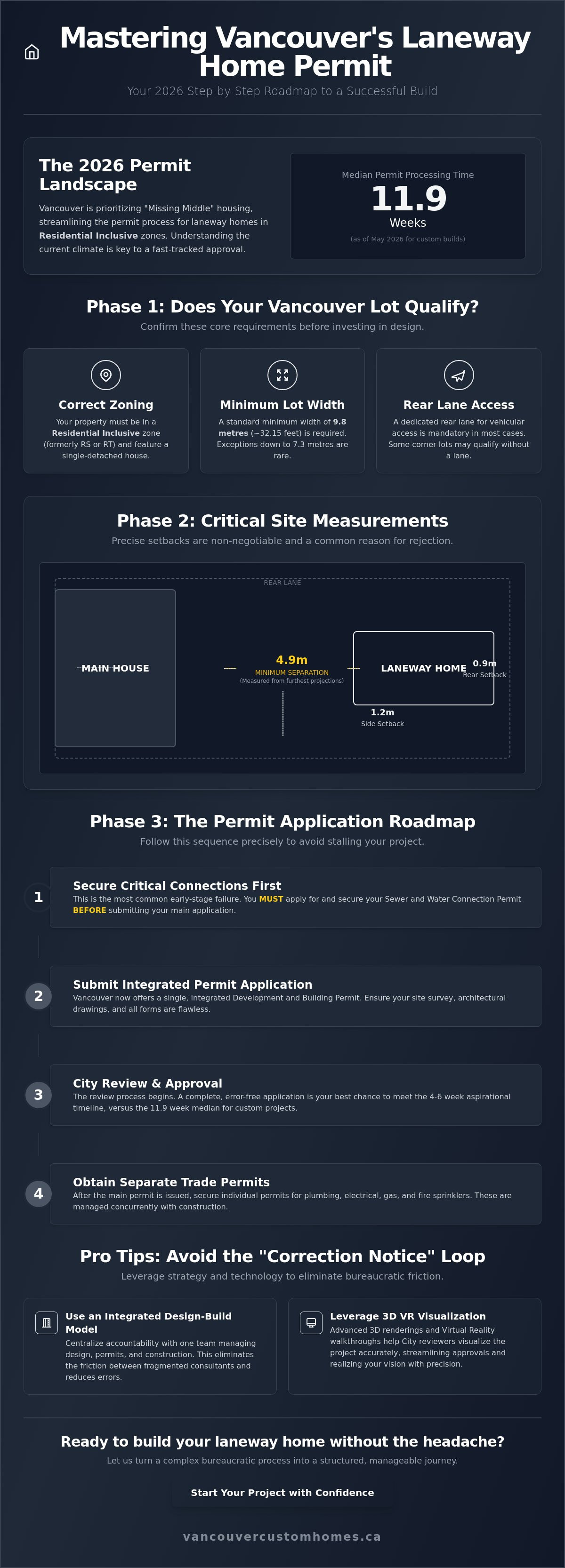
What does the clock look like in 2026? While the City has set an aspirational 4-6 week review window for standardized projects, the reality for custom builds is more complex. As of May 2026, the median elapsed time for a standalone laneway house permit remains roughly 11.9 weeks. If you want to hit the fast-track, your application must be flawless from day one. Delays often stem from minor clerical errors or incomplete site surveys. Using the City’s standardized designs can shave weeks off your schedule, but it often limits your ability to maximize your specific lot’s unique potential.
Key Permit Types: Development vs. Building
Understanding the distinction between a Development Permit (DP) and a Building Permit (BP) is crucial for a predictable journey. A DP focuses on how the structure looks and fits into the neighbourhood, while a BP focuses on safety and structural integrity. For most new standalone laneway houses, the City now offers a single, integrated development and building permit. This reduces paperwork and eliminates redundant review cycles. However, you still need separate trade permits for plumbing, electrical, gas, and fire sprinklers. You must apply for your sewer and water connection permit before you submit your main permit application. If you miss this specific sequence, your project stalls before it even starts.
Zoning and Site Eligibility: Does Your Vancouver Lot Qualify?
Is your property actually eligible for a secondary structure? Before you invest in architectural drawings, you must confirm your lot meets the City's strict 2026 baseline. Generally, a laneway home permit Vancouver is only available for lots with a single-detached house. If your property is zoned as Residential Inclusive (formerly RS or RT), you're in the right starting position. However, the physical dimensions of your land are where most projects either thrive or stall.
The standard minimum lot width is 9.8 metres, which is approximately 32.15 feet. While the Director of Planning has the authority to approve narrower lots down to 7.3 metres, these exceptions depend heavily on the project’s impact on neighbours. You also need a dedicated rear lane for vehicular access, though corner lots without a lane can sometimes qualify. If your lot doesn't meet these criteria, the permit journey ends before it begins. To ensure your vision fits these parameters, exploring professional Custom Home Design services is a logical first step to avoid costly zoning errors.
Standard setback requirements for 2026 include:
- Rear Setback: 0.9 metres from the rear property line.
- Side Setbacks: 1.2 metres from the side property lines.
- Main House Separation: 4.9 metres from the closest wall of the primary residence.
The 4.9-Metre Separation Rule
Why do so many designs face immediate rejection? It usually comes down to the distance between the main house and the laneway structure. You must maintain a minimum 4.9-metre separation. This isn't measured wall-to-wall. It's measured from the furthest projections, including eaves, gutters, and porches. If your main house has a deep rear deck, your buildable area shrinks significantly. Precision in your site survey is non-negotiable. Failing to account for a 12-inch eave can trigger a "Correction Notice" that stalls your project for weeks.
FSR and Height Restrictions
Your maximum floor area is capped at 0.25 Floor Space Ratio (FSR). This means your laneway house cannot exceed 25% of your total lot area. In 2026, the maximum building height is 8.5 metres for a two-storey structure. If you choose a 1.5-storey design, you must carefully manage shadow impacts on adjacent properties. Privacy screens and strategic window placement aren't just design choices; they're requirements for approval. The City prioritizes the privacy of your neighbours as much as your own living space, so your upper-floor windows must be positioned with foresight.
The Step-by-Step Laneway Permit Application Process
Securing a laneway home permit Vancouver in 2026 requires a methodical, five-phase approach. The City has moved away from paper-heavy submissions, favouring a streamlined digital workflow that rewards meticulous preparation. If you skip the pre-application due diligence, you risk getting trapped in a cycle of revisions that can easily double your 11.9-week timeline. Success begins long before you hit the "submit" button on the City portal.
Phase 1 starts with the pre-application and site survey. This isn't just about property lines; it's about capturing every topographical detail and existing utility connection. Phase 2 moves into design development. We prioritize 3D visualization at this stage because it allows you to see the 4.9-metre separation and FSR limits in a virtual space before the City ever sees your plans. Phase 3 is the digital submission via the updated 2026 Permit and Rate Estimator Tool (PRET). This tool has evolved into a comprehensive portal where you upload your documentation and receive an immediate, transparent fee breakdown. Phase 4 involves the City's technical review and your response to any "Correction Notices". Phase 5 is the finish line: final fee payment and permit issuance.
Preparing Your Documentation Package
Your application is only as strong as your documentation. You must include a professional site survey and a detailed topographical map. The City requires high-resolution architectural drawings, including floor plans, elevations, and cross-sections that clearly show height compliance. Don't overlook the landscape plan. In 2026, the City has strict permeability requirements to manage rainwater runoff. If your plan doesn't show enough soft landscaping or permeable surfaces, your permit will be flagged for correction immediately.
Navigating the Digital Submission
The 2026 PRET tool is the mandatory gateway for all applications. Start by setting up your online account through the City of Vancouver’s secure portal. You'll need to upload high-resolution PDFs that follow a very specific naming convention. If your files are named "Final_Draft_1", they will be rejected by the automated system. Once submitted, you can track your application status in real-time. This transparency allows you to see exactly which department is reviewing your file, from engineering to trees and landscaping, ensuring you stay in control of the journey.
Eliminating Bureaucratic Friction: Avoiding Common Permit Delays
Why do so many homeowners find themselves stuck in a cycle of permit "ping-pong"? The answer usually lies in fragmented communication between separate design and construction teams. When your architect, engineer, and builder operate in silos, the risk of a laneway home permit Vancouver being flagged for a Correction Notice increases exponentially. One minor discrepancy in your site plan or a failure to account for utility depths can trigger a review loop that costs you months of momentum. By centralizing accountability under a single roof, you eliminate the friction that leads to these bureaucratic stalls.
Addressing potential roadblocks early is the only way to maintain a predictable timeline. This means looking beyond the structure itself and focusing on the site's environmental and mechanical constraints. If you want to ensure every detail is tracked from day one, you should centralize your project management to avoid the common pitfalls of fragmented consulting. The City's 11.9-week median processing time is only achievable if your initial submission is complete and technically sound.
The Tree Protection Trap
Vancouver’s tree protection bylaws are remarkably strict. If your lot features a tree with a diameter greater than 20 centimetres, or if a neighbouring tree has a root zone extending into your property, you need a certified arborist report before permit approval. Rejection is often automatic if your design encroaches on a protected root zone. You must design your footprint with these biological boundaries in mind from the very first sketch. Designing around a root zone after the fact is a recipe for expensive architectural revisions and months of delay.
Utility Connection Strategy
Your utility coordination must happen in a specific, logical sequence. You are required to apply for your sewer and water connection permits before you even submit your main development and building permit. Failure to follow this order is a guaranteed way to stall your project. Additionally, 2026 standards require all new builds to be EV-ready, which often necessitates a significant electrical service upgrade. Whether you are coordinating with BC Hydro for overhead lines or trenching for underground service, managing these logistics early ensures that your site is ready the moment your permit is issued.
The Integrated Design-Build Advantage for Permit Approval
Why settle for a fragmented process that invites error? The traditional model of hiring a separate designer and builder often leads to misaligned expectations and costly permit delays. When you choose an integrated design-build approach, you create a single point of accountability. This means the team designing your home is the same team securing your laneway home permit Vancouver. This unified strategy ensures that every architectural detail remains compliant with the 2026 zoning rules we have discussed, such as FSR limits and height restrictions. It’s about replacing construction anxiety with a sense of controlled, predictable excitement.
A holistic management style allows us to anticipate City requirements before they become obstacles. If a design choice threatens to exceed the 0.25 FSR limit or encroaches on the 4.9-metre separation rule, it is identified and corrected in the drafting phase. We take full responsibility for every detail, from the initial site survey to the final trade permits. This proactive discipline is what allows our projects to move through the City’s review process with minimal friction, ensuring your building journey is as refined as the final product.
Visualizing Success with 3D VR Walkthroughs
Immersion leads to faster approval. We utilize 3D VR Walkthroughs to bridge the gap between technical drawings and physical reality. City reviewers often struggle to interpret how a structure fits onto a complex lot through 2D plans alone. By providing a virtual representation, we show exactly how the home interacts with the primary residence and the lane. This immersive tech allows us to catch spatial issues, such as eave projections or tree root zones, before they trigger a Correction Notice. It also serves as a powerful tool for neighbour relations. When neighbours can visualize the shadow impact and privacy screens through VR, they are far less likely to file formal complaints that could stall your project's progress.
Transparency Through the Project Portal
Eliminate the "black hole" of the construction waiting period. Our Project Management Portal Access provides total transparency during the review and build phases. You can log in at any time to see exactly where your laneway home permit Vancouver sits in the City queue. If a City official has an inquiry, you see the notification immediately. You also see our technical response. This direct line of communication ensures you are never left wondering about the status of your investment. It turns a notoriously opaque process into a structured, visible timeline. We manage the technical minutiae while you stay informed and in control, ensuring the transition from vision to occupancy is seamless and logical.
Realize Your Vancouver Laneway Vision with Confidence
Mastering the permit landscape requires more than just following rules; it demands a proactive, integrated strategy. You now understand the critical importance of the 4.9-metre separation and the necessity of coordinating utility connections before the first shovel hits the dirt. Securing a laneway home permit Vancouver is significantly more manageable when you replace fragmented consulting with a singular, accountable partner who manages the technical minutiae on your behalf.
By leveraging specialized Metro Vancouver expertise and immersive 3D VR visualization, you eliminate the guesswork that leads to costly City revisions. Our real-time project management portal keeps you informed at every stage, ensuring the journey is as structured and predictable as the final build itself. This holistic approach ensures your project remains on schedule and within your established budget.
Start your laneway home journey with a 3D VR walkthrough to see your project come to life with absolute design accuracy. Your property holds immense potential. With the right roadmap and a disciplined team, you can transform your backyard into a high-value reality today.
Frequently Asked Questions
Do I need a permit for a laneway house in Vancouver?
Yes. Every project requires a single, integrated development and building permit before any construction begins. You cannot legally bypass this process. In addition to the main permit, you must secure separate trade permits for plumbing, electrical, gas, and fire sprinklers to ensure the structure meets all safety codes. Securing a laneway home permit Vancouver is a non-negotiable step in your building journey.
How much does a laneway home permit cost in Vancouver in 2026?
City of Vancouver permit fees generally range from $8,000 to $15,000 as of 2026. This total includes the costs for the building and development permit, water and sewer hookups, and electrical and plumbing inspections. These are municipal fees paid directly to the City. They are separate from your architectural design fees or the actual costs of construction and project management.
Can I build a laneway house on a lot with a duplex?
No. Laneway houses are only permitted on lots with a single-detached house. This applies whether the main house has a secondary suite or not. You cannot build a laneway house on a lot that already contains a duplex, triplex, or any other multi-family dwelling. The City maintains these restrictions to manage specific density targets within Residential Inclusive zones.
How long does the permit review process take for a laneway home?
The median elapsed time for a standalone permit review was 11.9 weeks as of May 2026. While the City aims for faster turnarounds on standardized designs, your total timeline from initial concept to final occupancy typically ranges between 12 and 22 months. This window accounts for design development, City review cycles, and the physical construction of the home.
What is the minimum lot size for a laneway house in Vancouver?
The standard minimum lot width is 9.8 metres, which is approximately 32 feet. In certain cases, the Director of Planning may allow a narrower lot down to 7.3 metres if the project demonstrates minimal impact on the neighbourhood. If your lot does not meet these width requirements, you will likely face significant hurdles during the laneway home permit Vancouver application process.
Does a laneway house require a parking space?
The laneway house itself often does not require a new, dedicated off-street parking space under current 2026 regulations. However, you must still satisfy the parking requirements for the primary residence on the lot. This usually means maintaining at least one off-street parking spot. We suggest using the City’s digital tools to confirm the specific parking constraints for your property’s zone.
What happens if my laneway permit application is rejected?
If your application is not approved, the City will issue a "Correction Notice" outlining the specific areas that fail to meet zoning or building bylaws. You must then revise your architectural drawings and resubmit them for another round of review. This cycle can cause significant delays. Utilizing an integrated design team helps you avoid these rejections by ensuring compliance before the first submission.
Is a separate address assigned to the laneway house?
Yes. The City of Vancouver assigns a unique address to the laneway house to ensure that emergency services and utility providers can locate the unit easily. This address is typically associated with the rear lane access. It is important to remember that while the house has its own address, it cannot be strata-titled or sold separately from the primary residence.


