
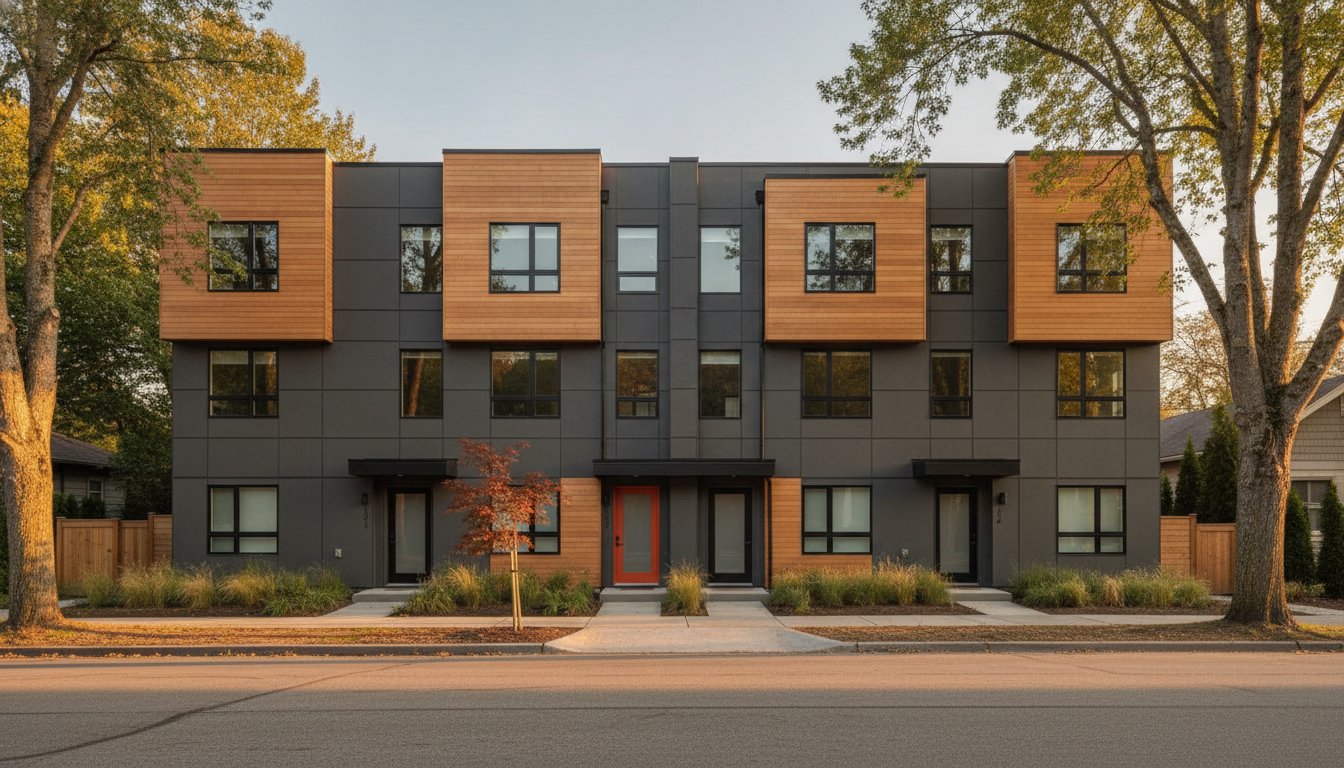
Did you know that multiplex applications now account for half of all new housing starts in Vancouver's R1-1 zones? It's a massive shift, yet many homeowners still feel paralyzed by the fear of hidden costs and city bureaucracy. You've likely heard about the June 30, 2026, deadline for municipal compliance, but understanding how the Vancouver multiplex housing rules actually apply to your specific lot is where the real value lies. It's time to stop viewing zoning as a barrier and start seeing it as your property's greatest potential.
We understand the anxiety that comes with shifting Amenity Cost Charges and the threat of construction delays. You want a predictable path from design to completion without the typical chaos of a large-scale build. This guide provides the clarity you need to navigate the new 1.0 Floor Space Ratio limits and the temporary 20% reduction in Development Cost Levies. We'll show you exactly how to determine unit capacity based on your lot size and transit proximity, ensuring you maximize density while maintaining total control over your investment.
Key Takeaways
- Understand how the R1-1 zoning consolidation simplifies design requirements, removing old restrictions on roof slopes to maximize your buildable space.
- Identify your property's unit capacity, ranging from four units on standard lots to eight units on larger sites when utilizing secured rental incentives.
- Evaluate the financial benefits of stratification for immediate returns versus the density bonuses and fee waivers offered for rental developments.
- Navigate the Vancouver multiplex housing rules with confidence by using professional feasibility studies and 3D VR walkthroughs to realize your vision.
- Learn how an integrated design-build model eliminates budget overruns and construction chaos by keeping design and management under one roof.
Understanding the Vancouver Multiplex Housing Shift: The RS-1-1 Zone
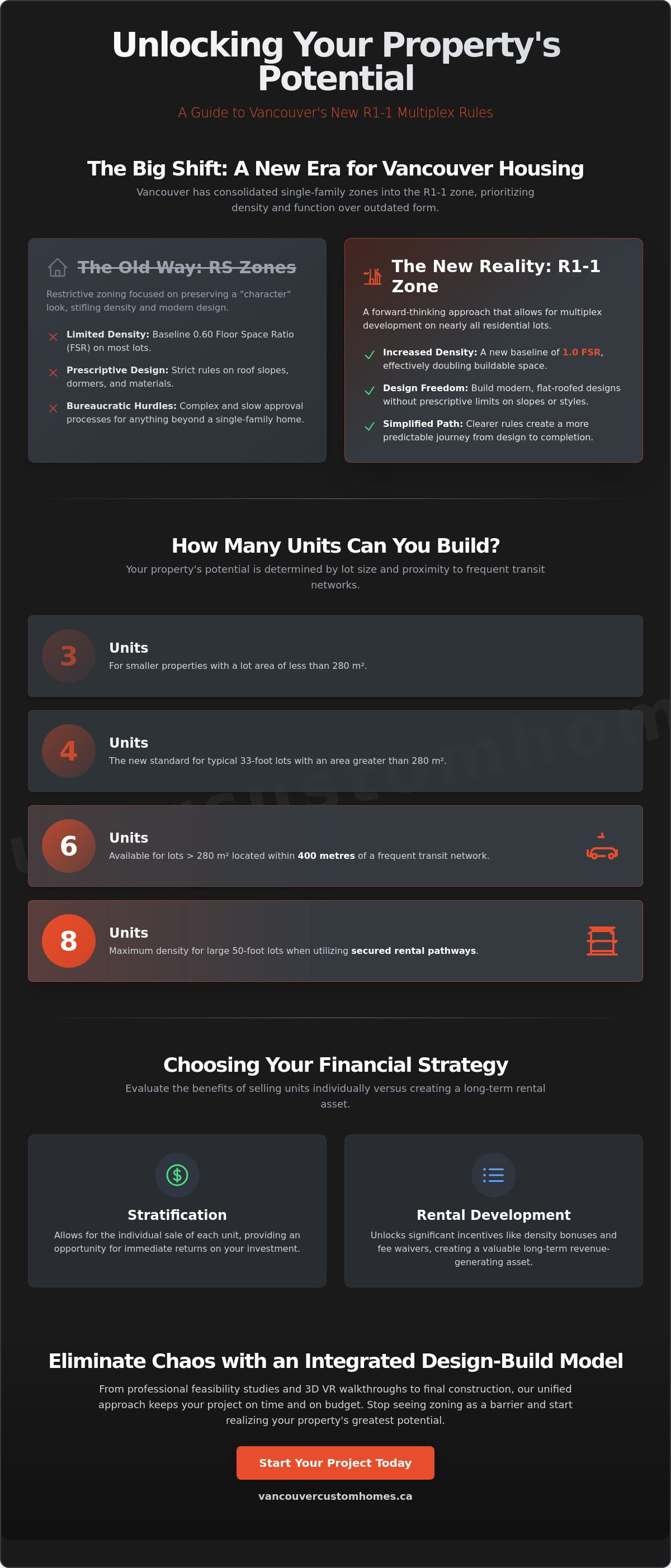
The City of Vancouver has fundamentally rewritten the rulebook for residential development. By consolidating nearly all single-family RS zones into the new R1-1 Residential Inclusive Zone (frequently referred to as the RS-1-1 shift), the city has removed the bureaucratic layers that previously stifled innovation. This isn't just a minor tweak; it's a structural pivot toward function over form. The old rules prioritized specific roof slopes and dormer sizes to maintain a "character" look. The new Vancouver multiplex housing rules prioritize how many people can live comfortably on a lot. This shift aligns perfectly with the June 30, 2026, Provincial mandate for municipal compliance. It ensures that density is no longer a special request but a baseline expectation for all residential land.
The Death of the Single-Family Only Lot
The era of the "single-family only" lot is officially over. For decades, Vancouver's urban planning philosophy focused on high-density towers in the core and low-density sprawl in the surrounding neighbourhoods. That gap, known as the "Missing Middle," is finally being bridged. Under the new framework, the traditional detached house is no longer the default development path. The city now prioritizes density over the preservation of character homes in most areas. If you own a lot previously zoned as RS-1, your property's value is no longer tied to a single dwelling. It's now tied to its potential as a four, six, or even eight-unit community. By allowing a Floor Space Ratio (FSR) of up to 1.0, the city has effectively doubled the buildable area compared to traditional single-family builds. This change reflects a disciplined move toward a more sustainable and accessible urban landscape.
Freedom of Design: What It Means for You
Architectural freedom has finally arrived. The removal of prescriptive design guidelines means you're no longer forced to build a "faux-heritage" box. Do you want a modern, flat-roof design that maximizes every cubic centimetre of interior volume? Now you can build it. By eliminating strict requirements for roof pitches and dormer placements, the city allows for cleaner lines and more efficient floor plans. However, this freedom isn't a free-for-all. You must still balance your vision with neighbourly setbacks and specific courtyard requirements designed to maintain light and air. The goal is to create high-quality living spaces that feel integrated rather than imposed. When you master these Vancouver multiplex housing rules, you unlock a level of design flexibility that was previously impossible. This flexibility allows for a more predictable path from initial concept to the final realization of your property's value.
Eligibility and Capacity: How Many Units Can You Build?
Determining your lot's potential is the first step toward a successful build. Under the current Vancouver multiplex housing rules, the number of units you're permitted to build depends primarily on lot size and transit proximity. For standard 33-foot lots, which typically exceed 280 m² in total area, you can now build a maximum of 4 units. If your property is smaller than 280 m², the city generally permits 3 units. However, the real opportunity lies in transit-oriented locations. Lots larger than 280 m² situated within 400 metres of a frequent transit network can unlock 6 units. For those with larger 50-foot lots, secured rental pathways can push this even further to a maximum of 8 units.
Site access also dictates project feasibility. While most multiplexes require laneway access for functional parking and utility connections, double-fronting lots offer unique design advantages for unit orientation. If your property lacks a lane, the city has streamlined requirements to accommodate your site, though it may influence your final unit count or parking configuration. It's a complex puzzle. Solving it correctly is what maximizes your property value. You can explore how these variables impact your specific site through our multiplex design services.
Calculating Your Floor Space Ratio (FSR)
The city's shift to a 1.0 FSR baseline is a game-changer for homeowners. This allows for a significant increase in buildable area compared to the 0.60 FSR typical of old single-family zones. Floor Space Ratio (FSR) is the ratio of building area to lot area that dictates your project size. While 1.0 is the standard, you don't have to stop there. By committing to high-performance sustainability standards or secured rental pathways, you can often achieve an FSR of 1.2 or 1.5. This extra volume is where you transform a standard project into a high-yield investment. Clarity is key.
The 2026 Lot Assessment Checklist
Before you commit to a design, you've got to clear the technical hurdles that often derail projects. The 2026 landscape includes several critical checks:
- Underground Utilities: Check for sewer easements or water main encumbrances that limit your building footprint.
- Floodplain Mapping: Verify if your lot falls within updated floodplain zones, which may require specific raised foundations.
- Heritage Designations: Specific heritage-listed properties still face unique conservation requirements that can restrict density.
- Amenity Cost Charges (ACC): Prepare for the new ACC framework launching in late July 2026, which replaces older density bonus structures for over 90% of multiplex lots.
Navigating these details early prevents the construction chaos that ruins budgets. Professional foresight ensures your project moves from vision to reality without expensive surprises. You're building for the future, so start with the right data.
Stratification vs. Rental: Choosing Your Financial Strategy
How do you plan to realize your property's value? This is the most critical question you'll face after confirming your lot's eligibility. The Vancouver multiplex housing rules provide two distinct financial pathways: stratification and secured rental. Stratification allows you to sell individual units as separate titles, offering a fast return on capital and immediate profit. In contrast, the rental path focuses on long-term yield and maximum density. Choosing the right strategy depends on your tolerance for city fees versus your desire for a steady, inflation-protected income stream. Ambiguity here is the enemy of profit; you need a clear financial roadmap before the first permit is filed.
Beyond commercial interests, these rules are a lifeline for multi-generational living. Many Vancouver families use the multiplex framework to keep three generations on a single lot while maintaining private, self-contained living spaces. Whether you're building to sell or building for family, the current market trends in East Vancouver show strata units fetching between C$1.2 million and C$1.8 million. Meanwhile, three-bedroom rentals in the same area command between C$3,200 and C$4,500 per month. Both paths are viable, but they require very different up-front investment structures.
The Amenity Share Contribution Explained
If you choose to stratify and sell your units, the City of Vancouver requires a contribution to local infrastructure. This was traditionally known as an "Amenity Share," but it is transitioning to a new Amenity Cost Charge (ACC) framework in late July 2026. This per-square-foot fee can be a significant line item in your budget. You must calculate these costs early to ensure they don't erode your margins. While these fees are a hurdle, the high sale price of new-build strata units typically offsets the cost, provided your project management is disciplined enough to avoid construction delays.
Secured Rental Incentives
The city is currently prioritizing rental housing through aggressive financial incentives. By committing to a secured rental project, you can often bypass the density bonus contributions required for strata builds. This can result in massive savings; some 8-unit rental projects see fee reductions between C$180,000 and C$228,000 compared to their strata counterparts. Rental-only multiplexes can bypass certain stratification taxes by committing to long-term tenure through a housing agreement with the city. You may also be required to navigate "Below-Market Ownership" or rental requirements, but the trade-off is often a higher Floor Space Ratio (FSR) and a more streamlined approval process. It's a strategic play for those looking to build a legacy portfolio in a high-demand market.
Navigating the Permit Path: Design, Visualization, and Approval
Moving from a financial strategy to a physical build requires navigating a rigorous approval pipeline. The Vancouver multiplex housing rules are designed to streamline this transition, but only if you start with a professional feasibility study. This pre-application phase identifies potential site constraints, such as underground utility encumbrances or specific rainwater management needs, before they become expensive change orders. Skipping this step often leads to the very city bureaucracy that homeowners fear most. A disciplined start ensures that your project remains a high-value investment rather than a logistical nightmare.
Sustainability is no longer optional in Metro Vancouver. Your project must comply with BC Energy Step Code 5, which mandates high-performance building envelopes and efficient mechanical systems. Additionally, the city requires robust on-site rainwater management to reduce the burden on municipal infrastructure. These technical requirements are integrated into the permit process, making it essential to have a design team that understands the intersection of modern engineering and local bylaws. You can begin this process with a Custom Home Design consultation to ensure your vision aligns with current regulations.
The Power of 3D VR Visualization
Why guess what your multiplex will look like when you can walk through it? We utilize 3D VR walkthroughs to realize the design before the first shovel hits the ground. This immersive technology allows you to experience courtyard light levels, unit orientation, and interior volume in a virtual environment. It's a proactive solution that prevents costly mid-construction design changes. Beyond your own peace of mind, high-fidelity visualization is a powerful tool for communicating your vision to city planners. It replaces ambiguity with certainty, showing exactly how your project respects setbacks and maintains neighbourly privacy.
Permit Milestones and Timelines
Understanding the distinction between the Development Permit (DP) and the Building Permit (BP) is vital for your project timeline. While the city is launching concurrent permit processes for projects with up to 4 units to reduce wait times, custom designs still require a methodical approach. You can often expedite these approvals by utilizing the Certified Professional (CP) program, which shifts the responsibility of code compliance to specialized consultants. You must also account for the following milestones:
- Site Preparation: Securing demolition permits for existing structures and identifying any hazardous materials early.
- Standardized vs. Custom: Choosing a standardized design may offer a faster permit path, while custom designs allow for maximum lot utilization.
- Engineering Review: Ensuring your foundation and structural plans meet the latest seismic and environmental standards.
A well-managed permit path turns a complex system into a structured, predictable journey. By taking full responsibility for every detail, we ensure your project moves through City Hall without the typical friction of fragmented management.
Eliminating Construction Chaos with Integrated Design-Build
Why do so many housing projects end in budget overruns? It's almost always the result of a fragmented process. When the architect and the builder operate as separate entities, the client is often caught in the middle of conflicting priorities. This friction is the primary cause of delays and hidden costs under the Vancouver multiplex housing rules. We eliminate this chaos through a unified "one-roof" solution. By keeping design, engineering, and construction under a single management team, we ensure that every architectural detail is feasible, cost-effective, and perfectly aligned with your original vision.
Vancouver Custom Homes organizes every build with a focus on punctuality and professional reassurance. We don't just build structures; we manage your peace of mind by removing the ambiguity common in the industry. This integrated approach means your compliance with the Vancouver multiplex housing rules is handled from day one. You receive a refined workflow where the transition from initial 3D visualization to the physical build is seamless. It's a disciplined strategy that replaces typical project anxiety with controlled, predictable excitement. You deserve certainty, and our integrated model provides it.
Transparency Through the Project Portal
Real-time communication is the backbone of a successful multiplex build. We provide our clients with Project Management Portal Access to ensure total transparency throughout the journey. From your smartphone, you can access daily logs, site photos, and budget updates instantly. This digital hub eliminates the "black hole" of construction timelines. When you can track every milestone as it happens, you maintain a sense of control and security. This integrated communication prevents the chaos of fragmented building and keeps your project moving toward a successful realization with no surprises.
Your Next Steps: The Feasibility Consultation
Moving from a "what if" scenario to a concrete project plan requires professional foresight. Your journey begins with a comprehensive site assessment to determine exactly how to unlock your property's potential. We specialize in navigating the logistical complexities of 2026 zoning so you don't have to worry about the details. If you're ready to master the process, read our full guide on how to Build a Multiplex in Vancouver: The 2026 Guide to Integrated Design and Construction. Booking your initial feasibility consultation is the most effective way to realize your property's value without the construction chaos.
Transform Your Property into a High-Value Legacy
The 2026 housing landscape offers a rare window of opportunity for Vancouver homeowners. By mastering the Vancouver multiplex housing rules, you move beyond the limitations of single-family zoning and into a high-yield reality. You've seen how the shift to R1-1 zoning and the strategic choice between strata and rental pathways can redefine your financial future. Why settle for the friction and budget overruns of fragmented management when you can have total transparency under one roof? The complexity of city bureaucracy doesn't have to be your burden to carry.
Our integrated design-build experts eliminate the ambiguity that often plagues large-scale construction. We utilize immersive 3D VR Walkthroughs to finalize your vision and our transparent Project Management Portal to track every milestone on your smartphone. We take full responsibility for every detail, ensuring your journey from initial feasibility to final completion is as refined as the product itself. It's time to replace the typical anxiety of construction chaos with a structured, predictable, and exciting experience.
Realize your property’s full potential with a Vancouver Custom Homes feasibility study. Your property is ready for its next chapter; let's build it with absolute certainty and professional dedication.
Frequently Asked Questions
Can I build a multiplex on a 33-foot lot in Vancouver?
Yes, you can build a multiplex on a standard 33-foot lot in Vancouver. Because most 33-foot lots exceed the 280 m² threshold, you're permitted to build up to 4 units as-of-right. This shift allows you to maximize your property's footprint without the need for a lengthy rezoning process. It's a straightforward way to increase density while staying within the established R1-1 zoning framework.
How much is the Amenity Share Contribution for multiplexes in 2026?
The financial landscape for amenities is shifting significantly this year. Effective June 30, 2026, the city is removing density bonus contributions for over 90% of multiplex lots. A new Amenity Cost Charge (ACC) is scheduled for introduction in late July 2026 to replace the old system. You should budget for these new charges early to ensure your project's financial feasibility remains intact during the transition.
Do Vancouver multiplex rules allow for stratified units?
Yes, the Vancouver multiplex housing rules explicitly allow you to stratify your units for individual sale. This path requires a specific payment to the city, which supports local infrastructure. While stratification involves higher up-front fees than rental projects, it offers the advantage of immediate capital return. It's a popular choice for homeowners looking to realize their property's market value quickly.
What is the maximum height for a multiplex under RS-1-1 zoning?
The maximum height for a multiplex is generally set at 11 metres, which is approximately 36 feet. This height allowance is specifically designed to accommodate modern three-storey buildings. By utilizing this vertical space, you can maximize your Floor Space Ratio (FSR) while maintaining the required setbacks. It's a disciplined approach to density that ensures light and privacy are preserved for both residents and neighbours.
How long does the multiplex permit process take at City Hall?
Permit timelines are becoming more predictable thanks to the city's concurrent permit process. This system allows for development and building permits to be processed simultaneously for projects with up to 4 units. While custom designs may take longer than standardized plans, navigating the Vancouver multiplex housing rules with an integrated team can significantly reduce friction and wait times at City Hall.
Can I still build a laneway house if I build a multiplex?
No, you cannot build a laneway house if you choose to develop a multiplex on your lot. A multiplex is a single, unified building that contains multiple primary dwellings, whereas a laneway house is a secondary structure. You're essentially choosing a higher-density model that provides more living space and units than the traditional house plus laneway configuration would allow.
What are the parking requirements for new multiplex developments?
Parking requirements depend heavily on your lot's proximity to public transportation. There are no minimum parking requirements for multiplexes located within 400 metres of a frequent transit network. If your lot is outside this range, you'll need to provide on-site parking as dictated by the R1-1 bylaw. This flexibility allows for more creative use of your lot's ground-level area for living space or courtyards.
Is my lot in a floodplain eligible for a multiplex build?
Lots located within a floodplain are still eligible for multiplex development, but they require specialized engineering. You'll need to adhere to specific flood construction levels, which often involve raising the ground floor or utilizing specific foundation designs. It's a technical hurdle that we manage during the design phase to ensure your build is both compliant and resilient against future environmental changes.


