
The traditional method of building a custom home in Metro Vancouver is fundamentally broken. Most homeowners enter the process expecting a linear path, only to be met with fragmented communication between architects and builders that leads to expensive change orders. If you're worried about your project becoming another cautionary tale, you aren't alone. You likely realize that the combination of complex 2026 BC Step Code requirements and the latest Vancouver Building By-law updates makes avoiding custom home budget overruns feel like a moving target.
It doesn't have to be a gamble. We believe that financial certainty is the result of meticulous planning rather than luck. This guide will show you how to master the strategies for a predictable build by using integrated design-build workflows and real-time transparency. You'll learn how 3D VR walkthroughs eliminate aesthetic guesswork before the first permit is even filed. We will also break down how a "one-roof" approach manages the 4.5% increase in 2026 permit fees and keeps your digital vision perfectly aligned with your final invoice.
Key Takeaways
- Learn why the integrated design-build model is the most effective strategy for avoiding custom home budget overruns in the volatile Metro Vancouver market.
- Discover how to identify and avoid the "Design-Bid-Build" trap by spotting unrealistic bids that omit essential project requirements.
- See how 3D VR walkthroughs allow you to finalize every aesthetic detail during the design phase, virtually eliminating the need for costly mid-construction changes.
- Gain full visibility into your project's progress with a digital management portal that replaces construction anxiety with real-time transparency.
- Understand how to navigate the 2026 BC Step Code and local permitting fees to ensure your budget remains stable from the initial quote to the final walkthrough.
Understanding the Anatomy of a Custom Home Budget Overrun
The construction industry often treats budget volatility as a force of nature. It isn't. To truly understand the financial health of your project, you must first define the problem. What is a cost overrun? In the simplest terms, it is the gap between a builder's initial optimistic quote and the final, harsh reality of the invoice. In Metro Vancouver, "extra" costs are frequently treated as inevitable byproducts of a complex industry. We disagree. Most overruns are predictable failures in foresight. Avoiding custom home budget overruns starts with recognizing that a quote is only as good as the data behind it. If your builder provides a "best-case scenario" estimate, they are essentially planning for your project to fail.
The psychological toll of this uncertainty is immense. When numbers climb mid-build, the excitement of creating a legacy home turns into a stressful survival exercise. This chaos usually stems from a lack of transparency. If you don't know why a cost has changed, you lose control of the journey. You must distinguish between market-driven increases, like a sudden spike in lumber prices, and poor project management. One is an external shift; the other is a failure of your builder to coordinate the moving parts of your project.
Common Culprits: From Low Bids to Hidden Site Costs
Vague "allowances" are the most common way budgets are manipulated. A builder might set a $20,000 allowance for cabinetry that actually costs $60,000 to meet your vision. This masks the true cost of a luxury build until it's too late to turn back. To avoid these pitfalls, it is vital to research specific finishing costs; for instance, benchmarking against specialists like Home Expo Asia can help you understand the price points of premium materials before you commit to a budget. Site conditions also play a massive role. If you are building in Richmond or Delta, soil stability is a known variable. If your builder hasn't accounted for specialized piling or foundation work during pre-construction, your budget will sink alongside the ground. Finally, there is the "fragmentation tax." This occurs when your architect and builder operate in separate silos. Without a unified design-build approach, you end up paying for the misunderstandings and errors that happen when the person drawing the house doesn't talk to the person building it.
The Vancouver Factor: Permits, Regulations, and the BC Step Code
Local regulations in the Lower Mainland add another layer of complexity. Municipal permit delays in Burnaby or West Vancouver can stretch timelines by several months. Every day of delay adds carrying costs, interest, and inflation to your bottom line. Meeting the 2026 BC Step Code is another critical factor. These energy efficiency requirements aren't just a checkbox; they require specific high-performance materials and airtightness testing that must be budgeted from day one. Additionally, while the new multiplex housing rules offer great opportunities for density, they come with unique utility connection fees and Development Cost Levies (DCLs) that can surprise the unprepared. Avoiding custom home budget overruns requires a partner who understands these local nuances before the first shovel hits the dirt.
The Pre-Construction Phase: Where Budgets are Won or Lost
Success in construction is decided long before the first excavator arrives on site. Mastering the pre-construction phase is the single most effective method for avoiding custom home budget overruns in the Lower Mainland. The traditional "Design-Bid-Build" model is a financial trap; it encourages architects to design without cost constraints and builders to bid low just to win the job. This fragmentation creates a conflict of interest that you eventually pay for in change orders. Instead, you should look for a unified model where the budget is a primary design constraint from day one.
Industry experts highlight several best practices for preventing budget overruns, starting with a robust contingency fund. We recommend a 10-15% buffer to account for the unexpected variables inherent in Vancouver's geography. Locking in your labour, material, and colour choices before the first shovel hits the dirt ensures that your initial quote remains a reality rather than a suggestion.
Designing to Budget vs. Budgeting for a Design
The secret to financial predictability lies in "value engineering." When your architect and builder work under one roof, they can evaluate the cost implications of every window placement and structural beam in real-time. This integrated approach to custom home design Vancouver allows you to prioritize "must-haves" over "nice-to-haves" while the plans are still fluid. It's much cheaper to move a wall on a screen than it is to move one made of 2x6 studs and drywall. You can explore our integrated approach to see how we align your vision with your wallet.
Visualizing Reality: Using 3D VR Walkthroughs to Prevent Change Orders
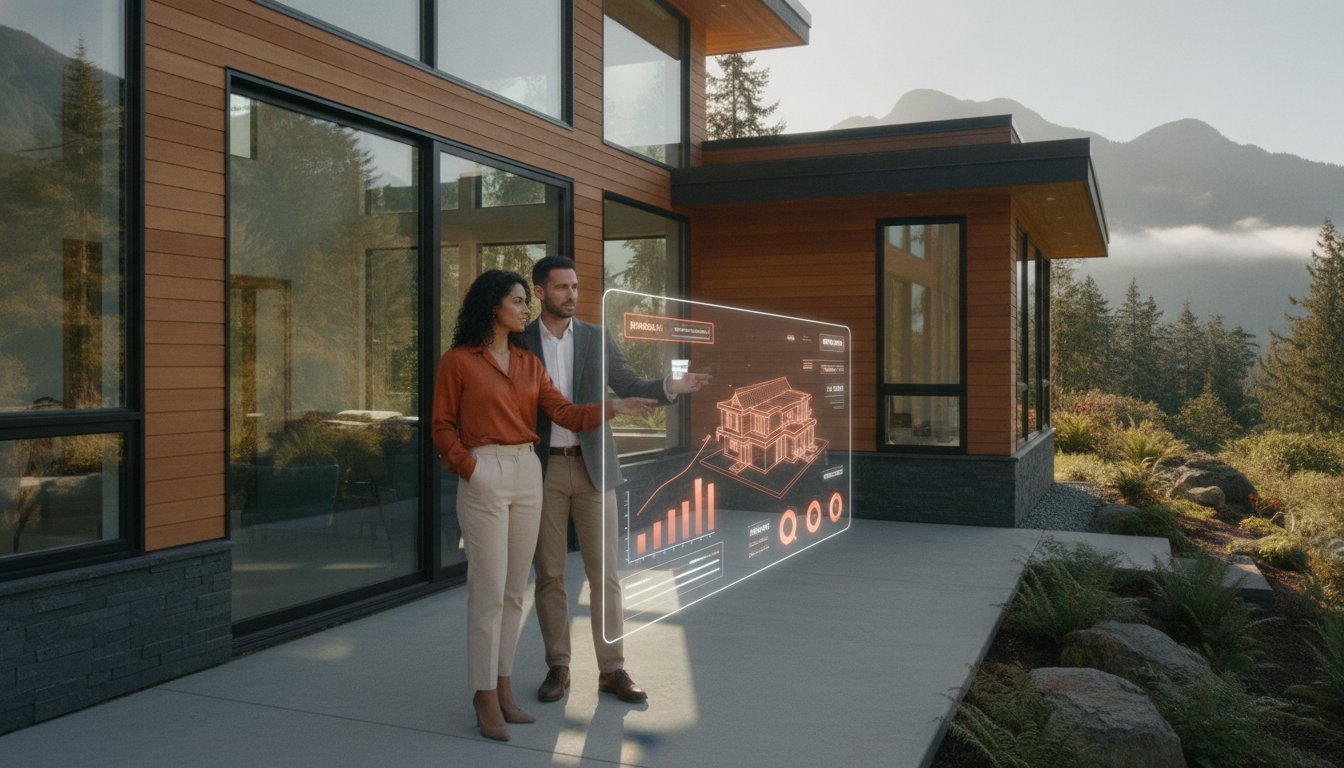
Aesthetic change orders are the silent killers of a construction budget. Homeowners often struggle to translate 2D blueprints into a 3D reality, leading to the dreaded "I didn't realize it would look like that" moment mid-build. These realizations are expensive. By the time the framing is up, changing a kitchen layout or ceiling height can cost tens of thousands of dollars. We use 3D VR walkthroughs to eliminate this risk entirely. You can "walk" through your digital twin, testing different layouts and finishes before any materials are ordered. This technology catches design flaws and structural conflicts early, ensuring that the home you see on the screen is exactly the home you get at the price you expected. Locking in these details early is essential for avoiding custom home budget overruns once construction begins.
Vetting Your Vancouver Builder: Identifying Realistic Bids
Choosing a builder based solely on a bottom-line number is a recipe for disaster. In the competitive Metro Vancouver market, bid-rigging often takes the form of tactical omissions rather than outright deception. Builders may leave out essential items like site services, landscaping, or even GST to make their proposal appear more attractive. A realistic bid should be a comprehensive document of line-item transparency, not a vague two-page summary. If a proposal lacks detail, the builder is likely deferring the true cost of your project to future change orders. Avoiding custom home budget overruns requires you to demand a breakdown that accounts for every nail and hour of labour before you sign anything.
This level of detail is a hallmark of professional contractors; for instance, River City Construction Inc applies these same principles of transparency to home remodelling to protect homeowners from financial surprises.
Fixed-price contracts are often marketed as the ultimate safety net for homeowners. However, these agreements are only as reliable as the specifications behind them. If you haven't finalized your material selections through a digital twin or VR walkthrough, a fixed-price contract is essentially a placeholder for future surprises. You need a partner with a proven track record in specific municipalities like North Vancouver or Coquitlam. A builder who understands the local nuances of those building departments will provide a quote that reflects reality, not a best-case scenario that collapses once construction begins.
The Danger of the 'Lowest Bidder' and Artificially Low Estimates
Low-ball tactics are designed to win the contract today and claw back profit margin tomorrow. When a bid seems significantly lower than the competition, ask why. Are they using undocumented labour? Have they underestimated the cost of high-performance materials required for the 2026 BC Step Code? Quality labour in Metro Vancouver carries a premium that you simply cannot cut without sacrificing the integrity of your home. When checking references, don't just look at the final aesthetics. Ask previous clients specifically about budget adherence. Did the builder stay within the initial quote, or was the journey defined by "unforeseen" invoices?
Why Integrated Teams Offer Greater Financial Certainty
The most effective way to ensure your budget remains stable is to eliminate the gap between design and execution. When the person who draws the plan is also responsible for building it, there is no room for finger-pointing. This unified accountability is the core of modern custom home construction Vancouver. An integrated team performs constant internal audits, ensuring that every architectural choice is grounded in current market pricing. This "one-roof" model removes the fragmentation tax and is the most reliable strategy for avoiding custom home budget overruns. It replaces the traditional builder-architect friction with a seamless, disciplined workflow that protects your investment from start to finish.

Maintaining Transparency During the Build
Active construction is often a "black box" for homeowners. You see a flurry of activity on site but have no visibility into the financial machinery behind the scenes. This lack of clarity is where anxiety thrives. Avoiding custom home budget overruns requires a shift from retroactive reporting to proactive data management. When you have access to real-time information, a minor site adjustment remains a minor expense rather than ballooning into a five-figure surprise. Professional supply chain management also plays a critical role here. By locking in orders and managing logistics with foresight, we protect your project from the "inflation surprises" that plague less organized builders.
Your Project Manager should be more than just a site supervisor; they are your financial advocate. Their job is to ensure that the work on the ground matches the vision in your contract without unauthorized deviations. This level of oversight turns a chaotic process into a disciplined realization of your home. To experience this level of control firsthand, view our project management approach.
Real-Time Tracking: The Role of a Project Management Portal
The days of waiting for a monthly paper invoice are over. A dedicated digital interface is the only way to maintain true accountability in a 2026 build. The home builder client portal benefits include 24/7 access to daily logs, progress photos, and budget updates directly from your phone. You can approve invoices instantly and see exactly where every dollar is allocated in real-time. This transparency ensures that there are no "mystery costs" at the end of the month, keeping the project's financial health visible to all parties involved.
Managing Change Orders and Contingency Funds Professionally
Verbal agreements are the enemy of a stable budget. A casual "let's just move that light fixture" on site can lead to a chain reaction of electrical and drywall costs that aren't documented until it's too late. We utilize a formal change order process for every modification, no matter how small. This ensures that you know the exact cost and schedule impact before the work begins. Your contingency fund is a strategic tool, not a slush fund. We help you decide when to dip into those reserves for essential structural needs and when to hold the line on elective upgrades. By documenting every modification, we ensure that avoiding custom home budget overruns is a shared, data-driven goal throughout the entire construction phase.
Partnering with Vancouver Custom Homes for a Predictable Build
Choosing a partner for your custom build is the most significant financial decision you'll make. At Vancouver Custom Homes, we act as a stabilizing force in an industry that's too often defined by ambiguity and shifting targets. Our commitment to assertive transparency means we take full accountability for every dollar spent. By replacing construction chaos with controlled excitement, we ensure that avoiding custom home budget overruns isn't just a goal; it's a structural reality of our workflow. We don't just manage projects; we lead them with a disciplined strategy that respects your time and your emotional well-being.
Our 'One-Roof' Approach to Cost Control
The traditional friction between designers and contractors is the primary driver of financial waste. We eliminate this conflict by integrating design, permitting, and construction under a single roof. This unified model allows us to perform rigorous internal audits at every stage, ensuring that your architectural vision never outpaces your budget. Whether we're building high-density laneway homes Vancouver or acting as elite custom home builders Richmond BC, our local expertise ensures we navigate municipal-specific regulations without costly delays. We understand the nuances of the 2026 BC Step Code and local utility connection fees, allowing us to provide a quote that remains stable from the first drawing to the final inspection.
From VR Design to Portal-Managed Construction
Our process leverages modern digital tools to give you absolute certainty. You'll experience your home through a 3D VR walkthrough before any physical work begins. This allows you to finalize every finish and layout detail, virtually eliminating the need for expensive aesthetic change orders later. Once construction starts, our dedicated project management portal keeps you fully informed. You can track daily logs and approve invoices from your laptop, ensuring that avoiding custom home budget overruns is a transparent, data-driven process. This level of organization is why our clients sleep better at night; they know their vision is being realized by a team that values precision as much as they do.
Your journey toward a predictable build starts with a conversation. From your initial site consultation to the final VR visualization, we provide a structured path that removes the guesswork. We invite you to experience a building process that's as refined as the final product we deliver. Let's build your legacy home with the discipline and transparency it deserves.
Realizing Your Vision Without the Financial Friction
Building a custom home in Metro Vancouver shouldn't feel like a high-stakes gamble. By shifting to an integrated design-build model, you eliminate the fragmentation that typically leads to expensive surprises. You've seen how 3D VR walkthroughs finalize aesthetic choices early and how real-time portal access keeps every dollar accountable. Avoiding custom home budget overruns is entirely possible when you prioritize transparency and disciplined planning over optimistic, low-ball estimates.
Whether you are planning a sprawling estate or navigating the complexities of a new multiplex build, we provide the technical expertise and visionary guidance to keep your project on track. Our specialists understand the unique regulatory landscape of the Lower Mainland, ensuring your home meets the 2026 BC Step Code without breaking the bank. It's time to replace construction anxiety with controlled, predictable excitement.
Book your 3D VR design consultation with Vancouver Custom Homes today to see your digital twin come to life. We look forward to helping you build a home that matches your vision and your budget perfectly.
Frequently Asked Questions
What is a realistic contingency fund for a custom home in Vancouver?
A realistic contingency fund for a Vancouver custom home is typically between 10% and 15% of the total construction budget. This buffer isn't a luxury; it's a strategic necessity to manage the region's unique geographical variables and soil conditions. Setting this aside early is a fundamental step in avoiding custom home budget overruns, ensuring that unforeseen ground issues or supply chain shifts don't derail your project's financial stability.
How do 3D VR walkthroughs actually save money on construction?
3D VR walkthroughs save money by identifying aesthetic and structural conflicts in a digital environment before any materials are purchased. It's significantly cheaper to move a virtual wall than a physical one. By "walking" through your home during the design phase, you finalize every layout detail and finish. This eliminates the need for expensive mid-construction change orders that often occur when homeowners can't visualize 2D blueprints.
Will the new Vancouver multiplex housing rules increase my building costs?
The new multiplex housing rules introduce specific cost drivers such as adjusted Development Cost Levies (DCLs) and utility connection fees. As of 2026, DCLs for low-density residential projects are approximately $50 per square metre. While these initial fees are higher, the ability to build up to six units on a single lot provides a significant return on investment. Professional guidance ensures these regulatory costs are integrated into your initial budget rather than appearing as surprises.
Why is the lowest bid often the most expensive choice in the long run?
The lowest bid is often a "best-case scenario" that lacks comprehensive line-item transparency. Many low-ball estimates intentionally omit essential costs like site services or high-performance materials to appear competitive. Once construction begins, these omissions resurface as mandatory change orders. You eventually pay a premium for the lack of foresight, often exceeding the price of a more realistic, detailed proposal from an integrated builder.
How does a project management portal help me track my home's budget?
A project management portal provides real-time visibility into your home's financial health. You can access daily logs, track budget allocations, and approve invoices directly from your phone. This technology replaces construction anxiety with data-driven certainty. By seeing exactly where every dollar goes, you maintain full control over the process. This level of transparency is essential for avoiding custom home budget overruns throughout the active building phase.
Can I change my mind about finishes mid-build without a huge cost overrun?
Changing finishes mid-build almost always leads to a budget overrun due to restocking fees and labour rescheduling. Every modification during active construction triggers a formal change order process to document the cost and schedule impact. While we manage these changes professionally, the most cost-effective strategy is to finalize all selections during the VR design phase. This ensures your final bill matches your initial expectations without elective surprises.
What are the most common hidden costs in Vancouver custom home building?
Hidden costs in Vancouver often involve site preparation, soil stability issues in areas like Richmond, and municipal permit delays. Site preparation can range from $60,000 to $95,000 depending on the lot's condition. Additionally, the 4.5% increase in Vancouver permit fees for 2026 and specific seismic design requirements can impact your bottom line. An integrated builder accounts for these local variables during the pre-construction phase to ensure total budget clarity.
How does the BC Step Code affect my custom home budget in 2026?
The 2026 BC Step Code requires detailed energy modelling and airtightness testing to ensure high-performance efficiency. These requirements impact your budget through the need for specialized insulation, high-efficiency windows, and advanced HVAC systems. While these materials carry a higher upfront cost, they are mandatory for compliance. Budgeting for these energy standards from day one prevents the expensive retrofitting that occurs when efficiency is treated as an afterthought.


