

In the high-stakes Metro Vancouver market of 2026, a low bid isn't a bargain; it's often a down payment on a future legal battle. Building a custom home should be the realization of a legacy, yet many homeowners face paralyzing anxiety over permit delays and the fear of losing a large deposit to an unreliable builder. You deserve a process that feels as refined as the final product, but the industry often delivers chaos instead of clarity.
One of the most common mistakes when building a custom home in Vancouver is ignoring the subtle red flags that signal a contractor lacks the necessary foresight or legal standing. This guide identifies the critical warning signs of a risky builder and teaches you how to protect your residential investment with confidence. We will explore BC Housing licensing requirements, the reality of 2026 permit timelines, and how digital accountability tools can ensure your home is delivered on time and within budget.
Key Takeaways
- Verify BC Housing licensing and avoid builders demanding more than a 15% upfront deposit. It's an essential safeguard for your residential investment in British Columbia.
- Treat immediate availability and "yes-man" attitudes as warnings rather than benefits. A reliable builder doesn't make promises without assessing technical feasibility first.
- Avoid one of the common mistakes when building a custom home in Vancouver by refusing to start construction without official permits. Shortcuts in the pre-construction phase often lead to expensive legal liabilities and site failures.
- Look for high communication standards and dedicated on-site management. Professional transparency through a project portal prevents the "ghosting" and fragmented leadership common in traditional contracting.
- Embrace an integrated design-build model to secure a single point of accountability. This unified approach ensures your budget remains accurate and your vision is realized without the chaos of siloed teams.
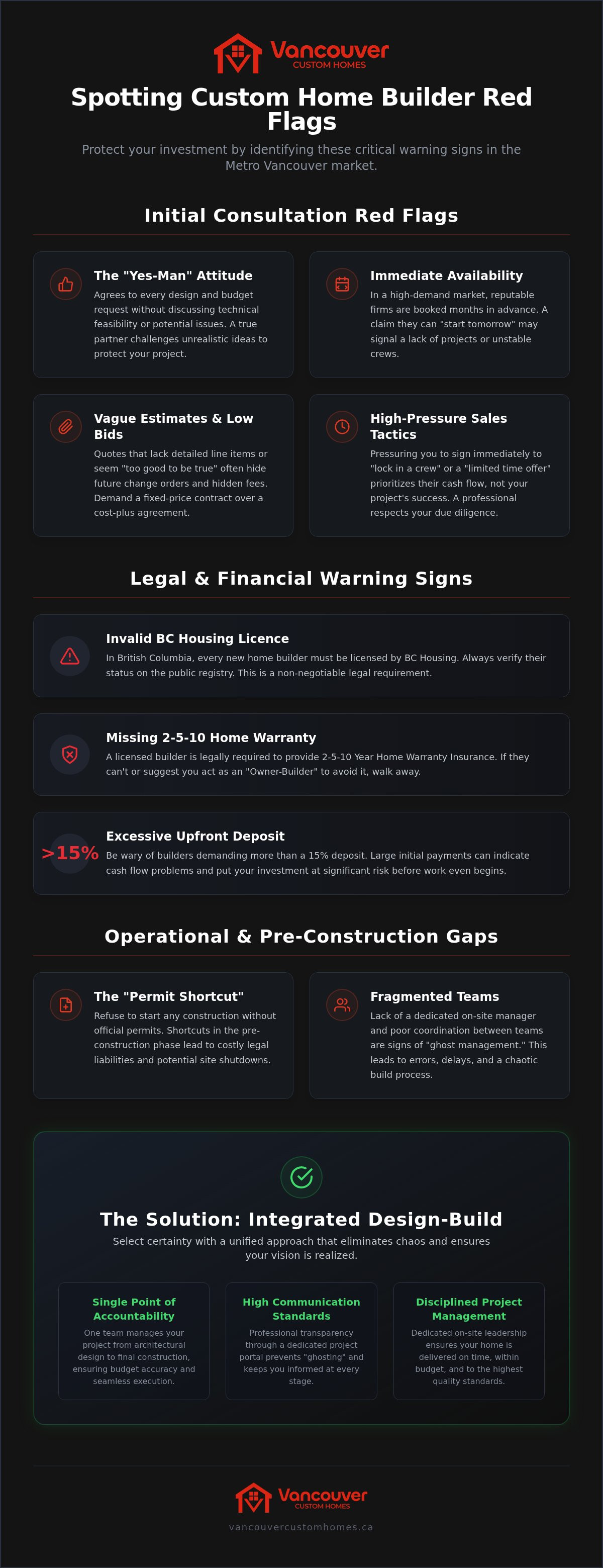
Initial Consultation Red Flags: Beware the Unrealistic "Yes-Man"
The first meeting with a potential builder sets the tone for your entire project. If a contractor agrees to every design whim and budget constraint without hesitation, you aren't talking to a partner; you're talking to a "Yes-Man." Understanding What is a General Contractor? and their professional responsibilities is the first step in vetting your team. One of the most common mistakes when building a custom home in Vancouver is mistaking total compliance for expertise. Why settle for a builder who says yes to everything only to deliver excuses later? A professional strategist will challenge unrealistic ideas to protect your investment. They discuss technical feasibility and budget impacts immediately, rather than letting problems surface during framing.
In the high-demand 2026 Metro Vancouver market, immediate availability is a glaring red flag. Most reputable firms have schedules booked months in advance. If a builder claims they can start tomorrow, it often suggests a lack of stable crews or a high turnover of dissatisfied clients. Always demand a list of local references from projects completed within the last 24 months. If they provide vague estimates lacking a detailed line-item breakdown of materials and labour, they are likely hiding a lack of organization or preparing for future hidden fees.
The Danger of the "Too Good to Be True" Quote
Low bids are seductive, but they are frequently a trap. A significantly lower quote often indicates that the builder missed essential permit costs or plans to use aggressive change orders later to recoup their profit. There is a massive difference between a rough estimate and a professional construction budget. Always seek a fixed-price contract rather than a vague cost-plus arrangement. In a volatile market, a cost-plus setup leaves you vulnerable to unlimited financial exposure and unpredictable cost escalations that can derail your residential investment.
Pushy Sales Tactics and Rushed Decision-Making
Building a custom home is a multi-million dollar investment that demands careful consideration. Any contractor pressuring you to sign immediately to "lock in a crew" is prioritizing their cash flow over your security. A professional builder respects your due diligence period. They should ask you detailed questions about your lifestyle, your lot's specific requirements, and your long-term goals. Avoiding these common mistakes when building a custom home in Vancouver requires a builder who values your emotional well-being as much as the physical build. If the conversation focuses on a "limited time offer" instead of your vision, it's time to find a more disciplined lead strategist.
Legal and Financial Warning Signs: Protecting Your BC Investment
Navigating the legal landscape of Metro Vancouver construction requires more than a casual understanding of the rules. It demands a commitment to absolute transparency. One of the common mistakes when building a custom home in Vancouver is assuming that a builder's portfolio replaces their legal standing. In British Columbia, the law is clear: every new home builder must be licensed by BC Housing. This isn't a suggestion; it's a mandatory requirement designed to protect your multi-million dollar investment from incompetence and fraud. If a builder cannot produce a valid licence, they shouldn't be on your shortlist.
Verifying BC Licensing and Home Warranty Insurance
Before signing any documents, visit the BC Housing Public Registry to confirm your contractor's current status. A licensed builder is legally required to provide 2-5-10 Year Home Warranty Insurance. This covers labour and materials for two years, the building envelope for five, and structural defects for ten. If a builder suggests you pull permits as an "Owner-Builder" to save on costs, they're asking you to assume massive legal risks. This tactic allows unlicensed contractors to circumvent provincial regulations, leaving you without warranty protection or legal recourse if the structure fails. A disciplined lead strategist will always provide their licensing credentials upfront to ensure your peace of mind.
The "Cash Only" and "No Contract" Trap
Handshake deals have no place in a professional build. They offer zero legal protection in BC courts during a dispute. Your project requires a rigorous, written contract that aligns with BC's Home Renovation Contract Requirements. This document must detail specific milestones, a clear payment schedule, and a defined process for dispute resolution. If a contractor refuses to provide a GST number or a valid municipal business licence, they're operating in the shadows. This lack of accountability is the primary cause of the chaos that plagues the industry. You deserve a unified design-build partnership where every financial transaction is documented and transparent.
Financial red flags often appear early in the bidding phase. Demanding a cash deposit larger than 15% before any work begins on the lot is a sign of poor liquidity. You should also verify their insurance coverage immediately. A reputable firm carries a minimum of C$5 million in general liability insurance and maintains active WorkSafeBC coverage. If a worker is injured on your property and the builder isn't compliant, the financial liability could fall on you. Avoiding these common mistakes when building a custom home in Vancouver is the only way to replace anxiety with a sense of controlled, predictable excitement.
The "Permit Shortcut" and Pre-Construction Gaps in Metro Vancouver
Impatience is expensive in the Vancouver construction market. One of the most common mistakes when building a custom home in Vancouver is allowing a builder to break ground before the city has officially issued your permits. This shortcut isn't an efficiency hack; it's a massive legal liability that often results in stop-work orders and significant municipal fines. A professional strategist understands that the pre-construction phase is where the project's success is actually decided. If your builder is unfamiliar with the 2026 City of Vancouver multiplex housing rules, they might miss critical density opportunities that significantly impact your property's long-term value. Another of the common mistakes when building a custom home in Vancouver is failing to conduct a thorough site survey or soil test before finalizing the architectural design. Without these data points, your structural engineering is based on guesswork rather than geology.
Navigating the Metro Vancouver Permit Maze
In 2026, permit timelines in Vancouver, Burnaby, and Richmond remain complex. Standard applications for new single-family homes can take 5 to 6 months to process. Cutting corners doesn't speed up the clock. It triggers municipal audits that can freeze your site for weeks. An integrated custom home design Vancouver process ensures that every architectural drawing and engineering spec is fully compliant before submission. This foresight replaces the typical anxiety of municipal rejection with a structured, predictable path to approval. You need a leader who manages the bureaucracy so you don't have to deal with the stress of City Hall.
Skipping the Visualization Phase
Building from 2D sketches alone is a relic of the past. It leads to expensive mid-construction changes and deep regrets when the physical space doesn't match your expectations. How can you truly realize your vision if you haven't walked through the space? We use 3D VR walkthroughs to identify structural issues and aesthetic misalignments before the first shovel hits the ground. It's a critical tool for modern accountability. A builder who cannot explain how they translate your vision into a constructible, digital plan is a major red flag. Knowing How to Vet a Contractor means looking for those who invest in visualization technology to eliminate guesswork. This unified approach ensures your final home is as refined as the digital model we create together.
Operational Red Flags: Fragmented Teams and "Ghost" Management
"Ghosting" isn't just a dating problem; it's a systemic failure in the construction industry. You hire a lead strategist, yet they are nowhere to be found when the concrete is being poured. This "Missing Foreman" scenario is one of the most common mistakes when building a custom home in Vancouver. If the person you hired is never on-site, they are leaving your multi-million dollar investment in the hands of unsupervised sub-contractors. This lack of oversight leads to structural errors and safety violations. Poor communication hygiene is another early warning sign. If a builder takes days to respond to simple emails during the bidding phase, expect total silence once they have your deposit.
The Absence of a Transparent Project Management Portal
In 2026, relying on fragmented text messages and buried email threads for a complex build is unacceptable. A modern project management portal acts as the single source of truth for all build data, from real-time schedules to daily site photos. Understanding the home builder client portal benefits is essential for any homeowner who values transparency. Without a centralized system for tracking project documents, you'll inevitably face "where is my money going?" anxiety. Digital accountability replaces chaos with a sense of controlled, predictable excitement.
Fragmented Accountability Between Architect and Builder
Traditional contracting often pits the designer against the builder. When the contractor claims a plan is unbuildable and the architect blames poor execution, the homeowner is the one who pays. This fragmented accountability is a major driver of budget overruns and timeline delays in Metro Vancouver. A builder who refuses to collaborate with your designer, or vice versa, is a red flag that signals future conflict. Contrast this with a unified team where design and construction happen under one roof. This integration ensures that every detail is technically feasible before the first nail is driven.
Site discipline is a direct reflection of a builder's professional dedication. A messy, disorganized job site suggests a lack of respect for safety and quality control. You shouldn't have to navigate debris just to see the progress of your home. If you want to replace the typical anxiety of large-scale projects with a reliable partnership, explore our unified design-build process. We take full responsibility for every detail, ensuring your experience is as refined as the final product.
Selecting Certainty: The Integrated Design-Build Advantage
How do you move from the fear of a failed project to the certainty of a successful build? The answer lies in replacing fragmented steps with a singular, unified process. One of the common mistakes when building a custom home in Vancouver is hiring an architect and a builder who operate in silos. This separation creates a gap where accountability disappears and costs escalate. By choosing an integrated design-build model, you secure a single point of contact who takes full responsibility from the initial sketch to the final walkthrough. This integration ensures that the builder is involved during the design phase, providing real-time feedback on material costs and technical feasibility before you commit to a plan.
Why a One-Stop Solution Eliminates Construction Chaos
Traditional contracting is often a recipe for conflict. When the designer and the builder aren't on the same team, the homeowner becomes the middleman in every dispute. This is why the custom home construction Vancouver standard is shifting toward a "one-roof" solution. A unified team manages the complexities of the 2026 Metro Vancouver multiplex housing rules with surgical precision. They understand both the architectural limitations and the construction requirements, ensuring permits are handled efficiently without the typical back-and-forth delays at City Hall. The result is a profound shift in your emotional experience. You trade "construction anxiety" for "controlled, predictable excitement."
Your Next Steps for a Stress-Free Build
To avoid the common mistakes when building a custom home in Vancouver, you must be proactive in your selection process. Start by creating a shortlist of vetted BC builders who are licensed, insured, and transparent about their management tools. A preliminary consultation is your best opportunity to test for communication red flags. Does the builder ask about your lifestyle? Do they show you their project management portal? If they focus on sales pressure instead of strategy, move on. You deserve a partner who values your time and financial security as much as the physical structure itself.
Your residential investment is too significant to leave to chance. It's time to replace the chaos of traditional contracting with a refined, integrated journey. Book a consultation with Vancouver Custom Homes to see our transparent process and discover how our 3D VR walkthroughs and dedicated portal can secure your vision. Let's build something extraordinary together.
Secure Your Legacy with a Disciplined Build
Building a custom home is a complex orchestration of design, law, and logistics. It's a journey that demands a leader who prioritizes accountability over empty promises. You've learned that ignoring licensing or bypassing permit protocols are among the most common mistakes when building a custom home in Vancouver. By identifying these red flags early, you protect your capital and your peace of mind. A successful project delivers security as much as it delivers a structure.
Realizing your vision requires a stabilizing force in an industry often perceived as chaotic. As a BC Housing Licensed Builder that is fully WorkSafeBC Compliant, we replace construction anxiety with a unified, "one-roof" solution. Our process integrates 3D VR Walkthroughs to ensure your project is technically sound before construction begins. You deserve a partner who values your emotional well-being as much as the physical build.
Ready to replace chaos with controlled excitement? Experience a Transparent Build: Book Your Vancouver Custom Homes Consultation today. Your dream home in Metro Vancouver is within reach. Let's ensure the journey is as refined as the final product.
Frequently Asked Questions
What is the #1 red flag when hiring a general contractor in BC?
The #1 red flag is an unrealistic "Yes-Man" attitude that ignores technical feasibility. A reliable builder should challenge your ideas with data and budget realities rather than blindly agreeing to every request. If they claim they can start a multi-million dollar build tomorrow in Metro Vancouver, they likely lack stable crews or professional organization. This lack of initial honesty often leads to one of the most common mistakes when building a custom home in Vancouver.
How do I check if a Vancouver builder is properly licensed and insured?
You must verify their status through the BC Housing Public Registry and request a current WorkSafeBC clearance letter. Every legitimate builder in British Columbia must hold a valid residential builder licence and provide 2-5-10 home warranty insurance. For liability, ensure they carry at least C$5 million in general liability coverage. Professional firms will provide these documents immediately to replace your anxiety with a sense of security and ease.
Should I ever pull the building permits myself as the homeowner?
No, you should never pull permits as an "Owner-Builder" if you are hiring a contractor. Doing so makes you legally responsible for site safety and structural integrity; this essentially exempts the builder from provincial licensing requirements. This is a tactic used by unlicensed contractors to avoid accountability. A professional design-build team handles the entire municipal process, ensuring your project remains compliant with the 2024 BC Building Code and Vancouver bylaws.
What is a reasonable deposit to pay a contractor before work starts?
A reasonable deposit typically ranges between 5% and 15% of the total project value. Demanding a larger upfront cash payment is a significant financial red flag that suggests poor liquidity or mismanagement. Your payment schedule should always be tied to verifiable project milestones rather than arbitrary dates. This structured approach ensures your residential investment remains secure and provides the transparency necessary for a stress-free building experience from design to realization.
How can I prevent "ghosting" and communication breakdowns during my build?
Insist on using a dedicated project management portal that acts as the single source of truth for your build. This digital tool eliminates the chaos of fragmented text messages by centralizing schedules, site photos, and budget tracking. If a builder refuses to provide a transparent communication system, they are likely hiding a lack of discipline. Avoiding these common mistakes when building a custom home in Vancouver requires a builder who values your emotional well-being.
Why is a "Yes-Man" contractor dangerous for my budget?
A "Yes-Man" contractor is dangerous because their initial compliance is often a mask for future "change order" traps. They agree to unrealistic budgets to win the contract, only to hit you with massive cost escalations once the project is underway. A disciplined lead strategist provides accurate, line-item budgeting from the start. They prioritize technical proficiency over sales tactics, ensuring your final costs remain predictable and your financial security is never at risk.
Is it a red flag if a contractor doesn’t use project management software?
Yes, the absence of modern project management software is a major operational red flag in 2026. Custom home building involves thousands of moving parts that cannot be managed effectively through paper files or spreadsheets alone. Without a digital portal, you lose the ability to track progress in real-time, leading to communication breakdowns and "ghost" management. Professional transparency through technology is the only way to replace construction chaos with a refined, integrated journey.
What should I do if I’ve already hired a contractor and start seeing red flags?
If red flags appear, document every interaction and review your contract's dispute resolution clauses immediately. Stop making payments until the issues are addressed in writing and tied to specific milestones. If the contractor refuses to comply with BC Housing regulations or WorkSafeBC standards, consult a legal professional specializing in BC construction law. It's better to pause a project and reorganize than to watch your residential investment disappear into a failing build.


