

What if a contract that gives your Vancouver home build more flexibility also leaves you responsible for costs that rise beyond the initial estimate? If you’re asking what is a cost-plus construction contract, the key is understanding which project costs you’ll pay and how the builder’s fee is calculated.
Flexibility can be useful when plans are still taking shape, but you also need a practical way to manage your budget. With cost-plus pricing, you pay the project’s eligible actual costs plus an agreed builder fee. The final amount can change as the design, selections or work evolve, so clear cost definitions, approval rules and regular reporting matter from the start.
This guide explains the pricing formula and common contract terms, then compares cost-plus with fixed-price contracts. Use the differences to assess which structure fits your project’s design and scope, and what budget controls and cost updates to discuss before committing to a Vancouver build.
Key Takeaways
- Understand what is a cost-plus construction contract and why the written definition of eligible project costs matters more than the label.
- Keep estimates, working budgets, approved changes and final costs distinct. An estimate alone doesn’t cap what you may pay.
- Compare cost-plus and fixed-price proposals by checking scope, cost visibility, changes and exclusions.
- Before committing, compare the scope with the drawings, specifications and current selections, then clarify fees, approvals, reporting and closeout.
- Assess the contract wording, design maturity and communication process together. Project oversight supports clear terms, but doesn’t replace them.
What Is a Cost-Plus Construction Contract, and How Does It Work?
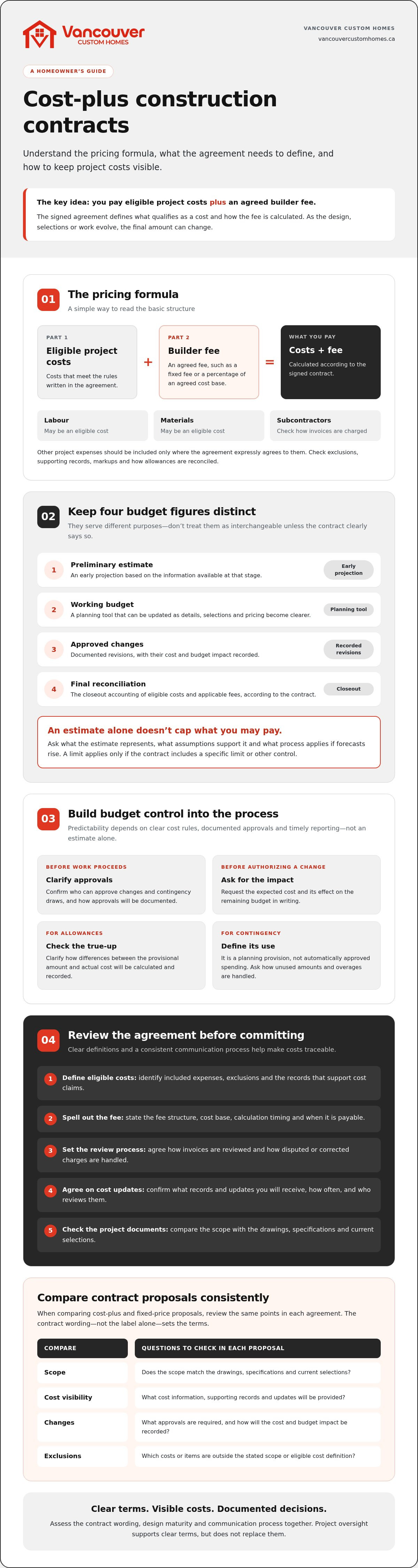
If you’re asking what is a cost-plus construction contract, the basic formula is eligible project costs plus an agreed builder fee. The homeowner pays costs that meet the agreement’s rules, then pays the fee according to the structure set out in the contract.
A cost-plus construction contract requires the homeowner to pay defined, eligible project costs plus a builder fee. The signed agreement determines what qualifies and how payment is calculated.
That definition is a starting point, not a universal set of terms. As the Cost-plus contract overview explains, cost-plus agreements can take different forms. For a homeowner, the practical questions are what the specific agreement means by “cost” and how the builder’s fee is applied.
A preliminary estimate or working budget can guide decisions, but it isn’t automatically a guaranteed final price or spending cap. If eligible costs change, the amount payable may change too, unless the contract includes a specific limit or other control. Check what the budget represents and what process applies if forecasts rise.
What does ‘cost’ include in a cost-plus contract?
The written agreement should define eligible costs. These may include labour, materials and subcontractor charges, along with other project expenses expressly agreed by the parties. Don’t assume every expense connected to the build is automatically reimbursable. Review the exclusions and ask what records, such as invoices or receipts, will support cost claims.
Check how the contract treats markups and allowances when actual selections differ. For example, clarify whether a subcontractor’s invoice is charged at its invoiced amount or includes an additional markup, and whether an allowance is reconciled against the final purchase cost.
How is the builder’s fee added?
Possible fee structures include a fixed fee or a percentage of an agreed cost base. These are general contract models, not terms to assume for any particular builder. A percentage fee could apply to different categories of costs, so identify exactly what’s included and whether changes to the work affect the calculation.
The signed agreement should state when the fee is calculated and when it’s payable, such as alongside progress claims or at another agreed point. Confirm how invoices are reviewed, how disputed or corrected charges are handled, and whether the fee applies to allowances or subcontractor markups. Clear wording helps you trace the calculation from supporting records to the amount due.
How Cost-Plus Construction Pricing, Estimates, and Budget Controls Fit Together
A cost-plus project can involve several budget figures. Keep the preliminary estimate, working budget, approved changes and final reconciled costs separate. Each serves a different purpose, and none should be treated as interchangeable unless the agreement clearly says so.
- Preliminary estimate: An early projection based on the information available at that stage.
- Working budget: A planning tool that can be updated as details, selections and pricing become clearer.
- Approved changes: Documented revisions to the work, with their cost and budget impact recorded.
- Final reconciliation: The accounting of eligible costs and applicable fees at closeout, according to the contract.
Budget predictability in a cost-plus build depends on clear cost rules, documented approvals and timely reporting, not on an estimate alone. Ask what assumptions support the estimate, how often the working budget will be updated and what happens if projected costs exceed it. Before authorizing a change, request its expected cost and effect on the remaining budget in writing.
What role do allowances and contingency play?
An allowance is a provisional amount for a specified selection or piece of work, subject to the contract’s terms. If the actual cost differs, ask how the difference will be calculated and documented. Contingency is a planning provision for uncertain or unforeseen items, not automatically approved spending. Clarify who can authorize contingency draws, how unused amounts are treated and how overages are reported before work proceeds.
What cost records and updates should owners expect?
Agree on the records and review process before construction starts. Ask whether updates will include itemized invoices, subcontractor records, approved changes and a current cost-to-complete view. Confirm who reviews the information, how often you’ll receive it and whom to contact about an unclear item. A regular reporting schedule can surface variances while there’s still time to discuss options.
Ask whether the project-management process gives you access to progress and cost updates, and what information it includes. A portal can support project visibility, but it doesn’t replace the contract’s approval and reporting terms. Vancouver Custom Homes provides a client project-management portal for progress and milestone visibility. Ask what cost information, if any, is available through the process. For a broader custom-home planning conversation, explore custom home construction in Vancouver.
One jurisdictional caution: the linked U.S. federal law on cost-plus contracts concerns U.S. government contracting. It isn’t guidance for a private residential build in British Columbia, so don’t use it to interpret a BC agreement.
Cost-Plus vs. Fixed-Price Contracts: Which Fits Your Home Project?
If your search began with “what is a cost-plus construction contract,” the next question is how that pricing model compares with a fixed-price agreement. The main difference is how the contract sets the amount you pay: cost-plus ties payment to eligible costs and a fee, while fixed-price sets a price for a defined scope. Neither structure is automatically cheaper or better. The fit depends on how settled the design is and what the contract says about costs and changes.
| Consideration | Cost-plus | Fixed-price |
|---|---|---|
| Pricing basis | Eligible project costs plus the agreed fee. | An agreed price for the stated scope of work. |
| Scope definition | May accommodate details that are still being refined, subject to the agreement. | Typically relies on a sufficiently defined scope, drawings and specifications. |
| Visibility | Cost records and regular updates help explain charges and changing projections. | The contract price gives a defined reference point, but inclusions and assumptions still need review. |
| Changes | Changes can affect eligible costs and the fee, as specified in the contract. | Changes may adjust the price through the contract’s change process. |
Concerned that cost-plus means unlimited, uncontrolled spending? It can expose an owner to rising costs, so review that risk directly. Look for clear limits on eligible costs, written approval steps, dependable cost reporting and an agreed process for addressing budget variances. Oversight doesn’t remove financial risk, but it can help you understand charges and make informed decisions as work progresses.
When might cost-plus be a reasonable structure?
Cost-plus may be worth considering if selections, specifications or parts of the scope are still being refined. That flexibility is useful only if the agreement also explains how costs are reported and when owner approval is required. Developing the design can bring key decisions into focus before construction commitments are finalized, giving you a firmer basis for budget discussions as the scope takes shape.
When might a fixed price feel more suitable?
A fixed-price structure may suit owners who prioritize a defined price and have sufficiently settled the design, specifications and selections. But certainty depends on what’s included, what’s excluded, which assumptions underpin the price and how changes are handled. Later decisions, scope revisions or items outside the agreed work may still affect the total. Compare the written scope with the project documents before treating the price as a reliable basis for planning.
Use scope maturity as a practical decision test. If important design choices remain open, ask how each contract handles them. If the project is well defined, examine which terms protect the agreed price and which allow adjustments. Compare complete contract terms, not just the headline pricing model.
How to Review a Cost-Plus Contract Before Building in Metro Vancouver
Before signing, review the agreement alongside the documents that describe the home. Comparing the proposal with your expectations and project documents can help reveal gaps. For broader project and builder context, see this custom home construction guide.
- Scope: Compare the written scope with the current drawings, specifications and selections. List missing details, unclear responsibilities or items described differently across documents.
- Eligible costs: Check which costs can be charged to the project, what’s excluded and what supporting records you’ll receive.
- Fee: Confirm how the fee is calculated, which cost base it applies to and when it’s payable.
- Approvals: Identify who can authorize purchases, substitutions and scope changes, and whether written approval is required before work proceeds.
- Reporting and closeout: Set expectations for cost updates, questions, incomplete work and the final account reconciliation.
Questions to ask about fees, approvals, and changes
Ask directly: Which expenses are reimbursable, and which are excluded? Can any costs carry a markup? Who may approve a substitution or change in scope, and how will its cost be documented? Find out how the contract handles disputed charges, incomplete work and final reconciliation. If an answer matters to your budget, record it in the agreement or a signed amendment instead of relying on an informal discussion.
Before signing, have a qualified British Columbia lawyer review the legal terms and advise whether relevant provincial requirements, including construction lien legislation, apply to your project. Ask a qualified Canadian tax professional to confirm current tax treatment for your specific arrangement. Don’t rely on general online explanations for legal or tax conclusions.
How design coordination can reduce uncertainty
More fully developed plans and selections can make the intended scope easier to identify before construction decisions are finalized. That gives you a clearer basis for discussing what’s included, what remains undecided and how later choices will be handled. It doesn’t prevent overruns or guarantee a particular price, but it can help expose assumptions early. For more on aligning design intent with build planning, read about custom home design in Vancouver.
For a custom home project in Metro Vancouver, you can discuss your custom home plans and ask how design coordination and project visibility fit into the process. Confirm any available contract structure directly; cost-plus terms aren’t assumed.
Choosing a Builder and Building Process That Keep Costs Visible
A suitable contract is only one part of a well-managed build. Consider the contract wording, how complete the project scope is, what cost information you’ll receive and how the builder communicates. Together, these factors help you assess whether the process gives you a clear view of decisions and their budget implications.
Project oversight can support organized communication, but it can’t replace clear contract terms. Ask how you’ll receive progress updates, cost information and milestone records, and who will answer budget questions or confirm written approvals. Vancouver Custom Homes provides a dedicated project-management portal for progress and milestone visibility. Ask what information is available through the portal and how it fits with the reporting and approval process in your agreement. For more context, read about home builder client portal benefits.
What to look for in a transparent construction process
Look for clear answers about who communicates changes, how decisions are recorded and where project information is shared. If you’re still evaluating what is a cost-plus construction contract, make sure the proposed process explains how cost questions and approvals will work under the written terms. A portal may help you follow progress, but don’t assume it contains invoices or cost reports unless that’s confirmed.
Next steps for a custom home, laneway home, or multiplex
Prepare a short project brief before an initial discussion. Include your goals, available site information, any existing drawings and design decisions that are still open. This gives a builder a clearer starting point for discussing scope, design development and the information needed for a useful budget conversation.
Ask the builder to explain which contract structures are available for your project and how each would handle cost reporting, changes and approvals. Don’t assume cost-plus is offered. If you’re comparing options, request the terms in writing and review them alongside the project documents.
If you’re planning a residential build in Metro Vancouver, discuss your residential building project with Vancouver Custom Homes as a considered next step. You can explore custom home construction, a laneway home or a multiplex, and clarify how design decisions and project visibility fit your plans.
Make Your Home-Building Decision with Clarity
Understanding what is a cost-plus construction contract starts with looking beyond the label. The written agreement should define eligible costs, the builder’s fee, approval steps and reporting expectations. An estimate isn’t automatically a price cap, so compare the contract’s budget controls with your comfort level and the maturity of your design.
Cost-plus may leave room for evolving plans, while a fixed-price agreement can provide a defined price for a clearly documented scope. Neither removes the need to review exclusions, assumptions and change terms. Match the contract structure to your project, then check that the drawings, specifications and selections support a shared understanding of the work.
Vancouver Custom Homes builds custom homes, laneway homes and multiplexes across Metro Vancouver, with in-house design, 3D VR walkthroughs and a dedicated project-management portal for progress and milestone visibility. Ask which contract structures are available for your project and how communication and cost information are handled.
Discuss your custom residential project with Vancouver Custom Homes to explore your plans and the next steps for your build.
Frequently Asked Questions
What is a cost-plus construction contract?
A cost-plus construction contract makes the homeowner responsible for eligible project costs plus an agreed builder fee. The signed agreement defines which costs qualify, how the fee is calculated and what records support payment. Labour, materials and subcontractor charges may be included if the contract says so. An estimate can help with planning, but it isn’t automatically a guaranteed final price or spending limit.
Is a cost-plus contract more expensive than a fixed-price contract?
Not necessarily. The final cost depends on the project, contract terms, work completed and how changes are managed. Cost-plus pricing reflects eligible actual costs and the agreed fee, while fixed-price pricing applies to a defined scope and may be affected by exclusions or changes. Compare proposals by checking what’s included, how fees work and how each agreement handles revisions rather than assuming one structure will cost less.
How is the builder’s fee calculated in a cost-plus contract?
The fee may be a fixed amount or a percentage of a defined cost base. The contract should state which costs the fee applies to, when it’s calculated and when payment is due. Check whether a percentage applies to subcontractor charges or other project expenses, and whether approved changes affect the fee. Review the signed wording and ask for unclear calculations in writing rather than relying on the contract label or a verbal explanation.
Does a cost-plus contract have a maximum price?
Not automatically. A cost-plus agreement may include a maximum price, cap or other spending limit, but it must be clearly set out in the signed contract. Check what the limit covers, which costs or changes may be excluded, and what happens if the forecast approaches it. A preliminary estimate or working budget isn’t the same as a contractual cap. If a maximum price matters to your plans, get qualified advice on the wording before signing.
How can I control costs under a cost-plus construction contract?
Start by defining eligible costs, exclusions, fee calculations and written approval requirements. Ask for itemized invoices, subcontractor records and regular budget updates that include a current cost-to-complete view. Review changes before authorizing them, including their projected budget impact. Clarify how allowances, contingency, overages and final reconciliation are handled. These practices can improve visibility and decision-making, but they don’t guarantee a particular final cost.
Is a cost-plus contract suitable for a custom home in Vancouver?
It may suit a project where design details or selections are still evolving, provided the agreement sets clear approval and reporting rules. A more fully defined scope may make fixed-price proposals easier to compare. Vancouver Custom Homes builds custom homes, laneway homes and multiplexes, with in-house design, 3D VR walkthroughs and a project-management portal for progress and milestone visibility. For projects in Vancouver, Burnaby, West Vancouver, North Vancouver, Richmond, New Westminster, Coquitlam, Port Moody, Port Coquitlam, Maple Ridge, Pitt Meadows, Langley, Surrey or Delta, ask which contract structures are available. Cost-plus availability isn’t confirmed.


