

What happens when your builder’s invoice is due, but your lender’s inspection or draw approval isn’t complete? Searches for “construction draw schedule custom home BC” often begin with this concern. A builder’s contract payment schedule and a lender’s draw schedule are connected, but they don’t always follow the same timeline.
Before construction begins, get clear answers about when payments are due, what counts as a completed milestone, and which inspections or documents may be required. Understanding these steps can help you plan cash flow and reduce the risk of avoidable delays or disputes.
This guide explains how construction draws work, how lender approvals relate to contract payments, and what to clarify with your builder and lender before signing. It also covers milestone definitions, inspection timing, supporting documents, and design decisions that can affect project progress. Clear milestones and accessible updates make a complex build easier to follow.
Key Takeaways
- A construction draw schedule custom home BC project depends on both lender requirements and the builder’s contract. Review the two timelines before construction begins.
- Ask how each milestone will be assessed, what evidence is needed, and who is responsible for submitting or approving it.
- Confirm the lender’s review steps so you can plan for the possible gap between an invoice and the release of funds.
- Check that milestone wording reflects the agreed scope, and confirm how local project requirements may affect inspections and approvals.
- Coordinate design decisions, project updates, and draw discussions early so progress is easier to track and questions are easier to raise.
What Is a Construction Draw Schedule for a Custom Home in BC?
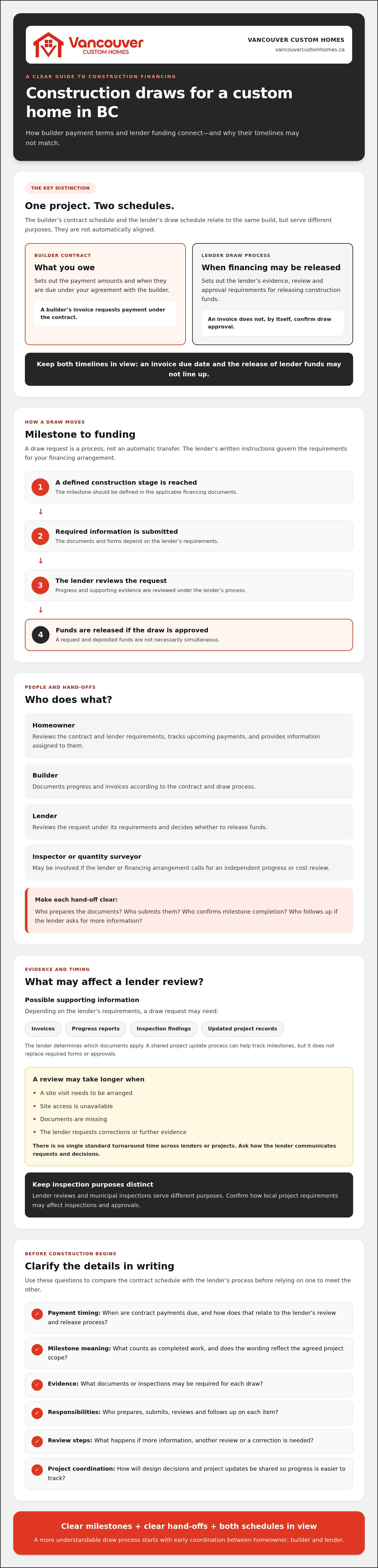
Before construction starts, you need to know what payments are expected, when they’re due, and what completed work supports each one. A construction draw schedule custom home BC project uses is a plan for releasing construction financing in stages, subject to the lender’s review and approval process. It is not automatically the same as the builder’s payment schedule in your construction contract.
The two schedules relate to the same project, but serve different purposes. Your contract sets out what you owe the builder and when. The lender’s draw process explains when financing may be released, what evidence is required, and how progress is reviewed. The sequence and requirements can vary with the lender, contract terms, project scope, and site conditions. Confirm the details in writing before relying on one schedule to meet the other.
How a construction draw differs from a regular mortgage payment
A regular mortgage generally involves payments after financing is advanced for a completed property. Construction financing may instead be released in stages as work progresses. The lender’s instructions determine the documentation and review steps for each request. Depending on the arrangement, a progress review may involve an inspection or other verification. Lenders do not all use the same number of draws, timing, or approval method.
This staged approach reflects broader project financing principles, where funding is connected to project progress and defined agreements. Treat that as background only. Your lender’s written instructions and your signed contract govern your specific build.
Who is involved in a custom-home draw
You, the homeowner, review the contract and lender requirements, track upcoming payments, and provide any information assigned to you. The builder documents progress and invoices according to the contract and draw process. The lender reviews the request under its own requirements and decides whether to release funds. An inspector or quantity surveyor may also be involved if the lender or financing arrangement calls for an independent progress or cost review.
A builder’s invoice requests payment under the contract. It does not, by itself, confirm that the lender has approved a draw. That distinction matters if invoice due dates and lender processing don’t line up. Ask who submits each document, who confirms milestone completion, and what happens if more information or another review is needed. Clear roles make it easier to identify timing gaps before they become cash-flow surprises.
How Custom-Home Draws Move from Milestone to Funding
A draw request is a process, not an automatic transfer. First, the work reaches a milestone defined in the financing documents. Next, the required information is submitted. The lender reviews the request and supporting evidence, then releases funds if the draw is approved. The lender’s written instructions govern the forms, inspections, and processing steps for your specific arrangement.
Lender-dependent sequence: Once a defined construction stage is reached, the required documents are submitted and progress is reviewed. Funds are released only if the lender approves the draw.
Keep the builder’s contract schedule in view alongside the lender’s process. A builder may issue an invoice under the contract, but the invoice does not confirm lender approval. A draw request and deposited funds are not necessarily simultaneous. Clarify how submission, review, and payment timing fit together before relying on financing for a contract payment.
What evidence may support a draw request?
Depending on the lender’s requirements, a request may need invoices, progress reports, inspection findings, or updated project records. The lender determines which documents apply to its financing arrangement. Confirm who prepares each item, who submits it, and who follows up if the lender asks for clarification or more information.
Make the handoffs clear before work begins. Ask whether the builder supplies progress records directly or whether you’re expected to coordinate their delivery. A shared project update process can help you track milestones and prepare questions, but it does not replace the lender’s required forms or approvals.
Why inspections and processing time affect the schedule
A review may take longer if a site visit needs to be arranged, access isn’t available, documents are missing, or the lender requests corrections or further evidence. Ask your lender what review steps to expect and how it communicates requests or decisions. Don’t assume there is one standard turnaround time across lenders or projects.
Lender reviews and municipal inspections serve different purposes. A lender may require a progress assessment to decide whether to release financing. Municipal inspections relate to the local permitting and building process. One should not be assumed to replace the other. Requirements can depend on the project and municipality, so confirm the applicable steps with the appropriate parties.
For a Canadian example of construction financing with defined program requirements, see the CMHC Apartment Construction Loan Program. It concerns apartment construction, not a standard custom-home loan, so your lender’s written terms remain the guide for your build.
Clear milestone updates can help you prepare for draw discussions. Project coordination is one consideration when assessing a builder’s process, including custom home project coordination.
Builder Payment Schedule vs. Lender Draw Schedule: What Is the Difference?
A builder’s invoice does not automatically mean the lender has approved a draw. The builder payment schedule describes when payment is due under your construction contract. The lender draw schedule describes how and when financing may be released, subject to the lender’s requirements. The schedules are related, but they are not interchangeable.
Compare them before signing. If a contract payment date arrives before a lender draw is reviewed and released, you’ll need to understand how that timing gap will be handled. The details of a construction draw schedule custom home BC project depend on its contract and financing arrangement, not on a universal percentage or payment interval.
| What to compare | Builder payment schedule | Lender draw schedule |
|---|---|---|
| Purpose | Sets out payments owed to the builder under the contract. | Sets out the process for requesting and releasing construction financing. |
| Decision-maker | Payment obligations are established by the homeowner and builder in their contract. | The lender assesses draw requests under its financing requirements. |
| Evidence | May include an invoice or other documentation specified in the contract. | May require forms, progress evidence, or inspections specified by the lender. |
| Timing | Due dates are set out in the contract. | Review and release timing depends on the lender’s process. |
| Governing documents | The signed construction contract and related written changes. | The lender’s financing documents and written draw instructions. |
What should the construction contract say about payments?
Read each payment milestone closely. Check how the contract defines completion, what an invoice must include, when payment is due, and how changes to the work affect payment terms. Ask how incomplete, delayed, or disputed work will be recorded and addressed under the agreement. If a milestone is unclear, request clarification in writing before signing. For contract interpretation or negotiation, consider independent legal review.
What should you confirm with the construction lender?
Ask what each draw application requires, whether inspections or other progress reviews apply, who arranges them, and what conditions must be met before funds are released. Confirm the expected steps and timing, then compare them with the contract’s payment dates and your cash-flow plan. Don’t assume an invoice and lender approval will happen at the same time.
Early coordination helps keep project scope, contract milestones, and financing requirements visible together. The broader planning process for custom home construction in Vancouver is also relevant when discussing how the project will be organized.
How to Review a Custom-Home Draw Schedule in BC
A draw schedule is easier to assess when each milestone can be checked against observable work, supporting evidence, and a clear approval path. For a construction draw schedule custom home BC project, don’t rely on broad labels alone. Ask your builder and lender to explain what each stage means for your project, and keep their written requirements with the contract.
Use this checklist as a starting point:
- Milestone wording: What visible work must be complete before a milestone is considered reached?
- Completion evidence: What records, reports, invoices, or inspection findings are needed to support the draw?
- Approval responsibilities: Who confirms progress, prepares the documents, submits the request, and follows up?
- Processing steps: What reviews or inspections may occur, and how will you be told about missing information or a change in timing?
- Exceptions and updates: How will incomplete items, approved changes, delays, or documentation gaps be recorded and communicated?
Clear answers help you understand what happens if work is partly complete or a review raises questions. They also give you a practical way to track progress without assuming that an invoice, site visit, or municipal inspection automatically satisfies the lender’s requirements.
Questions to ask before approving the schedule
Ask who decides that each milestone is complete and what evidence supports that decision. Find out how changes to the scope are documented and whether they affect a milestone or its supporting records. Agree on how you’ll receive updates if an inspection, document request, or funding step changes. A consistent update channel, such as a project management portal where available, can help keep project information accessible.
Requirements can differ between Vancouver and other Metro Vancouver municipalities, as well as between projects. Confirm which local inspections or approvals apply to your site with the relevant project professionals and municipality. Don’t assume that one location’s process automatically applies elsewhere.
BC holdback and lien questions to verify
Statutory holdback obligations may be relevant to construction payments in BC. The details can depend on the circumstances, so don’t rely on a general summary or assume a particular amount or deadline applies to your project. Ask an independent BC construction lawyer to verify current requirements under the Builders Lien Act and explain how they relate to the contract and payment process. This article provides general information, not legal, lending, tax, or project-specific financial advice.
For a custom-home project, discuss how scope, milestones, and progress updates will be coordinated from the outset. Custom home construction planning is one part of those early project discussions.
A More Predictable Draw Process Starts with Clear Project Coordination
A clearer draw process starts before the first funding request. The project scope, contract milestones, lender requirements, and communication plan need to work together. If a milestone is described differently in the contract and lender instructions, ask how the difference will be handled before construction begins. That way, you can track what’s complete, what evidence may be needed, and who to contact with questions.
How project visibility supports milestone tracking
Regular project updates help you follow progress against the agreed scope and spot upcoming decisions. They also give you a chance to ask questions before a draw request is prepared, rather than trying to piece together progress after an invoice arrives. Vancouver Custom Homes provides project management portal access for project updates and milestones. The portal helps keep project information accessible, but it does not submit lender draw requests, determine approval, or guarantee when funds will be released.
Before relying on any update channel, clarify what information you can access and how updates relate to the contract milestones. A progress update can support your understanding of the build, while the lender’s written requirements still determine its review process.
What to discuss with a builder before construction begins
Use early planning conversations to connect design decisions with the construction scope and project milestones. Ask how design changes will be documented, how progress updates will be shared, and who will explain a milestone if its completion is unclear. For a design-led build, review the custom home design process alongside your financing discussions so the intended scope and decision points are clear before work progresses.
For a construction draw schedule custom home BC project, coordination does not replace the lender’s approval process. It helps you understand how the pieces fit and where to direct questions. Before moving ahead, make sure you know which documents govern contract payments, which instructions govern lender draws, and how you’ll receive updates if an expected step changes.
Vancouver Custom Homes builds custom homes, laneway homes, and multiplex residential projects in Metro Vancouver, with custom design and project management options. Information about custom-home project planning with Vancouver Custom Homes can help you understand the company’s residential construction and design services.
Plan Your Build with Clear Milestones and Communication
A well-coordinated construction draw schedule custom home BC project brings the contract payment terms and lender’s funding process into view together. Before construction begins, make sure milestone wording is clear, ask what evidence and approvals each draw requires, and confirm how updates will reach you if a step changes.
That preparation helps you follow progress and raise questions early, without assuming a builder invoice means lender funds are approved or available. Clear project scope and consistent communication give you a steadier foundation for the decisions ahead.
Vancouver Custom Homes provides project management portal access for progress updates, along with custom design and 3D VR walkthroughs to review a home before construction. These services can make project scope and design decisions easier to discuss before work begins.
With the right questions asked early, you can move into construction with a clearer understanding of the process and greater confidence in the steps ahead.
Frequently Asked Questions
What is a construction draw schedule for a custom home?
A construction draw schedule sets out how construction financing may be released in stages as a home build progresses. Each draw is subject to the lender’s process and may require specified documents or a progress review. It’s separate from the builder’s contract payment schedule, which describes payments owed under the contract. Review both schedules together to identify differences in milestones, evidence requirements, and timing before construction begins.
How does a construction draw work in BC?
In BC, a construction draw generally involves work reaching a defined stage, required information being submitted, and the lender reviewing the request before deciding whether to release funds. The lender’s written instructions set the applicable forms, inspections, and processing steps. Requirements may differ by lender, project, and location. For builds in Vancouver, Burnaby, West Vancouver, North Vancouver, Richmond, New Westminster, Coquitlam, Port Moody, Port Coquitlam, Maple Ridge, Pitt Meadows, Langley, Surrey, or Delta, confirm which local project requirements apply.
What milestones can trigger a construction draw?
Milestones are the stages specified in the financing arrangement, not a universal list that applies to every custom home. For example, a lender may define stages around completed portions of work, with evidence or an inspection required to verify progress. Ask what observable work counts as complete, who confirms it, and what records are needed. Don’t assume a builder’s invoice or a municipal inspection automatically satisfies the lender’s draw requirements.
What is the difference between a builder payment schedule and a lender draw schedule?
The builder payment schedule sets out when payments are due under your construction contract. The lender draw schedule describes the lender’s process for reviewing requests and releasing financing. A builder’s invoice doesn’t automatically mean the lender has approved a draw, and lender approval doesn’t necessarily align with the contract’s payment due date. Compare milestone definitions, documents, responsibilities, and timing in both sets of written terms before signing.
How long does a construction draw approval take?
There isn’t one approval timeline that applies to every lender or project. Processing depends on the lender’s written procedure and may be affected by inspection scheduling, site access, missing documents, or requests for clarification. Ask your lender what steps apply, who arranges any review, and how you’ll be notified if more information is needed. Include the expected process in your cash-flow planning, but don’t treat an estimate as a guaranteed release date.
Can a lender refuse or delay a construction draw?
A lender may withhold approval or delay release if a request doesn’t meet the requirements of its financing arrangement, such as when required evidence is missing or further review is needed. The reasons and available next steps depend on the lender’s written terms. Ask how it communicates a declined or delayed request, what information could resolve it, and who should follow up. Keep the builder’s contract payment obligations in view as you clarify the timing.
Does the BC Builders Lien Act affect custom-home construction payments?
Statutory holdback obligations under BC’s Builders Lien Act may be relevant to construction payments, but how the Act applies depends on the circumstances. Don’t assume a specific amount, deadline, or payment treatment based on general information. Ask a BC construction lawyer to verify the current requirements and explain how they relate to your contract and payment process. This FAQ is general information, not legal advice.
Planning a custom home, laneway home, or multiplex in Metro Vancouver? Discuss your residential project with Vancouver Custom Homes and ask how custom design, 3D VR walkthroughs, and project updates can fit into your build.


