

Builder's risk insurance is not a routine administrative checkbox; it is the financial backbone of your entire project. If you assume a standard homeowner policy protects your property once excavation begins, a sudden storm or site fire can trigger catastrophic financial loss. Having builder's risk insurance BC explained clearly removes the dangerous ambiguity between course of construction coverage and standard residential insurance. Embarking on a custom home or multiplex build involves significant capital, and the anxiety of wondering who is legally liable if an incident occurs is completely understandable.
You deserve total clarity on policy scope, mandatory riders, and legal accountability before site work starts. In this guide, we break down what this coverage protects, how policies respond to local British Columbia climate risks, and how to evaluate whether you or your builder should hold the paperwork. Ahead, you will find a direct framework to secure your residential investment with complete confidence.
Key Takeaways
- Standard residential insurance strictly excludes active construction sites, making a dedicated course of construction policy vital to prevent catastrophic financial loss.
- With builder's risk insurance BC explained, you can pinpoint essential protections against fire, theft, and site damage while identifying critical riders required for regional climate risks.
- Deciding whether the property owner or the general contractor holds the policy determines legal control over claims administration, adjustments, and payout disbursements.
- Accurate replacement valuations must factor in local material shifts and municipal inspection schedules to avoid sudden coverage shortfalls mid-project.
- Financial insurance works best when paired with proactive jobsite risk management, where unified design-build oversight prevents costly hazards before they emerge.
What Is Builder's Risk Insurance in British Columbia?
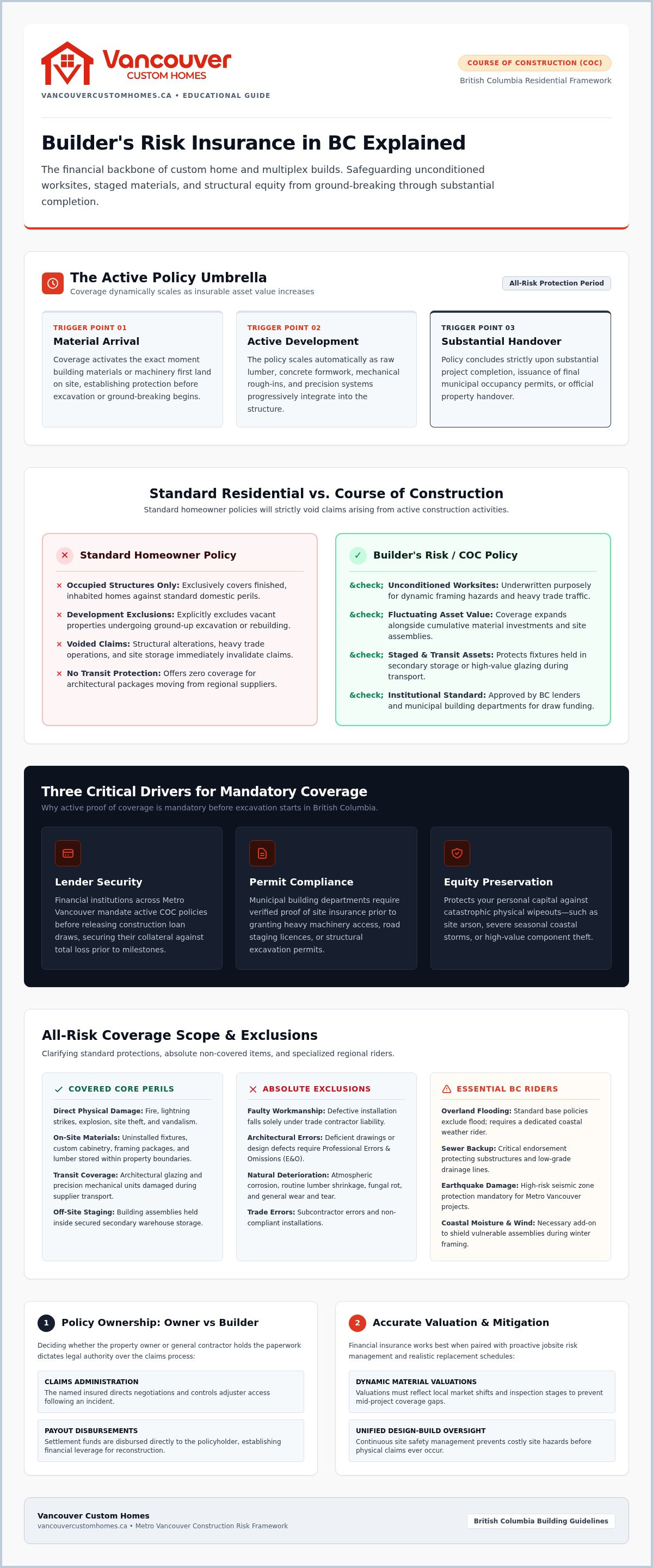
Builder's risk insurance, commonly referred to as Course of Construction (COC) coverage, protects physical structures while they are under active development. Whether you are breaking ground on an infill multiplex or building a custom home, this dedicated policy safeguards the unconditioned jobsite. It covers materials, fixtures, machinery, and structural assemblies directly tied to the build. Coverage activates the precise moment building materials arrive on site and remains active until substantial completion, final occupancy, or project handover occurs.
Understanding builder's risk insurance BC explained in practical terms means recognizing what it protects at each construction phase. It acts as an evolving umbrella. As raw lumber, concrete formwork, and precision mechanical systems integrate into the structure, the policy scales to protect the project's increasing insurable value.
Course of Construction vs Standard Homeowner Insurance
Standard homeowner policies protect existing, occupied buildings against routine domestic hazards and personal property claims. They explicitly exclude vacant structures undergoing ground-up development or major structural alterations. If excavation begins and structural framing starts under an everyday residential policy, the carrier will void claims related to site losses. Course of construction underwriting specifically accounts for the dynamic hazards of active, unconditioned worksites with fluctuating values and heavy trade traffic.
Why Municipalities and Lenders in BC Require It
Financial institutions across Metro Vancouver mandate active COC policies before releasing construction loan draws. Lenders will not fund early milestones, such as foundation excavation or framing, without proof that their collateral is fully protected against total loss. Similarly, several municipal building departments across BC require verified coverage prior to issuing specific street use permits or staging licences. Having comprehensive builder's risk insurance BC explained and secured early safeguards your accumulated equity, ensuring an unforeseen site incident cannot stall your project before reaching lock-up stage.
- Lender security: Guarantees capital recovery for institutional financiers throughout each construction draw.
- Permit compliance: Satisfies municipal liability and site-staging requirements before heavy machinery arrives.
- Equity preservation: Shields your personal financial investment against site fires, severe weather, or major material loss.
What Does Builder's Risk Insurance Cover and Exclude in BC?
Builder's risk insurance functions primarily as an all-risk policy. It safeguards your project against direct, external physical losses unless an item is explicitly excluded in the wording. Having builder's risk insurance BC explained in depth reveals that while core perils like fire, lightning, explosion, site theft, and vandalism are standard, coverage nuances shift dramatically once regional weather comes into play. Coastal British Columbia experiences heavy seasonal rainfall and intense windstorms, making comprehensive moisture and wind protection essential during the vulnerable framing phase.
Direct Physical Damage and Site Perils Covered
The policy covers installed structural elements, custom framing packages, prefabricated assemblies, and mechanical rough-ins against sudden damage. Protection extends beyond physical works on site to include materials in transit or staged at off-site facilities before installation:
- On-site materials: Uninstalled fixtures, custom cabinetry, and structural lumber stored within property boundaries.
- Transit coverage: High-value architectural glazing and mechanical systems damaged during transport from regional suppliers.
- Off-site storage: Materials held temporarily in secured secondary warehouses awaiting installation.
Critical Exclusions Every Homeowner Must Recognize
Policies do not cover everything. Course of construction insurance never covers faulty workmanship, design flaws from deficient architectural drawings, or trade contractor errors; those liabilities fall under trade insurance or professional errors and omissions coverage. Standard wear, tear, atmospheric corrosion, fungal rot, and routine lumber shrinkage are also barred. Crucially, overland flooding, sewer backup, and earthquake damage require specialized endorsement riders rather than being included in standard baseline terms.
Hard Costs vs Soft Costs Protection
Hard costs represent the tangible components of your structure: concrete footings, structural timber, plumbing stacks, and labour required to rebuild physical damage. Soft costs involve the consequential financial damages stemming from a project delay. Indirect expenses such as construction financing interest, additional municipal permit extensions, architectural re-drafting fees, and legal charges can quickly destabilize your budget after a major site loss.
Securing a comprehensive policy with adequate soft-cost extensions is crucial for complex single-family or multi-unit residential builds. Partnering with a dedicated builder who values open communication, such as the team at Vancouver Custom Homes, ensures that all site logistics, insurance riders, and structural schedules align seamlessly to eliminate dangerous coverage gaps before framing begins.
Who Should Purchase the Policy: Homeowner or General Contractor?
Either the property owner or the general contractor can purchase the builder's risk policy. This choice directly determines who controls claims administration, policy adjustments, and settlement disbursements if a loss occurs. When you have builder's risk insurance BC explained through a legal and practical lens, the decision comes down to project oversight and financial alignment. Clear contracts eliminate guesswork by explicitly assigning premium payments, deductible obligations, and claims handling duties before any ground breaks.
Owner-Purchased vs Contractor-Purchased Policies
When you purchase the policy as the property owner, you maintain ultimate authority over the coverage. Insurance payouts flow straight to you and your lender, ensuring reconstruction funds stay under your direct financial supervision. In contrast, contractor-purchased policies streamline administrative overhead. An experienced lead builder already manages project documentation, site engineering reports, and ongoing policy extensions, handling complex claim submissions directly so you don't carry the paperwork burden.
Course of Construction vs Commercial General Liability (CGL)
Homeowners often confuse physical property protection with liability coverage. Course of construction insurance covers direct damage to your physical structure, framing, and uninstalled site materials. Commercial General Liability (CGL), on the other hand, protects against third-party bodily injury and property damage caused to neighbouring parcels. A professional builder always maintains robust CGL coverage and active WorkSafeBC registration for all site personnel alongside dedicated property insurance:
- Course of Construction: First-party property protection for physical works, framing, and on-site building assets.
- Commercial General Liability: Third-party coverage for property damage or physical injuries affecting adjacent properties or visitors.
- WorkSafeBC coverage: Mandatory provincial compensation insurance protecting trades against workplace injuries.
The Role of Additional Insured and Loss Payee Designations
Regardless of who secures the master policy, naming all key stakeholders prevents costly coverage disputes. Designating your construction lender as the primary loss payee satisfies institutional mortgage covenants, allowing smooth draw approvals. Naming the homeowner, general contractor, and major subcontractors as additional insured parties ensures mutual legal protection. Crucially, policies must include a waiver of subrogation clause; this prevents the insurer from suing any project participant to recover claims costs caused by accidental site incidents. Complete alignment across all designations ensures that builder's risk insurance BC explained in contract terms delivers absolute peace of mind during your build.
Essential Policy Considerations for Metro Vancouver Home Builds
Navigating coastal construction risks requires local precision. Metro Vancouver's unique blend of wet maritime weather, seismic conditions, and dense urban lots creates distinct insurance demands that generic online guides overlook. To ensure complete protection, evaluate these five critical operational steps when setting up your coverage:
- Step 1: Calculate full replacement value: Include post-incident demolition expenses, environmental site clearing, and material price escalation buffers.
- Step 2: Calibrate project duration: Account for municipal inspection lead times and trade staging windows to avoid sudden mid-project expiries.
- Step 3: Secure geographic endorsements: Add explicit coverage for regional earthquake tremors, sewer backup, and overland stormwater pooling.
- Step 4: Implement site security protocols: Meet strict underwriter requirements for perimeter fencing and monitored cameras to prevent theft claim denials.
- Step 5: Review occupancy triggers: Ensure coverage stays intact through final cosmetic punch lists and does not cancel the day your occupancy permit arrives.
Calculating Accurate Replacement Values and Limits
Setting your policy limit strictly equal to the initial construction budget is a dangerous mistake. If localized material costs climb or a major loss occurs midway through framing, debris removal and site re-clearing can rapidly consume hundreds of thousands of dollars before rebuilding even starts. Under-insuring a project activates restrictive co-insurance clauses. These penalties scale down insurance payouts during partial losses, leaving you out of pocket. Solid valuations factor in current Vancouver labour dynamics, structural lumber shifts, and concrete pricing.
Aligning Policy Terms with Lower Mainland Timelines
Standard builder's risk policies traditionally run on 6 to 12-month terms. Complex custom residences or multi-unit multiplexes often face municipal inspection bottlenecks and weather windows that extend construction schedules. Waiting until a policy expires to request an extension can lead to punitive underwriting fees or restricted terms. Review timelines early and coordinate with an experienced builder who maintains rigorous scheduling documentation.
Navigating Deductibles and Site Security Mandates
Underwriters heavily scrutinize Metro Vancouver worksites due to persistent risks of tooling and material theft. Most insurers mandate lockable perimeter fencing, locked storage containers, and motion-activated security cameras before honouring full copper, wire, or fixture theft claims. Water damage and earthquake deductibles also carry significantly higher percentage thresholds than baseline fire claims.
Protecting a major residential build requires relentless organization and complete transparency at every stage. You can streamline your project's compliance, secure your jobsite, and eliminate administrative friction by exploring the full-service approach at Vancouver Custom Homes.
How Professional Builders Mitigate Construction Risk
Insurance provides financial reimbursement when disaster strikes, but disciplined site management prevents catastrophic failures before they happen. An all-risk policy cannot replace lost construction months or the emotional toll of rebuilding charred framing. Leading residential builders view insurance as an ultimate safety net rather than a substitute for rigorous jobsite protocols. By integrating design oversight with field execution under one roof, elite teams catch structural conflicts early, adhere to strict safety codes, and run transparent worksites that keep insurers and homeowners fully protected.
Preventative Site Management and Quality Control
Effective risk mitigation starts with operational discipline on the ground. Daily trade check-ins enforce hot-work safety procedures, mandating fire-watch intervals after cutting or welding to eliminate the primary cause of residential framing fires. Coastal precipitation requires active protection; timely building envelope dry-ins and tarping schedules preserve structural framing assemblies throughout persistent Pacific Northwest atmospheric rivers. Clean jobsites also remove combustible waste and deter opportunistic vandalism before exterior lock-up.
Digital Documentation and Client Portal Oversight
Modern building requires real-time accountability. Access to a centralized project management portal provides clients and project leads with date-stamped photo logs capturing installations before walls are closed. This verifiable record eliminates dispute ambiguity with insurers or lenders during progress reviews:
- Subcontractor compliance tracking: Verifies that every trade carries active liability coverage and WorkSafeBC clearance before stepping foot on site.
- Inspection records: Creates an audit-ready timeline that accelerates municipal building approvals and lender draw releases.
- Real-time condition logs: Produces definitive evidence of site protection measures in the rare event of an external weather claim.
The Transition to 2-5-10 Home Warranty and Occupancy
Course of construction coverage terminates automatically the moment a municipal occupancy certificate is granted or personal belongings enter the home. Having builder's risk insurance BC explained from groundbreaking to handover helps you execute this transition smoothly. As your temporary builder's risk policy concludes, your permanent residential insurance and mandatory BC 2-5-10 Home Warranty coverage must activate immediately without a gap in coverage.
Navigating these handovers is seamless when your contractor prioritizes transparent governance from architectural concept to key delivery. Connect with the team at Vancouver Custom Homes to realize your single-family or multiplex project through an integrated, professional building process that safeguards your equity every day.
Secure Your Investment Before Ground Breaks
A successful residential project relies on proactive planning, not reactive damage control. Having builder's risk insurance BC explained from initial excavation through to final occupancy ensures your investment remains secure against regional coastal weather, site theft, and costly delays. When you pair proper policy riders with diligent site management, you replace construction anxiety with absolute financial clarity.
True peace of mind comes from partnering with a team that treats risk management as a foundational standard. Through an end-to-end design-build model, strict trade safety protocols, verified WorkSafeBC compliance, and transparent project management portal access, we eliminate chaotic handoffs and safeguard your equity at every turn. Ready to bring your architectural vision to life with total confidence? Plan your custom residential build with Vancouver Custom Homes and establish a solid, secure foundation for your project today.
Frequently Asked Questions
Is builder's risk insurance mandatory by law in British Columbia?
No provincial statute explicitly mandates builder's risk insurance by law, but practically speaking, you cannot build without it. Construction lenders across Vancouver and Burnaby require an active policy before releasing construction financing draws. Municipal building departments also mandate verified coverage before issuing specific street use or staging permits. Foregoing coverage leaves your accumulated project equity entirely exposed to site fires, severe weather, or structural collapse.
How much does builder's risk insurance cost in BC?
Policy premiums are calculated as a percentage of your total completed construction value rather than a flat fee. For residential builds in Metro Vancouver, rates vary based on project scale, structural materials, anticipated construction duration, and selected deductible thresholds. Wood-frame builds carry higher rate factors than non-combustible assemblies. Adding soft-cost riders, seismic endorsements, and overland flood coverage will also adjust the total premium structure.
Can I rely on my existing homeowner insurance while building a custom home?
No, standard homeowner insurance policies cannot protect a property undergoing ground-up residential construction. Residential insurers automatically void physical loss claims once excavation begins or structural framing is altered. Having builder's risk insurance BC explained highlights the need for specialized course of construction underwriting, which accounts for unconditioned jobsites, fluctuating on-site inventory, and constant trade movement across North Vancouver and Richmond properties.
What happens to the builder's risk policy when construction finishes?
The policy terminates automatically the moment a municipal occupancy permit is granted or personal belongings enter the property. Coverage ends because the risk profile shifts from an active jobsite to an occupied home. Homeowners must coordinate with their builder to ensure standard residential homeowner insurance and mandatory BC 2-5-10 home warranty protection take effect simultaneously on the day of handover.
Does builder's risk insurance cover subcontractor tool theft or injuries on site?
No, builder's risk policies do not cover individual trade tools or jobsite personal injuries. This insurance strictly protects the permanent structure and uninstalled building assets intended for the home. Trade contractors must carry separate inland marine insurance for their own tools and equipment. Workplace injuries fall under mandatory WorkSafeBC coverage and the general contractor's commercial general liability insurance.
What is the difference between soft costs and hard costs in a construction policy?
Hard costs cover physical building components, whereas soft costs cover indirect financial losses resulting from project delays. Hard costs replace concrete foundations, framing packages, roofing, and reconstruction labour after an insured peril. Soft costs reimburse continuous financing loan interest, municipal permit renewals, architectural re-drafting fees, and legal charges while repairs occur on custom residences or multiplexes in West Vancouver and Coquitlam.
How do atmospheric rivers and heavy rain affect construction insurance coverage in Vancouver?
Persistent rainfall and severe atmospheric rivers demand explicit overland water and sewer backup endorsements to ensure total claim protection. Standard policies often exclude exterior water pooling and subsurface runoff unless specific riders are attached. With builder's risk insurance BC explained, owners realize that underwriters also require active on-site mitigation, such as timely building envelope dry-ins and perimeter drainage, to honour water damage claims.


