

In 2026, building a laneway house in Vancouver isn't just a construction project; it's a high-stakes equity play that demands a lender-grade approach to construction financing for laneway homes to navigate a 4.45% prime rate environment. You've likely felt the tension of shifting interest rates and the confusion of choosing between a HELOC or a dedicated construction loan while fearing the cost overruns that plague unmanaged builds. It's a common anxiety, but it shouldn't stall your vision for a secondary suite.
This guide will help you master these financial complexities, providing a professional roadmap to secure funding and realize your property's full potential. You'll learn how to secure a low-friction loan and understand the exact ROI of your build in today's market. We'll also explore why finding a builder that banks trust is the most critical step in protecting your investment. From current 2026 market rates to the specific benefits of a design-build model, we'll provide the clarity you need to move from initial vision to a profitable, finished reality with total confidence.
Key Takeaways
- Compare the distinct advantages of HELOCs versus progress-draw mortgages to select the most cost-effective path for your equity position.
- Understand why a builder's track record and 2-5-10 Home Warranty insurance are non-negotiable requirements for securing construction financing for laneway homes.
- Identify hidden soft costs, including Vancouver's 2026 Development Cost Charges and permit fees, to prevent budget creep before you break ground.
- Master the wealth-building math by calculating rental cap rates and property value increases specific to the current Lower Mainland market.
- Learn how an integrated design-build model with transparent project management provides the financial security and predictability that lenders demand.
Understanding Laneway Home Financing in the 2026 Vancouver Market
Securing construction financing for laneway homes is fundamentally different from obtaining a standard renovation loan. While a kitchen remodel might enhance your lifestyle, a laneway house is a specialized residential investment that creates a separate, income-generating dwelling on your property. To understand the scale of this project, it helps to start with the basics of What is a Laneway House? and how it functions as a distinct asset class in the Lower Mainland. In the 2026 market, lenders view these builds as high-value equity additions rather than simple debt. This shift in perspective is driven by Vancouver's chronic housing shortage and the increasing demand for "missing middle" housing options.
Lender appetite has evolved alongside provincial mandates. With the BC government aggressively incentivizing density, banks now recognize that a well-executed laneway build significantly de-risks a mortgage. The appraisal process reflects this. Unlike a basement suite, a laneway house is appraised based on its potential to generate market-leading rental income and its contribution to the overall residual value of the land. This makes the initial financial roadmap essential for any homeowner looking to unlock their backyard's potential.
The Impact of New Vancouver Zoning on Appraisals
Recent multiplex and laneway zoning updates in Vancouver have fundamentally changed how land is valued. These regulations allow for higher density, which increases the "highest and best use" of your lot. Consequently, lenders are becoming more flexible. Many now allow homeowners to include a significant portion of projected rental income in their debt-servicing ratios. This flexibility often makes the difference between a rejected application and a successful loan. However, banks require certainty. They prioritize projects led by professional laneway home builders Vancouver banks trust to deliver on time and within budget.
CMHC and Provincial Incentives for Secondary Suites
The 2026 financial landscape includes several strategic advantages for Vancouver homeowners. The Canada Mortgage and Housing Corporation (CMHC) and provincial bodies offer specific programmes to encourage affordable rental construction. These incentives can offset the initial costs of construction financing for laneway homes through favourable terms or grants. The Secondary Suite Incentive Programme provides forgivable loans to homeowners who commit to renting their units at below-market rates for a set period, and it remains a cornerstone of BC's housing strategy in 2026. While rental income is taxable, many associated costs; including interest on your construction loan and property maintenance; are often deductible, making the net-positive reality of these builds even more attractive.
Financing Options: HELOC vs. Construction Mortgages
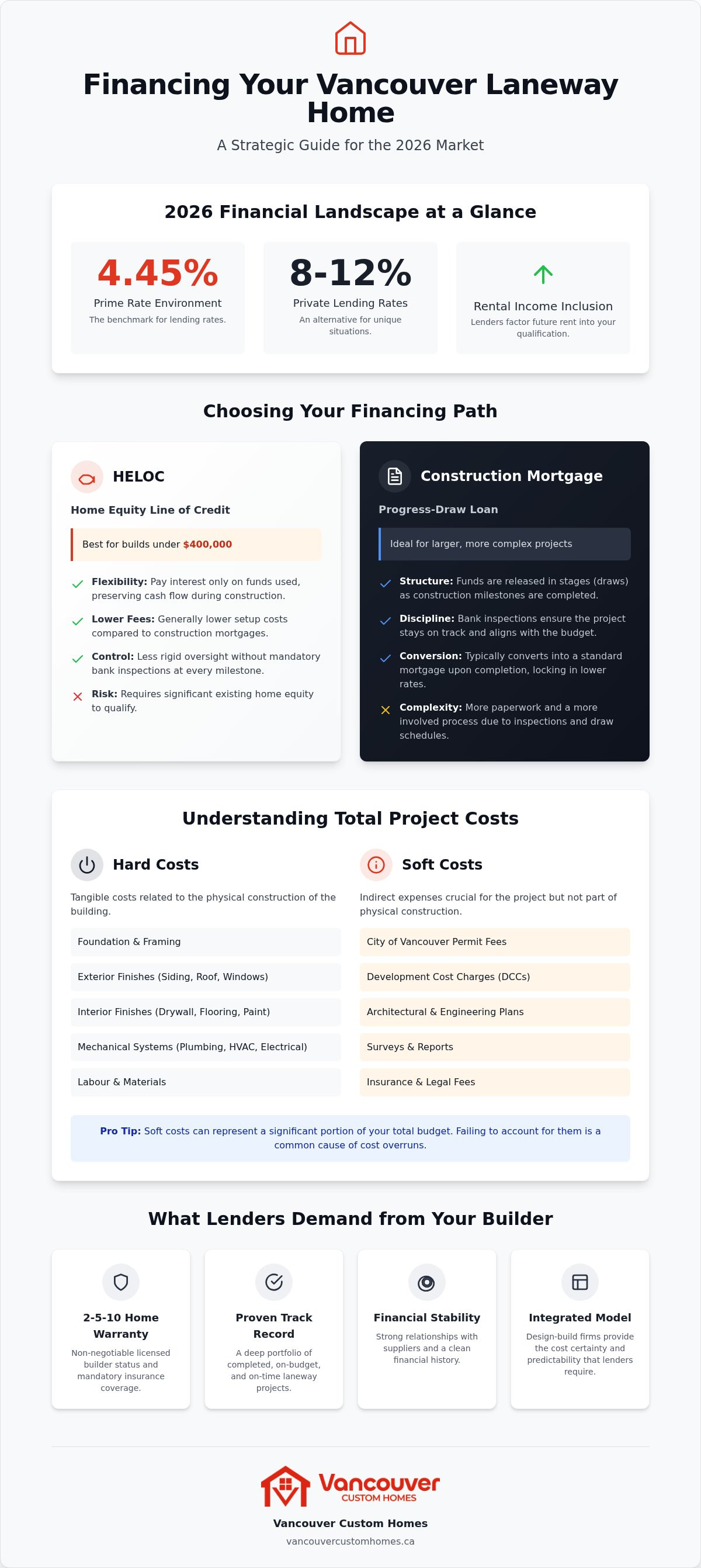
Choosing the right vehicle for construction financing for laneway homes depends entirely on your current equity and the scale of your build. In the 2026 Vancouver market, where the prime rate sits at 4.45%, the decision between a Home Equity Line of Credit (HELOC) and a progress-draw construction mortgage is a strategic one. While a HELOC offers unmatched flexibility, a construction mortgage provides the structured discipline necessary for larger, more complex secondary suites. Long-term property owners often utilize a "Refinance and Build" strategy; rolling the construction costs into a new primary mortgage to lock in lower residential rates once the unit is complete.
The HELOC Advantage for Small Builds
A HELOC is often the preferred choice for builds under $400,000. Why? It allows for interest-only payments during the construction phase, which preserves your monthly cash flow while you're paying for materials and labour. Setup fees are generally lower than traditional construction loans, and you only pay interest on the money you've actually spent. This flexibility is ideal for homeowners with substantial existing equity who want a low-friction funding process without the rigid oversight of bank inspections at every minor milestone.
Construction Mortgages for Major Developments
For more ambitious projects exceeding 900 square feet, a progress-draw construction mortgage is the standard. This loan releases funds in "draws" based on specific milestones, such as foundation completion, lock-up, and final occupancy. Lenders require a fixed-price contract from your builder to mitigate risk. This structure protects you from budget creep, as the bank's own appraisers must verify the work before the next tranche of capital is released. To ensure your project meets these rigorous banking standards, consider reviewing our integrated design-build process which prioritizes financial transparency from day one. This methodical approach ensures that every dollar is accounted for, providing peace of mind to both you and your financial institution.
Budgeting for Success: Soft Costs and Hard Costs
Successful construction financing for laneway homes hinges on a budget that survives the transition from paper to pavement. While most homeowners focus on the "hard" visible costs like lumber and flooring, it's often the "soft" costs that disrupt a loan application. In Vancouver, these hidden expenses represent a massive portion of your initial capital outlay. Lenders look for a comprehensive breakdown that includes a 10-15% contingency fund to absorb the shocks of a dynamic market. This disciplined approach follows the same rigorous custom home construction Vancouver standards we apply to full-scale residential builds; ensuring your project remains bankable from start to finish.
Vancouver-Specific Permit and Utility Fees
Do you know the exact cost of your backyard's potential? Regulatory friction in the City of Vancouver is a major budget driver. For 2026, the City-Wide Development Cost Levy (DCL) is $49.88 per square metre, and the Utilities DCL adds another $39.06 per square metre. These rates include a temporary 20% reduction that is expected to remain in effect until September 30, 2026. Additionally, the Metro Vancouver Development Cost Charge is currently $29,197 per unit. Beyond these levies, you must budget for separate utility meters. While installing individual connections for gas and electricity increases upfront costs, it's a requirement for most rental-backed financing models. Using an integrated design-build model reduces unexpected permit delays, which currently average 11.4 weeks for standalone units.
Managing Material and Labour Volatility
The 2026 labour market in the Lower Mainland is finally showing signs of stabilization. While residential construction costs rose by 2.8% year-over-year in the first quarter of 2026, a slowdown in large-scale condo projects has made skilled trades more available for private residential builds. This shift allows for more competitive bidding and better punctuality. We strongly recommend a fixed-price contract to protect your construction financing for laneway homes from inflationary spikes. While a cost-plus model bills you for actual expenses as they occur, a fixed-price contract locks in the total project cost at the start, providing the absolute price certainty that bank underwriters demand before approving a draw schedule.
How to Qualify: What Lenders Demand from Your Builder
When you apply for construction financing for laneway homes, the bank scrutinizes your builder as closely as your credit score. Lenders view backyard suites as complex logistical puzzles. They want proof that the project will reach completion without stalling. A builder's track record is the primary metric for this risk assessment. If your contractor lacks a history of successful Vancouver builds, your loan application is likely to face heavy resistance or outright rejection. Banks prioritize builders who demonstrate financial stability and professional accountability, often through rigorous project governance models like those advocated by VULPIN Capital to ensure long-term asset survivability.
In British Columbia, 2-5-10 Home Warranty insurance is a non-negotiable requirement for most major lenders. This mandatory coverage protects the investment against structural defects and ensures the build meets provincial standards. Without it, you won't secure a progress-draw mortgage. Beyond insurance, professional design documents are essential. They provide the granular detail appraisers need to establish a "subject to completion" value. This valuation determines your total borrowing power, making the quality of your initial architectural plans a direct factor in your financial success.
The Power of 3D VR Visualization in Appraisals
Appraising a structure that doesn't exist yet is inherently difficult. Traditional 2D blueprints often leave too much to the imagination, leading to conservative valuations that can leave you with a funding gap. We solve this by utilizing advanced custom home design Vancouver tools, including 3D VR walkthroughs. These immersive previews allow appraisers and lenders to "step inside" the finished unit before the first shovel hits the dirt. By visualizing the exact finishes and spatial flow, banks can assign a more accurate and aggressive market value to the project. This reduces lender risk and helps you secure the maximum possible loan amount.
Transparency Through the Project Management Portal
Lender trust is built on a foundation of consistent, verifiable data. One of the most significant home builder client portal benefits is the ability to provide banks with real-time updates on construction milestones. When it's time for a draw request, the portal offers a transparent paper trail of progress, photos, and budget tracking. This level of organization eliminates the typical "construction chaos" that makes banks nervous. It streamlines the inspection process and ensures funds are released punctually, keeping your project moving at a steady rhythm. To experience this level of financial control firsthand, connect with our team and see how our integrated process protects your investment.
Maximizing ROI: Turning Financing into Wealth
Is your laneway house a debt or an asset? In Vancouver's 2026 market, it's a wealth-building engine. While some skeptics claim these units take decades to pay off, they often ignore the exponential growth in property equity. When you secure construction financing for laneway homes, you aren't just borrowing money; you're leveraging your land to create a high-yield investment. A laneway home can add between $200,000 and $350,000 to the assessed value of your property. This immediate equity boost often outweighs the initial cost of the loan when viewed through the lens of long-term capital appreciation.
The net-positive reality becomes even clearer when you weigh property tax increases against rental income. While your annual taxes will rise, the monthly cash flow from a secondary suite far exceeds the incremental tax and interest costs. For long-term owners, the strategic exit plan is simple. Selling a property with an established, income-generating unit attracts a wider pool of buyers, particularly those looking for "mortgage helpers" to qualify for their own financing. This makes your primary lot significantly more liquid and valuable in a competitive market.
Rental Income Projections for Metro Vancouver
What can you actually expect in monthly returns? As of February 2026, the Vancouver rental market remains incredibly tight. A 1-bedroom laneway house currently rents for $2,000 to $2,800 per month. If you build a 2-bedroom unit, you can command between $2,500 and $3,500. These figures transform your debt-servicing ratios. By marketing your suite to high-quality tenants in Burnaby, Richmond, or Vancouver, you realize a consistent stream of revenue that can cover a substantial portion of your primary mortgage. This isn't just a suite; it's a financial stabilizer.
The Vancouver Custom Homes Advantage
Lenders value predictability above all else. Our integrated design-build approach ensures your project stays on budget, which is exactly what banks want to see. We leverage our established reputation to help you secure more favourable terms with local credit unions and major banks. By providing a transparent, "one-roof" solution, we eliminate the financial ambiguity that leads to loan rejections. Ready to see what's possible on your lot? Contact us to start your laneway feasibility study today. We'll help you navigate the complexities of construction financing for laneway homes and ensure your build is as refined as your financial strategy.
Securing Your Financial Future with a Strategic Laneway Build
Navigating the 2026 interest rate environment and Vancouver's evolving zoning laws requires a disciplined, strategic approach. You've learned how selecting the right vehicle; whether a flexible HELOC or a structured construction mortgage; sets the stage for a successful project. High-quality construction financing for laneway homes is ultimately secured through builder accountability and the professional design documentation that lenders demand.
We replace the typical anxiety of large-scale builds with a sense of controlled, predictable excitement. By utilizing our immersive 3D VR walkthroughs for appraisal accuracy and our transparent project management portal for real-time tracking, you remain in full control of your investment. Our fixed-price construction contracts provide the final layer of security your bank requires to release funds with confidence.
Book a Laneway Feasibility Consultation today to start your journey. Your property has the potential to become a powerful wealth-generating asset; let's work together to realize its full value.
Frequently Asked Questions
Can I get a construction loan for a laneway house if I have an existing mortgage?
Yes, you can absolutely secure a loan with an existing mortgage in place. Lenders typically facilitate this by either adding a second mortgage to your property or refinancing your current debt into a single, larger loan that includes the build costs. This "all-in-one" approach is a standard path for construction financing for laneway homes because it simplifies your monthly payments and often results in better overall interest terms.
How much equity do I need in my home to finance a laneway build in Vancouver?
You generally need a minimum of 20% equity in your total property value to qualify for a construction loan. Lenders use the Loan-to-Value (LTV) ratio to assess your borrowing power and risk level. For example, if your home is valued at C$2 million and you owe C$1 million, your 50% equity position provides a very strong foundation for a bank to approve additional funding for your backyard suite.
Do Vancouver banks consider future rental income when qualifying me for a loan?
Most Vancouver financial institutions allow you to use projected rental income to help you qualify for a larger loan amount. In 2026, lenders typically "offset" your debt-servicing ratios by including 50% to 80% of the anticipated market rent in your total income calculation. Providing a professional rental appraisal along with your builder's fixed-price contract is the most effective way to prove these figures to a bank underwriter.
What is the difference between a progress draw and a completion mortgage?
A progress draw mortgage releases funds in stages as specific construction milestones are met, while a completion mortgage only provides the full loan amount once the unit is finished. For laneway builds, the progress draw is the industry standard. It provides the necessary cash flow to pay trades and purchase materials throughout the project. Completion mortgages are rarely used for secondary suites unless the homeowner has the cash to fund the entire build upfront.
Are interest rates higher for laneway home construction financing?
Yes, interest rates for construction loans are typically higher than standard residential mortgage rates. You should expect to pay prime plus 2% to 4% during the build phase, which currently translates to approximately 6.45% to 8.45% in the 2026 market. Once your laneway house receives its occupancy permit, most owners convert this high-interest debt into a traditional term mortgage at a lower residential rate to maximize their long-term cash flow.
What happens if the construction costs exceed my approved financing?
If costs exceed your approved limit, you are responsible for covering the difference from your own cash reserves. This is why we insist on a 10% to 15% contingency fund and a fixed-price contract to protect your construction financing for laneway homes. Lenders rarely increase a loan amount mid-build. If you run out of funds, the project could stall, which risks your standing with the bank and delays your eventual rental income.
Can I use a HELOC to pay for the design and permit phase of my laneway home?
Using a HELOC to fund the design and permit phase is a highly efficient and flexible strategy. It allows you to pay for "soft costs" like architectural fees and City of Vancouver permit applications without committing to a full construction loan immediately. Since you only pay interest on the money you actually use, it provides the financial breathing room needed to navigate the median 11.4-week permit processing time before major construction begins.
Does the City of Vancouver offer any grants for building laneway houses in 2026?
While the City of Vancouver doesn't offer direct grants, the Provincial Government's Secondary Suite Incentive Programme remains a vital resource in 2026. This programme provides forgivable loans for homeowners who build a suite and commit to renting it at below-market rates. Additionally, the 20% reduction in Development Cost Levies (DCLs) serves as a significant indirect financial benefit for projects that break ground before the September 30, 2026 deadline.


