
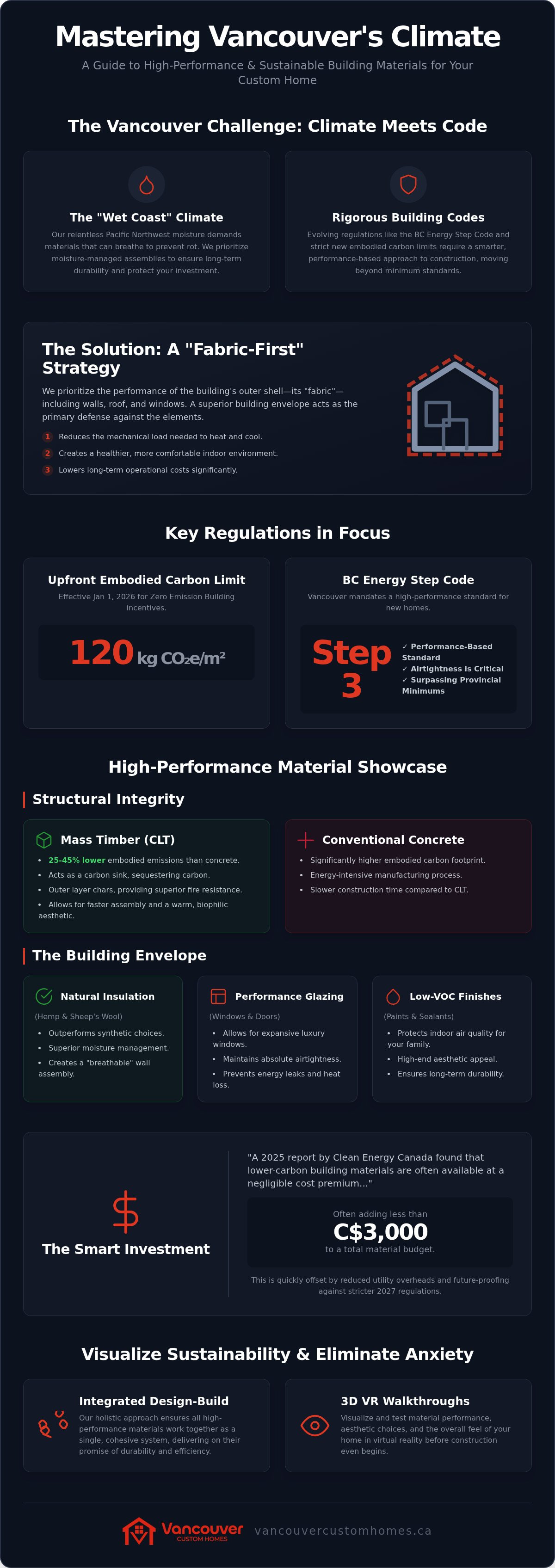
Why build a house that merely meets the code when you can build one that masters the climate? In Vancouver, the definition of luxury is shifting from aesthetic finishes to structural performance. You likely feel the pressure of the 120 kg CO₂e/m² embodied carbon limits and the evolving requirements of the BC Energy Step Code. It's frustrating to face a sea of greenwashing while trying to protect your investment from the relentless Pacific Northwest moisture. Choosing the right sustainable building materials for custom homes isn't just about being eco-friendly; it's about building for long-term survival and comfort.
This guide cuts through the noise to show you how to exceed BC's rigorous standards while creating a healthier indoor environment for your family. We'll explore the high-performance materials that actually work in our unique "Wet Coast" environment, from mass timber to advanced low-VOC sealants. You'll discover how an integrated design-build approach ensures these materials deliver on their promise of lower long-term costs and superior durability. We're moving past the recent regulatory shifts to focus on what truly matters: a home that is as efficient as it is beautiful.
Key Takeaways
- Understand why Vancouver’s 2026 building regulations demand a "fabric-first" strategy to balance mandatory energy efficiency with our specific coastal climate.
- Discover how choosing the right sustainable building materials for custom homes, such as Mass Timber and ICF, provides superior structural integrity and moisture resistance.
- Learn why the building envelope is the most critical factor in your home’s lifecycle and how natural insulation options like hemp and sheep's wool outperform traditional synthetic choices.
- Identify the specific low-VOC paints and finishes that protect your family’s indoor air quality without sacrificing high-end aesthetic appeal or durability.
- See how an integrated design-build model and 3D VR walkthroughs eliminate construction anxiety by allowing you to visualize and test material performance before the build begins.
The Shift Toward Sustainable Building Materials in Metro Vancouver
Sustainability in Vancouver construction is no longer a niche preference; it's a performance requirement. We define sustainable building materials for custom homes by two critical metrics: low embodied energy and high operational efficiency. Embodied energy accounts for the carbon produced during extraction, manufacturing, and transport. As of January 1, 2026, Vancouver projects pursuing Zero Emission Building incentives must meet a strict upfront embodied carbon limit of 120 kg CO₂e/m². This regulatory shift necessitates a "fabric-first" strategy. If you prioritize the building's shell, you reduce the mechanical load required to heat and cool it. The result is a home that is cheaper to run, healthier to live in, and significantly more valuable on the resale market.
Meeting the BC Energy Step Code in 2026
Vancouver currently mandates Step 3 of the BC Energy Step Code for most new residential builds. This is a performance-based standard. It doesn't dictate exactly which products you must use, but it sets rigorous targets for how the finished home must perform. Material density and thermal resistance (R-value) are your primary levers for hitting these targets. However, high R-values mean nothing without absolute airtightness. We treat the building envelope as a single, integrated system where every seal and joint works in unison to prevent energy leaks. This holistic approach ensures your home remains comfortable while easily surpassing provincial minimums.
Designing for the Pacific Northwest Climate
Our "Wet Coast" climate is unforgiving. If your materials don't breathe, they rot. We prioritize moisture-managed assemblies and local BC timber to ensure longevity. Using local wood isn't just about supporting the regional economy; it significantly lowers the carbon footprint of your build by reducing transport distances. A common concern for custom builds is balancing the desire for large luxury windows with thermal performance requirements. We solve this by utilizing high-performance glazing and precision-engineered frames. These components allow for expansive views while maintaining the airtightness required by Step 3. By selecting materials specifically adapted to our humidity and temperature fluctuations, you protect your investment from the moisture-related issues that plague lower-quality builds.
The economic argument for these choices is equally compelling. A 2025 report by Clean Energy Canada found that lower-carbon building materials are often available at a negligible cost premium, often adding less than C$3,000 to a total material budget. When you consider the reduction in utility overheads and the future-proofing against even stricter 2027 regulations, the decision to build sustainably becomes the most logical financial path forward.
Structural Integrity: Eco-Friendly Framing and Foundation Options
How do you build a legacy that withstands both the "Wet Coast" and the test of time? It starts with the skeleton. While traditional stick-framing remains the local standard, sustainable building materials for custom homes are evolving to offer better resilience and a significantly lower carbon footprint. Every structural choice you make is an opportunity to sequester carbon rather than emit it. By selecting materials that act as carbon sinks, you turn your home's physical structure into a tool for environmental benefit.
Mass Timber and Cross-Laminated Timber (CLT)
For those considering a multiplex development Vancouver, recycled steel is another powerful alternative. It provides unmatched longevity and fire resistance in high-density builds. Steel is infinitely recyclable, making it a logical choice for homeowners who value a circular economy. If you want to see how these structural choices fit your vision, our team can help you visualize the integration during the custom home design phase.
Insulated Concrete Forms (ICF) vs. Traditional Poured Concrete
Your foundation is your first line of defence against the Pacific Northwest's damp soil. Traditional poured concrete is a major carbon emitter and offers poor thermal performance. Insulated Concrete Forms (ICF) solve both problems. ICF consists of interlocking blocks of expanded polystyrene that stay in place after the concrete is poured, creating a double-insulated wall system. This creates incredible thermal mass. Your basement stays cool in the summer and retains heat in the winter, which is a key requirement for meeting Step 3 of the BC Energy Step Code.
The benefits of ICF extend beyond temperature. The sound-dampening qualities are exceptional. If you are building on a busy Metro Vancouver street or developing a multi-unit project, this acoustic barrier is essential for maintaining a sense of private luxury. It's a disciplined approach to construction: one material provides the structure, the insulation, and the soundproofing in a single, efficient step. This is how we replace the typical anxiety of foundation work with the certainty of a high-performance build, a standard also upheld by specialists like UptopContractor for projects in the Greater Toronto Area.
The Building Envelope: High-Performance Insulation and Windows
If the structure is the skeleton, the building envelope is the skin. It's the most critical factor in a home's lifecycle sustainability. A weak envelope leads to energy loss, thermal bridging, and eventual structural decay. In the Pacific Northwest, your envelope must do more than just insulate; it must manage moisture. Choosing the right sustainable building materials for custom homes ensures your property remains airtight while allowing the structure to breathe. This balance is what separates a standard build from a high-performance masterpiece.
Sustainable Insulation: Beyond Fibreglass
Traditional fibreglass often fails to meet the rigorous demands of modern energy codes. We look toward materials with higher thermal mass and lower environmental impact. Cellulose, made from recycled paper, provides excellent gap-filling properties that traditional batts cannot match. Hempcrete is another innovator; it's a carbon-negative material that offers natural humidity regulation. For the Lower Mainland, mineral wool is a standby for its fire resistance and superior moisture management. It doesn't lose its R-value when damp, making it ideal for our climate. Using these sustainable building materials for custom homes allows us to achieve superior airtightness. Regarding the BC Step Code 4 or 5 compliance, R-value is the numerical representation of a material's resistance to heat flow; a higher number signifies a more efficient thermal barrier for your home.
Glazing Strategies for Energy Efficiency
Windows are often the weakest link in a thermal shield. In luxury custom home construction Vancouver, triple-pane glazing is now the baseline requirement rather than an upgrade. These units utilize two layers of argon gas and Low-E coatings to reflect heat back into the room during winter while blocking solar gain in the summer. This technology allows you to enjoy massive floor-to-ceiling views without compromising your energy rating. The framing is just as vital. While traditional wood is beautiful, we often recommend thermally broken aluminium or fibreglass frames. These materials prevent the "cold bridge" that leads to condensation and mould growth around window perimeters.
Proper air sealing and vapour barriers complete the system. We treat every penetration in the envelope as a potential failure point. By using intelligent membranes that change their permeability based on humidity levels, we ensure that any incidental moisture can escape the wall cavity. This level of precision is how we guarantee a healthy, rot-resistant environment for your family. It's not just about meeting a code; it's about building a home that performs predictably for decades.
Interior Health: Low-VOC Finishes and Reclaimed Materials
Luxury isn't just about what you see; it's about what you breathe. Indoor air quality (IAQ) is often the missing link in high-performance construction. Why build a home that is airtight if it traps toxic chemicals inside? We prioritize sustainable building materials for custom homes that promote a healthy atmosphere without sacrificing premium aesthetics. By focusing on non-toxic finishes, you eliminate the typical "new house smell" which is actually the scent of harmful chemicals off-gassing into your living space.
Breathable Interiors and Non-Toxic Finishes
The solution starts with strict adherence to VOC (Volatile Organic Compound) limits. Under the Canadian Environmental Protection Act, we ensure flat coatings don't exceed 100 g/L and non-flat coatings remain under 150 g/L. For adhesives and sealants, we aim for a maximum of 70 g/L. These aren't just suggestions; they are the benchmarks for family health. We specifically look for Greenguard Gold certified products to ensure your home meets the world's most rigorous chemical emissions standards.
Beyond paints, the materials on your walls matter. Natural clay and lime plasters are making a comeback in high-end Vancouver builds. These finishes are naturally moisture-regulating, which helps prevent the mould and rot concerns common in the Pacific Northwest. They provide a soft, tactile depth that synthetic drywall finishes cannot replicate. When you combine these with formaldehyde-free cabinetry and millwork, you create a sanctuary that is as safe as it is beautiful.
The Luxury of Reclaimed and Recycled Materials
Sustainability often means looking backward to move forward. Reclaimed Douglas Fir, sourced from local BC sites, adds immediate heritage and character to a new build. Whether used for structural feature beams or wide-plank flooring, these materials offer a stability that new-growth wood lacks. It's a way to integrate the history of the region into a modern, minimalist design. This approach isn't just for rustic styles; when handled by expert craftsmen, salvaged timber looks incredibly sophisticated in a contemporary setting.
Recycled glass and stone countertops offer another avenue for eco-conscious luxury. These surfaces provide the same durability and heat resistance as quarried marble or granite but with a fraction of the environmental impact. If you want to explore how these finishes look in your specific floor plan, you can book a 3D VR walkthrough to experience your material choices before construction begins. This integrated approach ensures that your flooring, from FSC-certified hardwoods to sustainable cork, aligns perfectly with your vision for a healthy, unified home.
Visualizing Sustainability with Vancouver Custom Homes
Sustainable construction shouldn't feel like a gamble. We replace the typical anxiety of material selection with a data-driven, integrated process. By housing design and construction under one roof, we ensure that the high-performance goals established in the planning phase aren't lost during the build. This unified approach is the only way to guarantee that your choices for sustainable building materials for custom homes translate into a structure that actually meets BC's 2026 performance requirements. We act as your visionary guide, simplifying complex systems into a structured, enjoyable experience.
The Power of 3D VR in Material Selection
Our 3D VR walkthroughs bridge the gap between custom home design Vancouver and the physical reality of the site. You can see how the natural light of your specific lot interacts with sustainable textures like reclaimed wood or lime plaster. This isn't just about aesthetics; it's a tool for precision. If you can finalize every detail in a virtual environment, you avoid the costly material waste and delays that plague traditional projects. It allows you to realize the final product before a single shovel hits the ground, ensuring that every sustainable choice serves both the planet and your personal style.
Transparent Sourcing via the Client Portal
Transparency is our standard, not an option. Our project management portal gives you direct access to the logistical heart of your project. You can track every eco-certification and material milestone in real-time, ensuring your laneway home builders Vancouver project stays on mission. If you want to verify the carbon footprint of your structural steel or the sourcing of your FSC-certified flooring, the data is available at your fingertips. This level of oversight ensures that your vision for a healthy home is never compromised by the fragmented communication common in the industry.
The 2026 building landscape is complex, but your experience doesn't have to be. We take full responsibility for the technical details, from meeting the 120 kg CO₂e/m² carbon limits to optimizing your building envelope. Our team is ready to help you navigate these regulations with confidence and ease. If you're ready to align your vision with BC's green building standards, we invite you to consult with our lead strategists. Let's build a home that defines the future of Vancouver living, providing your family with the security and comfort they deserve.
Building the Future of Vancouver Living
Choosing the right path for your build shouldn't feel like a leap of faith. We've shown you how high-performance envelopes and low-carbon structural choices protect your property from the Pacific Northwest climate. Selecting sustainable building materials for custom homes is no longer just an environmental choice; it's a strategic financial decision that ensures your home remains your primary defence against the elements. You can now realize a design that balances luxury with absolute performance while meeting the province's highest standards.
As locally owned Vancouver experts, we provide the technical mastery needed for BC Step Code 4 and 5 compliance. Our dedicated project management portal offers complete material transparency, giving you peace of mind from the first pour to the final finish. We replace the chaos of traditional construction with a disciplined, integrated process that puts you in control. Are you ready to see your vision in high definition?
Start your sustainable journey with a 3D VR walkthrough of your future home today. We're here to help you build a legacy that your family will enjoy for generations.
Frequently Asked Questions
What are the most cost-effective sustainable building materials for Vancouver homes?
Cellulose insulation and locally sourced BC timber are among the most cost-effective choices available today. A 2025 report by Clean Energy Canada indicates that lower-carbon materials often add less than C$3,000 to a total material budget. By choosing local wood, you reduce transportation costs and support regional forestry. These sustainable building materials for custom homes provide high performance without the luxury price tag often associated with green building.
How do sustainable materials help in meeting the BC Energy Step Code?
Materials with high thermal resistance and superior airtightness are essential for meeting Step 3 of the BC Energy Step Code. High-performance glazing and intelligent vapour membranes ensure your home maintains a consistent temperature with minimal mechanical help. If your material selection is integrated into a "fabric-first" design, you can easily surpass provincial energy targets while lowering your long-term utility overheads and increasing resale value.
Is reclaimed wood durable enough for structural use in a new custom home?
Reclaimed wood is exceptionally durable and often more stable than new-growth timber because it has already finished shrinking and seasoning. Old-growth Douglas Fir salvaged from local BC sites offers structural density that is difficult to find in modern lumber. When used for feature beams or flooring, these materials provide both structural integrity and a unique, high-end aesthetic that connects your home to the region's history.
Can I build a net-zero home in Vancouver using standard building materials?
Building a net-zero home with standard materials is nearly impossible due to the extreme airtightness and insulation levels required. Standard builds often rely on mechanical systems to compensate for a weak building envelope. To achieve net-zero, you must prioritize advanced sustainable building materials for custom homes, such as triple-pane windows and mineral wool insulation. These components work together to ensure the home produces as much energy as it consumes.
What is the difference between embodied energy and operational energy in construction?
Embodied energy refers to the carbon emissions produced during a material's extraction, manufacturing, and transport; operational energy is what the home uses for heating and cooling. As of 2026, Vancouver builders must manage both. While operational efficiency has long been the focus, new regulations now limit upfront embodied carbon to 120 kg CO₂e/m². Choosing materials with low embodied energy is now a mandatory part of the permit process.
Are low-VOC materials significantly more expensive than traditional finishes?
Low-VOC paints, adhesives, and sealants are no longer a high-cost specialty item. Most premium architectural brands have transitioned to low-VOC formulations to meet Canadian environmental regulations. While some specialized natural finishes like lime plaster may carry a labour premium, the raw materials are comparable in price to high-end synthetics. The primary benefit is a healthier indoor environment, which far outweighs any minor price difference.
How does the Vancouver climate affect the choice of sustainable insulation?
Vancouver's high humidity necessitates insulation that can manage moisture without losing its thermal properties. Mineral wool is often superior to fibreglass in our climate because it is hydrophobic and does not sag when damp. Sustainable choices like hempcrete also perform well by naturally regulating indoor humidity. If your insulation cannot breathe or resist rot, the structural integrity of your home is at risk during our long rainy seasons.
Why should I choose a design-build firm for a sustainable custom home project?
A design-build firm provides a unified process that ensures your sustainability goals aren't lost between the architect's vision and the builder's execution. We take full responsibility for every detail, from BC Step Code compliance to eco-certified material sourcing. By using tools like 3D VR walkthroughs and a transparent project portal, we eliminate the typical gaps in communication. This integrated approach ensures your home performs exactly as promised.


