

What if the most dangerous part of your Metro Vancouver build isn't the excavation or the framing, but the ink on your contract? Choosing between a fixed price vs cost plus contract BC homeowners often face can feel like picking between a capped ceiling with hidden compromises or a basement with no floor. You want the certainty of a final number, yet you dread the thought of a builder cutting corners to protect their margin. Conversely, the transparency of a cost-plus model is attractive until the open-ended invoices start rolling in alongside 2026's rising material costs.
It's natural to feel anxious about how the BC Step Code requirements or the new PST regulations on design services will impact your final budget. We realize that you need a framework that offers both total transparency and rigid financial control. This guide will show you how to navigate these complex agreements to ensure your investment remains protected. You'll learn how integrated design and digital project portals are changing the game in 2026. We'll preview the specific pros and cons of each model so you can build with zero financial surprises and full confidence in every dollar spent.
Key Takeaways
- Identify the fundamental differences between stipulated price and open-book billing to determine which model best protects your investment in the current market.
- Evaluate the fixed price vs cost plus contract BC choice across five key metrics, including risk transfer, design flexibility, and administrative overhead.
- Navigate 2026 regulatory shifts, such as the BC Step Code and new PST on design services, to avoid unexpected budget inflation during your build.
- Learn how digital tools like 3D VR walkthroughs create scope certainty, making fixed-price bids more reliable and reducing the risk of costly change orders.
- Discover how a real-time project management portal eliminates the financial anxiety of cost-plus billing by providing full transparency into every labour hour and material cost.
Understanding Construction Contracts in the 2026 BC Market
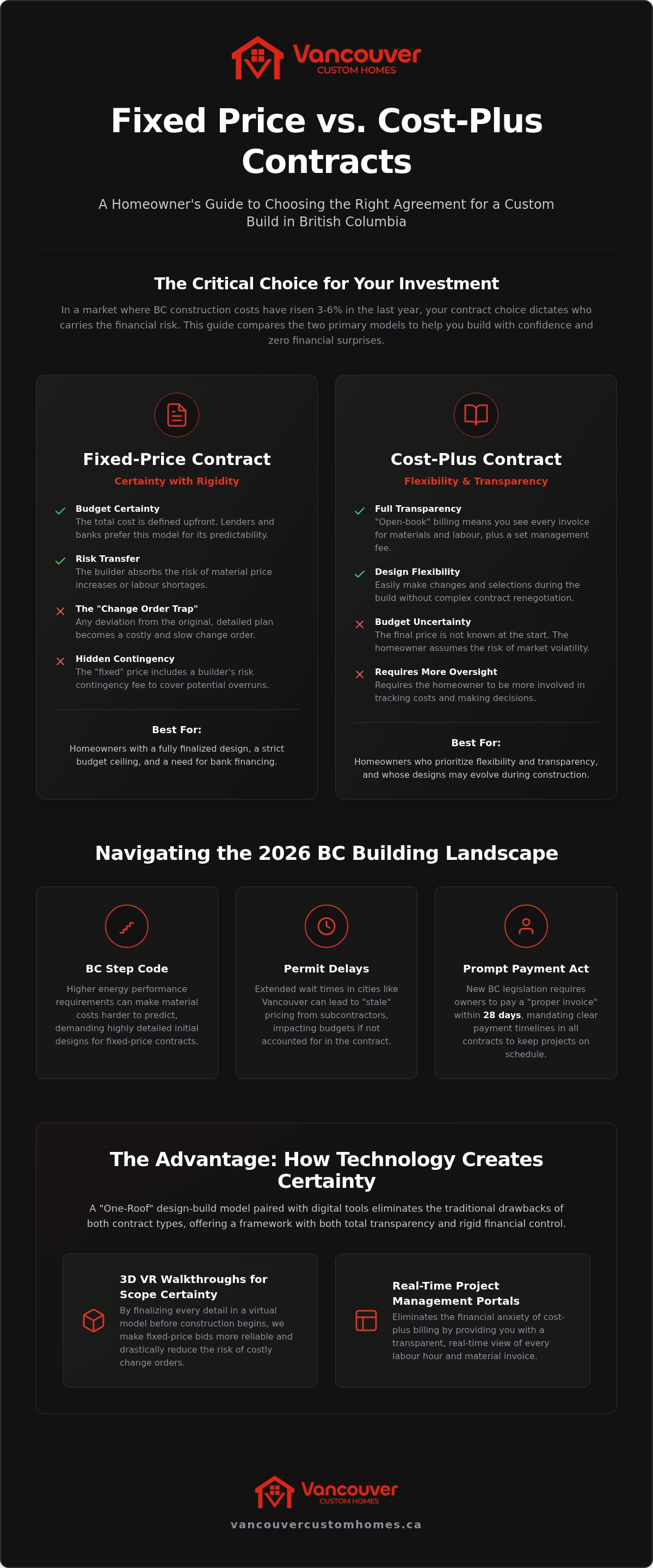
Choosing the right framework for your build is the first step toward a successful project. In the Lower Mainland, the debate usually centres on a fixed price vs cost plus contract BC homeowners must decide upon before groundbreaking. A Fixed Price (or Stipulated Price) contract sets a hard total for a strictly defined scope of work. Conversely, a Cost-Plus Contract involves paying for the actual labour and materials used, plus a pre-agreed management fee. Why does this choice matter so much in 2026? With construction costs in BC rising between 3% and 6% over the last year, the decision dictates who carries the burden of market volatility. You're essentially choosing between the comfort of budget certainty and the agility of project flexibility.
The Shift Toward Integrated Building Models
Traditional construction often feels like a battle between a separate architect and a builder. This fragmented approach leads to "scope creep" and finger-pointing when costs rise. We've seen that a "One-Roof" design-build model simplifies everything. By integrating design and construction, financial accountability becomes a singular point of contact. Modern contracts now rely on digital transparency. When you use a real-time project management portal, the "open-book" nature of a cost-plus agreement becomes manageable rather than mysterious. It transforms the build from a series of fragmented steps into a unified, predictable journey that prioritizes your peace of mind.
BC-Specific Regulatory Factors
Your contract doesn't exist in a vacuum. Local regulations in the Lower Mainland directly influence your bottom line. Consider these three factors that impact contract reliability in 2026:
- BC Step Code: As municipalities require higher steps of energy performance, material costs become harder to predict. A fixed-price contract requires a very detailed initial design to account for these high-performance components before the first nail is driven.
- Permit Delays: In cities like Vancouver, permit wait times can stretch for months. If your contract doesn't account for these pauses, you might face "stale" pricing from subcontractors by the time work actually begins.
- Builders Lien Act and Prompt Payment: Every agreement must respect BC legislation. With the recent abolition of the "Shimco Lien" and the introduction of the Construction Prompt Payment Act, your contract must clearly define payment timelines. Owners must now pay a "proper invoice" within 28 days to keep the project moving.
If you prioritize a finished product with zero financial surprises, understanding these local nuances is mandatory. Whether you're building a custom home or a multiplex, the right contract acts as your project's North Star. It ensures that every dollar spent is an investment in quality rather than a response to chaos.
Fixed Price Contracts: Certainty or Rigidity?
A fixed-price contract acts as a financial shield. It provides a definitive total for a specific scope of work, which is why it remains a popular choice when comparing a fixed price vs cost plus contract BC residents often consider. The primary advantage is the "Transfer of Risk." In this model, the builder assumes the burden of material price spikes or labour shortages. If the price of framing lumber increases mid-build, your bottom line stays protected. However, this security isn't free. Builders typically include a "risk contingency" in their initial quote to cover these unknowns. You're essentially paying for an insurance policy against market fluctuations.
The danger lies in the "Change Order Trap." When a contract is based on vague specifications, every minor adjustment becomes an expensive "extra." This often leads to friction and delays. If the scope isn't crystal clear from day one, you'll find that the "fixed" price is anything but stable. It requires a disciplined approach to design before the contract is even signed.
When Fixed Price is the Right Choice
This model is ideal for homeowners with a strict budget ceiling and a fully finalized design. Lenders and banks overwhelmingly prefer this structure for custom home construction Vancouver projects. It provides them with the valuation certainty needed to approve construction loans. To make this work, you must ensure every finish, fixture, and structural detail is documented. Without that level of detail, you leave yourself open to disputes over what was actually included in the original price.
Eliminating Scope Creep with 3D VR Visualization
We've found that the biggest cause of fixed-price disputes is a lack of visual clarity. Most homeowners struggle to interpret 2D blueprints, leading to "I didn't realize it would look like that" moments during framing. By utilizing 3D VR walkthroughs, you can virtually "live" in your home before construction begins. This level of visual certainty is a cornerstone of modern custom home design Vancouver.
When you can see exactly how the light hits the kitchen island or how the hallway flows, you eliminate the need for mid-build changes. This makes your fixed-price contract far more reliable. It replaces guesswork with visual evidence. If you want to see how this technology protects your budget, you can explore our integrated design-build process to see visual transparency in action. This proactive discipline ensures that the price you agree to is the price you actually pay.
Cost-Plus Contracts: Flexibility and Transparency
Why would a homeowner choose a contract where the final price isn't locked in? For many, the answer is total control. A cost-plus agreement allows you to pay for actual expenses plus a management fee, providing a level of flexibility that a fixed-price model cannot match. When weighing a fixed price vs cost plus contract BC homeowners often find that cost-plus is the only way to ensure they aren't paying for a builder's "risk buffer" that never actually materializes. This level of transparency is essential when working with kitchen and bathroom remodeling contractors who manage complex sub-trades and high-end material procurement. You see every invoice. You approve every labour hour. This open-book approach means you only pay for the value you receive.
The fee structure is usually straightforward. Builders either charge a flat management fee or a percentage of the total project cost. While the final price remains unknown until the last nail is driven, this model excels when you want the freedom to upgrade finishes or adjust the layout mid-build without negotiating a complex change order every time. It's a partnership based on trust, but that trust must be verified by data.
Transparency is only useful if it's timely. Waiting for monthly paper invoices in 2026 is a recipe for budget disaster. By then, the money is already spent. We've found that a home builder client portal is the only way to maintain control. It allows you to track daily expenses and labour logs from your phone. This digital transparency replaces the typical anxiety of cost-plus billing with a sense of controlled excitement. You're never in the dark about where your C$400 to C$600 per square foot investment is going. If a material cost spikes, you know instantly, not four weeks later.
Managing the "Blank Cheque" Anxiety
How do you prevent a cost-plus build from spiralling out of control? The solution is often a Guaranteed Maximum Price (GMP) or an "upset price." This hybrid approach sets a ceiling on the project while still allowing you to benefit from any savings the builder finds. Our integrated design-build teams keep material selections aligned with your original vision from the start. We use proactive project management to navigate Lower Mainland labour costs, which can fluctuate based on seasonal demand. By combining real-time data with disciplined oversight, we ensure that open-book doesn't mean open-ended. You get the flexibility you want with the financial boundaries you need.
Selecting the Best Contract for Your BC Project
This focus on financial discipline and high-end results is shared by boutique luxury firms like Maverick Design and Construction, which demonstrate how specialized builders can provide certainty and transparency even within flexible contract models.
Deciding on a fixed price vs cost plus contract BC homeowners often find, requires a cold-eyed look at five variables: risk, flexibility, speed, total cost, and administrative burden. If you prioritize budget certainty, fixed price wins on risk management. If you value the ability to pivot design mid-stream, cost-plus is the superior choice. In the 2026 financial climate, where BC's real GDP growth is forecasted at a modest 1.1%, every dollar must be strategic. High interest rates mean that construction loans are more expensive to carry, making the speed of your build a critical cost factor. A cost-plus model often allows for a faster groundbreaking because you don't need every single door handle selected before signing, potentially saving you thousands in interest carry costs.
You must also account for the BC Builders Lien Act. Regardless of your contract type, a 10% holdback is mandatory on all progress draws to protect against potential liens. As of late 2025, the holdback period has been shortened from 55 to 46 days. This change improves cash flow for contractors but requires you to be more disciplined with your final payment timelines. Understanding these mechanics ensures that your financing remains stable from the first draw to the final occupancy permit.
Contracts for Laneway Houses and Multiplexes
The type of structure you're building heavily influences the ideal agreement. Many laneway home builders Vancouver recommends fixed-price contracts for smaller footprints. Because these projects have more predictable scopes and fewer structural unknowns, locking in a price protects your ROI. However, for multiplex development Vancouver investors often face a different reality. With multiple stakeholders and the potential for complex municipal requirements, a cost-plus or hybrid model provides the flexibility to adjust as the project scales, ensuring the build doesn't stall due to rigid contract terms.
The Hybrid Solution: Guaranteed Maximum Price
If you find yourself torn between the two models, a Guaranteed Maximum Price (GMP) contract offers a middle ground. This hybrid approach gives you the "open-book" transparency of a cost-plus model but includes a contractually mandated ceiling. It's becoming the gold standard for luxury builds in Burnaby and Richmond. You benefit from any savings found during construction, yet the builder assumes the risk for costs exceeding the cap. For this to succeed in BC, you need a highly organized lead strategist who can provide detailed cost reporting. If you're ready to secure a contract that combines flexibility with a hard budget ceiling, contact our project management team to review your site-specific needs.
The Vancouver Custom Homes Advantage: Integrated Transparency
The choice between a fixed price vs cost plus contract BC homeowners face shouldn't feel like a gamble. We've replaced industry fragmentation with a unified "One-Roof" model that prioritizes your financial security. By housing design, engineering, and construction under a single point of accountability, we eliminate the gaps where budgets usually slip. Whether you opt for a set total or an open-book fee, our integrated process ensures that every decision is backed by data rather than estimates. We act as a stabilizing force, turning a complex logistical puzzle into a structured, enjoyable experience.
Our 3D VR walkthroughs go beyond simple visualization; they create a "Digital Twin" of your project. This allows for surgical precision in fixed-price bidding because every structural detail is resolved before a single shovel hits the dirt. For those choosing cost-plus, our real-time project management portal provides the hard evidence required for progress draws. You see the exact material receipts and labour logs that justify every invoice. This level of dedication has made us a leading choice for custom home builders Richmond BC residents trust for high-stakes residential projects across the Lower Mainland.
Eliminating Construction Chaos
Fragmented builds often devolve into "he-said, she-said" disputes between architects and contractors. When the design doesn't match the budget, the homeowner pays the price. Our integrated teams prevent these conflicts by collaborating from day one. Deciding on the fixed price vs cost plus contract BC framework is simpler when you have a singular point of contact who takes full responsibility for the outcome. There is a profound psychological benefit to seeing real-time progress and budget data through your portal. It replaces the typical anxiety of a large-scale build with a sense of controlled, predictable excitement. We believe the build process should be as refined and disciplined as the final home itself.
Start Your Transparent Build Today
Your lot, your goals, and your risk tolerance are unique. Determining the best contract for your project requires a strategic look at your specific site and vision. The first step in our process is a deep dive into visualization and budgeting to ensure your scope is ironclad. We invite you to a consultation to explore how our digital tools can protect your investment. Let's replace construction chaos with a rhythmic, predictable journey toward your new home.
Request a Consultation to Define Your Project Scope and Budget
Securing Your Investment with Financial Clarity
Building a custom home in the Lower Mainland requires more than just a vision; it demands a contract that acts as a stabilizing force. Deciding on a fixed price vs cost plus contract BC framework is ultimately a choice about how you want to manage risk and transparency. You've seen how integrated 3D VR visualization creates the scope certainty needed for a reliable fixed-price bid. Conversely, our digital project management portal provides the real-time evidence required to make cost-plus billing completely transparent. By unifying design and construction under one roof, we replace the typical anxiety of large-scale projects with a sense of controlled, predictable excitement.
Our team is BC New Home Warranty (2-5-10) Certified and committed to total accountability from the first rendering to the final inspection. We realize that your time and emotional well-being are as valuable as the physical build itself. Book a Design Consultation to Secure Your Build Strategy and ensure your project stays on budget and on schedule. Your dream home deserves a financial framework that is as solid as its foundation. We look forward to guiding you through a seamless, professional building experience.
Frequently Asked Questions
Can a contractor charge more than the quoted price in a fixed-price contract in BC?
A contractor cannot unilaterally increase the price of a fixed-price contract unless the scope of work changes. If you request a different kitchen layout or upgraded flooring, the builder will issue a change order. However, if the original plans remain identical, the builder absorbs any internal cost overruns. This is why we use 3D VR walkthroughs to finalize every detail, ensuring the fixed price vs cost plus contract BC debate ends with total budget certainty.
Is a construction quote legally binding in British Columbia?
A construction quote isn't legally binding on its own; it's an offer that requires a signed contract to become enforceable. In BC, most reputable builders use standard CCDC forms to codify the agreement. Once you sign, the price and scope become a legal obligation. It's critical to ensure that every detail from the initial quote is explicitly included in the contract's "Schedule A" to avoid disputes during the build.
What is the standard management fee for a cost-plus contract in Vancouver?
Management fees for cost-plus projects in Metro Vancouver typically range from 10% to 20% of the total construction costs. The exact percentage often depends on the project's complexity and the builder's level of involvement. Some firms offer a flat management fee to remove the incentive for the builder to spend more. This fee covers site supervision, project management, and the administrative work required to track every invoice and labour hour.
How does the BC Builders Lien Act affect my contract payments?
The BC Builders Lien Act requires you to retain a 10% holdback from every progress payment you make to your contractor. This isn't optional; it's a legal safeguard that protects you from liens filed by unpaid subcontractors. Following late 2025 updates, you must hold these funds in a dedicated account for 46 days after the project is substantially complete. You only release the holdback once the lien-filing period has officially expired.
Which contract type is better for a laneway house or multiplex?
Fixed-price contracts are generally superior for laneway houses because the scope is predictable and the footprint is smaller. For multiplex developments, the choice is more complex. Multiplexes often involve more municipal hurdles and stakeholder input, making the flexibility of a cost-plus model attractive. Investors often prefer fixed prices to protect their ROI, but builders may require a cost-plus model to handle the 2026 market's shifting labour and material costs.
Can I switch from cost-plus to fixed-price once the design is finished?
You can certainly switch models once the design phase is complete. In fact, starting with a cost-plus design agreement is a smart way to refine your vision without being locked into a premature price. Once our 3D VR walkthroughs have finalized the "Digital Twin" of your home, we can convert the project into a fixed-price contract. This provides you with the flexibility to explore ideas early on and the security of a capped budget later.
What happens if material costs spike mid-build in a fixed-price agreement?
In a fixed-price agreement, the contractor assumes all responsibility for material price fluctuations. If the cost of high-performance windows or insulation spikes mid-build, the builder must pay the difference. When evaluating a fixed price vs cost plus contract BC homeowners should understand that the builder's quote likely includes a contingency to cover this risk. You pay a slightly higher premium upfront in exchange for total protection against 2026's material market volatility.
Do lenders in BC require a specific contract type for construction loans?
Most lenders in British Columbia prefer fixed-price contracts because they provide a clear "upset" limit for the loan. Banks need to know the exact cost to ensure the completed home's value covers the mortgage. If you choose a cost-plus model, lenders often demand a Guaranteed Maximum Price (GMP) or a significantly higher contingency fund. This ensures the project has enough capital to reach the occupancy stage without requiring emergency refinancing mid-build.


