

In a Vancouver market where housing starts have plummeted by 42 percent, the real danger to your custom home isn't the interest rate. It's the contract you sign before the first shovel hits the dirt. When weighing a fixed price vs cost plus contract vancouver builders offer, why should you have to choose between "open-ended" budgets and hidden fees? You've likely heard the horror stories of costs that spiral out of control. It's exhausting to plan a legacy home when you're caught between the fear of overpaying and the anxiety of constant financial disputes.
We believe you deserve total transparency for every dollar invested. This guide provides a clear breakdown of these contract models to help you navigate the financial complexities of building in Metro Vancouver. You'll learn how to keep your project on schedule despite new BC Building Code cooling and seismic requirements. We'll show you how 3D VR walkthroughs and digital project portals bridge the gap between design and reality. By the end, you'll know exactly which strategy provides the budget certainty and peace of mind your family deserves.
Key Takeaways
- Discover why the "change order trap" is the biggest threat to a fixed-price budget and how to use 3D VR walkthroughs to lock in your design before construction begins.
- Learn when a cost-plus model is the only logical choice for complex Metro Vancouver sites and how a digital project portal ensures you never lose track of a single dollar.
- Master the 2026 financial landscape by understanding the trade-offs of a fixed price vs cost plus contract vancouver builders use to manage material price spikes and labour shortages.
- Navigate the latest BC Building Code requirements for cooling and seismic resilience without letting technical updates derail your building schedule or bank account.
- Shift your perspective from fragmented steps to a "one-roof" integrated design-build approach that prioritizes your emotional well-being as much as the physical structure.
Understanding Custom Home Contracts in the Metro Vancouver Market
Securing a lot in Metro Vancouver is only the first hurdle. Your next decision determines whether your build is a controlled investment or a financial drain. The choice between a fixed price vs cost plus contract vancouver builders present is the most significant financial lever you'll pull. It sets the rules for how your money is spent, how risks are shared, and how disputes are settled over a typical 12-to-18-month construction timeline. In a market where housing starts dropped 42 percent in mid-2026, choosing the wrong framework can stall your project before it even begins.
A Fixed Price model, often called a stipulated sum contract, provides a single number for a clearly defined scope of work. It offers a sense of finality that many homeowners crave. On the other hand, a Cost-Plus Contract focuses on transparency. You pay for the actual costs of labour and materials, plus a management fee. This model is often favoured for high-end custom homes where the design might evolve during the build. Both have merits, but their success depends on the stability of the local market and the precision of the planning phase.
The Stakes of Building in Metro Vancouver
Building today means navigating a maze of evolving regulations. The BC Step Code and 2025 updates for adaptable dwellings and seismic design add significant technical requirements to every project. These aren't just suggestions; they're mandatory standards that impact your initial quote. When you factor in Vancouver's notorious permit delays, the timeline often stretches. If material prices rise during a six-month permit wait, a fixed-price quote can become a point of contention. The emotional cost of this ambiguity is high. Without a clear contract, financial disputes can quickly overshadow the excitement of creating a new home or multiplex. You need a model that accounts for the fact that a build today costs nearly double what it did in 2015.
Fixed Price vs. Cost Plus: A Quick Overview
Risk is the primary differentiator between these two paths. In a Fixed Price model, the builder carries the risk of material price spikes or labour shortages. This model provides the budget certainty that Vancouver lenders and banks demand for construction financing. It's the standard for predictability. Cost Plus offers flexibility for complex sites or custom designs where hidden issues might arise. However, the client carries the risk if costs escalate. While Cost Plus is transparent, it requires the owner to be deeply involved in reviewing weekly invoices. For most families, the goal is a stress-free journey where the final product matches the initial vision without constant financial surprises.
The Fixed-Price Model: Seeking Budget Certainty through Precise Design
For families in Metro Vancouver with a hard ceiling on their budget, the fixed-price model is often the preferred choice. It provides a "Stipulated Sum" based on official contract definitions, offering a level of predictability that helps manage the stress of a major build. When debating fixed price vs cost plus contract vancouver options, the fixed-price model stands out because it creates a clear boundary for your investment. It shifts the risk of material price spikes and labour inefficiencies onto the builder. However, this certainty is only as strong as the planning that precedes it.
The "Change Order Trap" is why many fixed-price projects in the city fail. Most disputes arise because the scope was never truly "fixed" to begin with. If you start construction with vague allowances for cabinetry or flooring, you're on a collision course with extra costs. Integrated design services solve this by finalizing every detail before the contract is signed. Many homeowners find that visualizing their custom home design in 3D is the only way to truly commit to a fixed price with confidence. It allows you to catch design flaws in the digital phase, where they cost nothing to fix.
How to Lock in a Fixed-Price Contract
Achieving budget certainty requires a disciplined pre-construction phase. You cannot simply guess at the numbers. Follow these steps to ensure your quote holds firm:
- Step 1: Complete detailed architectural drawings and structural engineering to remove structural guesswork.
- Step 2: Finalize all interior selections, from flooring to faucets, before the contract is signed.
- Step 3: Conduct a thorough site analysis to minimize "unforeseen condition" clauses that can trigger extra fees.
- Step 4: Use 3D VR walkthroughs to "walk through" the home, ensuring the layout is perfect before any lumber is cut.
Pros and Cons of the Fixed-Price Approach
The primary benefit of this model is peace of mind. You'll enjoy predictable cash flow and significantly easier mortgage approvals, as banks prefer a locked-in number. It also incentivizes the builder to be highly efficient and organized to protect their margin. On the downside, you may face a higher initial cost. Builders often include a "risk premium" to cover potential market volatility. Additionally, any changes you make during construction will be expensive and can cause friction in the builder-client relationship. If you value a "no surprises" journey, this model is your best path forward.
The Cost-Plus Model: Flexibility for Complex Vancouver Projects
While fixed-price models offer certainty, they aren't always the right fit for every Metro Vancouver build. If you're tackling a heritage restoration or building on a steeply sloped lot in West Vancouver, the scope of work is often impossible to pin down upfront. In these scenarios, the fixed price vs cost plus contract vancouver debate leans toward flexibility. A cost-plus model allows the project to start before every tile and faucet is selected. This prevents design paralysis from delaying your permit application in a city where timelines are already extended.
This model relies on an "Open Book" promise. You pay the actual costs of labour and materials, plus a management fee for the builder's expertise. In Vancouver, these fees are typically structured as either a flat fee or a percentage of the total build cost. Citing expert advice on understanding the financial structure of building contracts is vital for homeowners. It ensures you understand how contingencies and overhead are managed. Transparency is the only way to maintain a stress-free relationship when budgets aren't locked from day one.
Managing the Risks of Cost-Plus Contracts
To protect your investment, consider a "Guaranteed Maximum Price" (GMP) hybrid option. This sets a ceiling on the project while still allowing for the transparency of a cost-plus structure. Success here depends on real-time data. You should expect access to a dedicated digital project management portal. This tool allows you to track every invoice and receipt as they arrive. By setting clear approval thresholds for trade quotes and material purchases, you maintain control without micro-managing the job site. It turns a potentially chaotic process into a structured, manageable experience.
Is Cost-Plus Right for Your Custom Home?
This model is ideal for clients who want to make decisions as the build progresses. If you're working on a unique architectural multiplex where the complexity defies standard pricing, flexibility is your friend. Be cautious of the "Percentage Fee" incentive, though. Some homeowners worry it might discourage cost-saving since the builder's fee grows with the total spend. We prefer structures that align our goals with your budget. This ensures every dollar spent adds genuine value to your property. If you value the ability to pivot your design choices mid-build, the cost-plus model provides the breathing room you need.
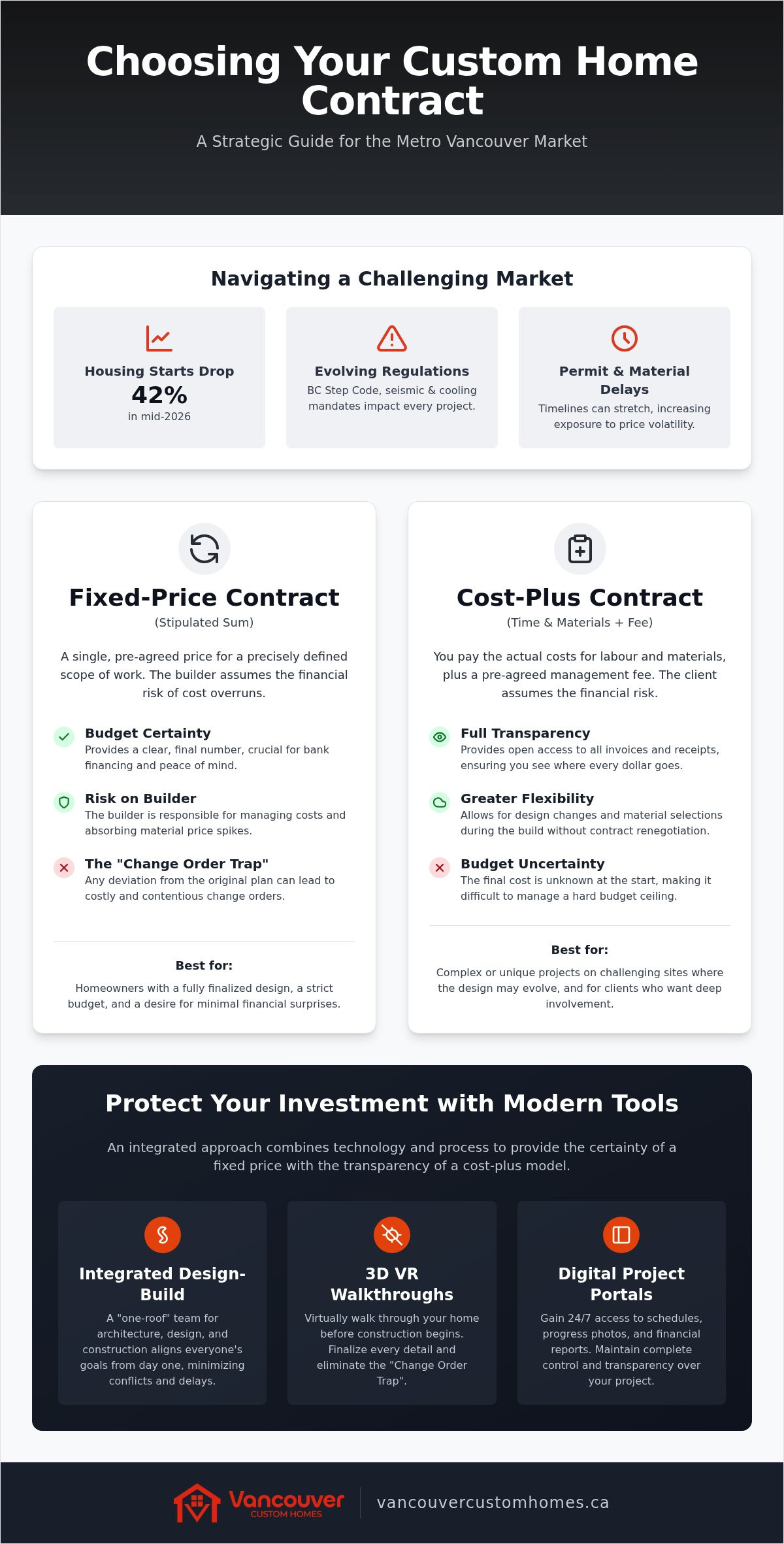
Comparative Analysis: Risk, Transparency, and Financial Control
Deciding between a fixed price vs cost plus contract vancouver homeowners often face requires a clear-eyed look at who carries the burden of the unknown. In 2026, material price volatility and labour shortages remain the two biggest variables in any build. In a fixed-price model, the builder acts as an insurance policy. If the cost of copper or high-efficiency glazing spikes mid-build, the builder absorbs that hit to protect your stipulated sum. Conversely, in a cost-plus model, you pay the market rate at the time of purchase. While this lacks a price ceiling, it ensures you aren't paying a "risk premium" baked into a fixed quote for events that might never happen.
The administrative burden also differs significantly between these two paths. Fixed-price contracts typically follow monthly progress draws based on completed milestones. It's a "set and forget" approach that suits busy professionals. Cost-plus models require weekly invoice reviews and a much deeper level of client involvement to maintain financial control. As custom home construction Vancouver standards evolve, the industry is moving toward a middle ground where technology bridges the gap between these two extremes. The goal is to align the builder's incentives with your desire for both quality and efficiency.
Risk vs. Reward: A Vancouver Homeowner's Matrix
To choose the right path, you must weigh your priorities across three critical dimensions:
- Budget Certainty: Fixed Price offers high certainty, while Cost Plus is variable.
- Design Flexibility: Fixed Price is rigid once the contract is signed; Cost Plus allows for fluid, on-the-fly changes.
- Transparency: Fixed Price is medium, as you see the final number but not the builder's margins. Cost Plus is high, provided you have the right tools to track every cent.
The Role of Transparency Technology
We believe that construction shouldn't be a "black box" of expenses. A dedicated project management portal is no longer a luxury; it's an essential tool for modern transparency. In a cost-plus model, this portal allows you to see receipts and trade quotes in real time, eliminating the fear of hidden markups. For fixed-price builds, the same technology tracks milestones to ensure your project stays on schedule. This data-driven approach helps you avoid "The Vancouver Surprise," where municipal permit delays or utility connection fees can create sudden friction. By using data to predict these costs, we replace anxiety with controlled, predictable excitement. Explore our project management portal to see how we maintain total accountability throughout your build.
Beyond the Contract: How Integrated Design and Technology Protect Your Investment
The debate over a fixed price vs cost plus contract vancouver often misses the most vital factor: the integration of your team. Choosing a contract is a legal formality, but choosing a "one-roof" design-build model is a strategic decision. When the architect and builder work under a single management umbrella, the friction between design vision and construction reality evaporates. This unified approach replaces the typical chaos of residential construction with a disciplined, holistic process. It ensures everyone is pulling in the same direction from the first sketch to the final inspection. By integrating these roles, we eliminate the finger-pointing that often occurs when a third-party architect's design exceeds a builder's budget.
The 3D VR Advantage in Fixed-Price Accuracy
3D VR walkthroughs are the bridge that makes budget certainty possible. Most change orders happen because a client couldn't visualize a 2D plan. By using immersive technology, you can experience the light, flow, and finishes of your home before breaking ground. This eliminates guesswork. Some industry professionals report that immersive visualization can reduce design-related change orders by 40 percent or more. It allows you to lock in a fixed price with genuine confidence because you've already "lived" in the space. For a deeper look at how this technology transforms the planning phase, read our guide on custom home design Vancouver.
Accountability Through the Project Management Portal
Accountability isn't just a promise; it's a digital trail. A dedicated project management portal provides real-time updates that you can access from your phone at any time. It centralizes communication, ensuring that vital decisions aren't buried in fragmented emails or texts. These scattered messages are the enemies of a successful build. Whether you are weighing a fixed price vs cost plus contract vancouver, this level of transparency is non-negotiable for a modern project. It provides the peace of mind that comes from knowing exactly where your project stands every day. Ultimately, a firm's internal process and their commitment to digital integration matter more than the specific contract template you sign. You aren't just buying a house; you're investing in a managed, professional journey.
Securing Your Building Future in Metro Vancouver
Building a custom home in 2026 requires more than just a signed agreement; it requires a strategy that evolves with the market. You've learned that the choice between a fixed price vs cost plus contract vancouver builders offer isn't just about risk. It's about how you use technology to eliminate ambiguity. Whether you prioritize the budget certainty of a fixed price or the flexibility of a cost-plus model, success depends on the precision of your pre-construction phase. By integrating 3D VR walkthroughs and real-time project management portals, you replace the traditional anxiety of construction with controlled, predictable excitement.
Our "one-roof" approach ensures your architect and builder are always aligned on your goals. We specialize in navigating Vancouver's complex zoning and Step Code requirements to ensure your investment is protected from the start. You deserve a building journey defined by transparency and accountability rather than financial disputes. Start your transparent building journey with Vancouver Custom Homes today and experience a process as refined as your final home. Your vision is too important to leave to chance.
Frequently Asked Questions
Is a fixed-price contract better for a laneway house in Vancouver?
A fixed-price contract is generally the superior choice for a laneway house because the scope is highly predictable. These projects often follow standardized footprints and municipal requirements, allowing for accurate upfront quoting. By locking in the price early, you avoid the administrative burden of tracking small invoices for a secondary dwelling. It provides the budget certainty necessary for families who are financing the build through a mortgage or home equity line of credit.
What happens if material costs go up in a fixed-price contract?
In a true fixed-price contract, the builder carries the risk of material price fluctuations. If the cost of lumber or concrete spikes after the contract is signed, the builder must absorb those additional expenses. This is why builders often include a risk premium in their initial quote. It protects you from market volatility, ensuring that your total investment remains unchanged regardless of global supply chain shifts or local labour shortages.
Can I switch from cost-plus to fixed-price halfway through a build?
Switching contract models mid-build is rare and technically complex. While it is possible if both parties agree to a contract amendment, it requires a complete audit of all work performed to date. The builder would need to establish a firm price for the remaining scope, which is difficult once walls are closed and systems are installed. Most homeowners find it more efficient to stick with their original model while utilizing a project management portal to maintain financial control.
How much should a builder's fee be in a cost-plus contract in BC?
Builder fees in British Columbia typically range between 10 percent and 20 percent of the total project cost. This fee covers the contractor's overhead, site supervision, and profit. The exact percentage often depends on the project's complexity and the level of risk the builder is assuming. Some firms may offer a flat management fee instead of a percentage to better align their incentives with your budget goals. Always ensure the fee structure is clearly defined in your agreement.
What are the hidden costs in a fixed-price building contract?
Hidden costs often stem from "unforeseen conditions" or items excluded from the initial scope. Common examples include unexpected rock excavation, municipal utility connection fees, or hazardous material remediation. Additionally, any deviation from the original design will trigger a change order. To minimize these surprises, ensure your contract includes a detailed "Schedule of Values" and that you've conducted thorough site testing before the stipulated sum is finalized.
How do 3D VR walkthroughs help keep my Vancouver home on budget?
3D VR walkthroughs allow you to finalize every architectural detail before construction begins. By experiencing the space digitally, you can identify layout issues or finish preferences that would otherwise lead to expensive change orders on-site. This technology effectively "fixes" the scope of a fixed price vs cost plus contract vancouver. It ensures that the design you see in the virtual world is exactly what the builder prices and delivers in the physical one.
Does a project management portal work with both contract types?
A dedicated project management portal is essential for both contract models. For cost-plus projects, it provides the "open book" transparency needed to track every receipt and trade invoice in real time. In a fixed-price scenario, the portal serves as a central hub for tracking construction milestones, schedule updates, and daily logs. It eliminates the chaos of fragmented communication, ensuring that you remain fully informed and in control of your project's progression from your smartphone.
What is a CCDC 5B contract and should I use it for my multiplex?
The CCDC 5B is a standard Canadian construction document for cost-plus contracts where the builder acts as the prime contractor. It is a highly professional framework often used for complex residential multiplexes. This contract provides a clear legal structure for managing trade costs and builder fees. While it offers excellent flexibility for evolving designs, it requires diligent administrative oversight. It is a strong choice if you prioritize transparency and have a highly organized project management team in place.


