

Your builder's transparency is just as critical as your credit score when you are learning how to finance a custom home build BC. In the 2026 market, the distance between a initial vision and a finished foundation often feels wider than ever. You likely already know that high interest rates and rigid equity requirements in Metro Vancouver can turn a luxury project into a financial maze. It's frustrating to face cash flow gaps caused by complex draw schedules that don't align with your actual construction timeline. Why should your vision be stalled by fragmented financing or unpredictable bank requirements?
This guide provides the professional reassurance you need to fund your project with total certainty. We'll show you how to transform the typical anxiety of large-scale builds into a sense of controlled excitement. You will learn to manage progress draws effectively, navigate the current 2.25 percent policy rate environment, and leverage new multiplex rules to maximize your property's potential. We are laying out a clear roadmap for loan approval that simplifies complex systems into a structured, predictable experience. Discover how to align your financing with a unified design-build process for a seamless journey home.
Key Takeaways
- Master the interest-only payment structure of construction mortgages to maintain financial stability while your home is under development.
- Navigate the five-stage progress draw schedule with confidence by understanding exactly how lenders and inspectors verify each milestone.
- Leverage the latest 2026 BC multiplex zoning rules to realize higher appraisal values and unlock more competitive financing for your property.
- Identify and budget for essential "soft costs," such as design and permits, which are typically funded outside of your primary construction loan.
- Learn how to finance a custom home build BC using a unified design-build model that provides the transparency and cost certainty required for lender approval.
Understanding BC Construction Financing vs. Traditional Mortgages
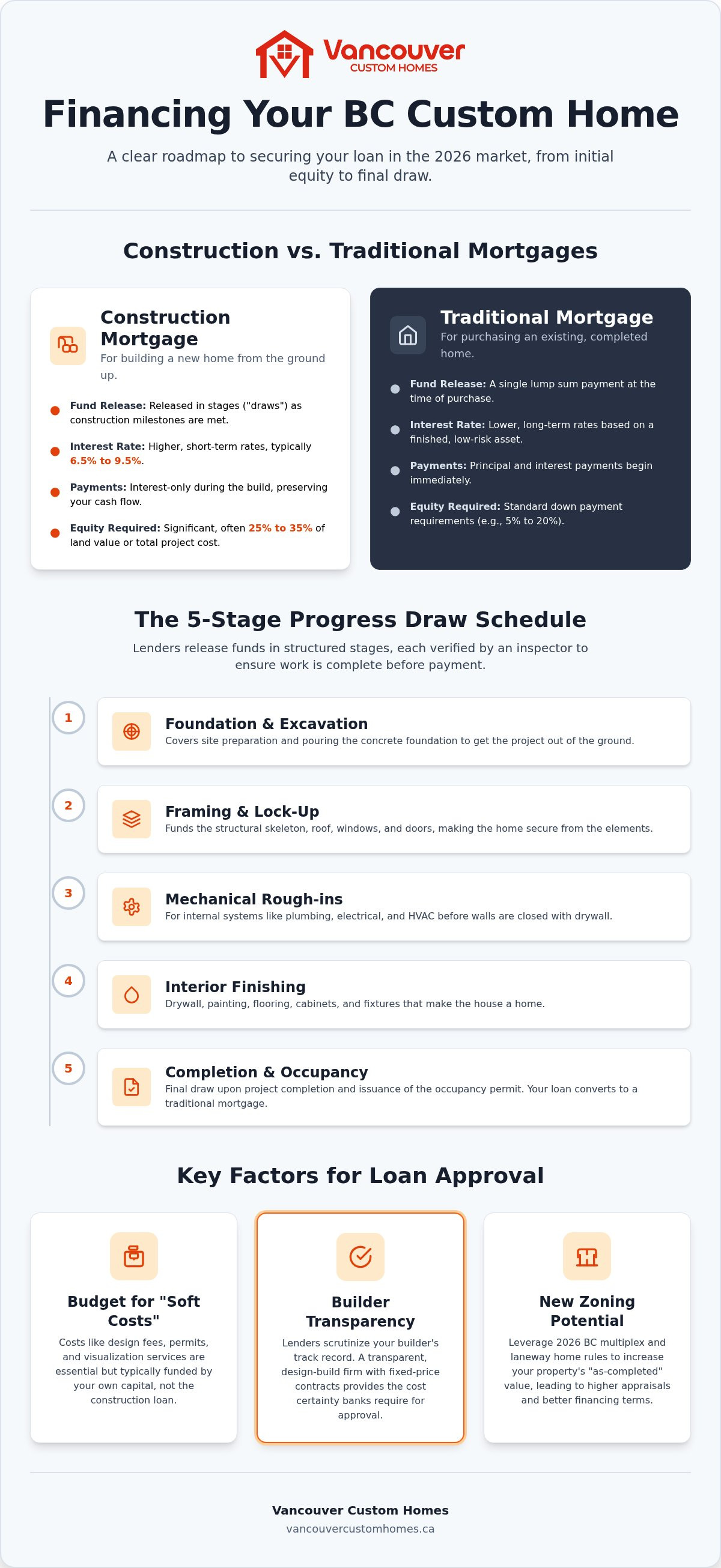
Securing funds for a new build is fundamentally different from purchasing an existing property. While Traditional Mortgages provide a lump sum to buy a finished structure, a construction mortgage acts as a short-term, high-interest tool designed to cover the specific duration of your build. In 2026, private lender rates for these loans typically range from 6.5 percent to 9.5 percent; this reflects the higher risk associated with unbuilt assets. You won't pay back the principal immediately. Instead, you'll manage an interest-only payment structure. This setup is a vital stabilizing force for your cash flow, ensuring you only pay for the funds you've actually used at each stage of the project.
If you are researching how to finance a custom home build BC, you must prepare for strict equity requirements. In the expensive Metro Vancouver market, lenders often demand 25 percent to 35 percent equity in the land or a similar down payment on the total project cost. This creates a secure foundation for the bank, but it requires you to have significant capital ready before the first shovel hits the dirt. Your land value is often your greatest asset in this equation, especially if you've owned the property long enough to see its value appreciate.
The Two Main Types of Construction Loans
Most custom projects rely on progress draw mortgages. Under this model, the lender releases funds in stages, or "draws," as your builder reaches specific milestones. This ensures that the money stays aligned with the physical progress of the house. In contrast, completion mortgages are common for spec homes or pre-built residences where the buyer pays the full amount only when the home is 100 percent finished. For a true custom build, a completion mortgage is rarely an option because your builder needs active cash flow to pay for specialized labour and materials. Once your occupancy permit is issued, your construction loan typically rolls over into a standard mortgage with lower, long-term rates.
Why Traditional Banks View Custom Builds Differently
Lenders don't just look at your credit score; they scrutinize your builder with equal intensity. A bank views an unbuilt home as a liability until it's finished. They prioritize builders with a proven track record of punctuality and transparency. This is why a fixed-price contract is often non-negotiable for loan security. If costs are unpredictable, the bank's risk increases. We use 3D VR walkthroughs and detailed project management portals to help appraisers realize the "as-completed" value of the home with high precision. By providing a unified, "one-roof" design-build solution, you offer the bank the certainty they crave, which often leads to smoother approvals and better terms.
Navigating the Progress Draw Schedule and Equity Requirements
Understanding the mechanics of fund releases is vital for maintaining momentum on your site. Unlike a standard mortgage where you receive funds upfront, Navigating the Progress Draw Schedule requires a disciplined approach to project milestones. Lenders do not simply take your word for it when you claim a stage is finished. Instead, they dispatch a Quantity Surveyor or a bank inspector to the property to verify that the work matches the requested funds. This professional assessment ensures the bank's investment remains protected while providing you with the capital needed to pay your specialized trades. If the inspector finds the work is only 80 percent complete for a specific stage, the bank will only release 80 percent of that draw, potentially leaving you with a temporary cash flow gap.
The Five Critical Milestones of a BC Build
Most lenders in British Columbia follow a structured five-stage release pattern. This organized sequence mirrors the physical reality of the construction process:
- Stage 1: Foundation and Excavation. This covers the cost of getting the project out of the ground, including site preparation and pouring the concrete.
- Stage 2: Framing and Lock-up. This milestone focuses on the structural skeleton of the home. The lock-up stage is the specific point when the home is protected from the elements with windows and doors installed.
- Stage 3: Mechanical Rough-ins. Funds are released once the internal "veins" of the house, including plumbing, electrical, and HVAC systems, are in place but before the walls are closed.
- Stage 4: Interior Finishing. This stage covers the visible elements like drywall, cabinetry, flooring, and initial paint.
- Stage 5: Final Completion. The final funds are released once landscaping is finished and the municipality issues the crucial occupancy permit.
Managing the Cash Flow Gap
One of the biggest hurdles when learning how to finance a custom home build BC is the 10 percent holdback required by the BC Builders Lien Act. By law, you must retain 10 percent of each payment to your builder and trades in a separate account for 55 days after the project is substantially performed. This protects you from potential liens, but it means you must have enough liquid capital to cover these amounts while waiting for the bank to release the final holdback funds. We recommend maintaining a contingency fund of at least 15 percent to navigate these timing delays without stress. You can track these financial milestones in real-time through our project management portal, which ensures your lender has the documentation they need for every draw request. This proactive discipline replaces the typical anxiety of construction with a structured, predictable journey.
Financing Options for Laneway Homes and Multiplexes in BC
The 2026 BC multiplex zoning rules have fundamentally shifted how lenders appraise residential land. Previously, a single-family lot was valued solely on its existing structure or replacement cost. Today, appraisers must realize the "highest and best use" potential, which often includes the capacity for three to six units. This change in valuation is a powerful tool when you are learning how to finance a custom home build BC. Lenders are increasingly receptive to "pro-forma" calculations, where they allow you to use up to 80 percent of projected rental income from your future units to qualify for a larger loan. This foresight turns your property into an active investment rather than just a primary residence.
Laneway Home Financing: Leveraging Your Existing Equity
Building a secondary dwelling doesn't always require a complex construction mortgage. If you have significant equity in your primary home, a Home Equity Line of Credit (HELOC) is often the most efficient path. It provides immediate liquidity with interest-only payments, allowing you to pay for materials and labour as needed. Alternatively, you can refinance your primary mortgage to include the cost of the build. This integrates the project into a single monthly payment, though it may trigger a new appraisal to confirm the added value. For a deeper look at site-specific requirements, consult our guide for Laneway Home Builders Vancouver.
Multiplex Development: Financing for Density
Once your project exceeds two units, the line between residential and commercial lending begins to blur. For a four-unit multiplex, some major banks still offer residential products, but they will scrutinize your debt-servicing ratios with professional intensity. You may need to secure "take-out financing," which is a pre-arranged mortgage that replaces the construction loan once the units are occupied. This ensures you aren't stuck with high-interest debt after the build is complete.
Private landowners should also investigate the BC Builds construction financing program. In 2026, this provincial initiative offers interim construction rates as low as 2.75 percent for projects that provide rental housing for middle-income households. To qualify, your units must remain accessible to households with incomes up to $212,240 for two-bedroom suites. While the reporting requirements are strict, the interest savings can be substantial, especially when navigating Metro Vancouver's $29,197 Development Cost Charges per unit. Our latest Multiplex Development Vancouver analysis covers how these programs integrate with modern density trends to maximize your project's viability.
Budgeting for "Soft Costs": Permits, Design, and Visualization
Lenders typically prioritize the tangible structure of your property. This creates a significant hurdle when you're figuring out how to finance a custom home build BC. Most construction loans do not trigger until the foundation is poured, meaning you must cover "soft costs" out-of-pocket or through a personal line of credit. Architectural fees, site surveys, and municipal permits are your responsibility before the first bank draw. In Metro Vancouver, these expenses are not trivial. For 2026, the City of Vancouver applied a 4.5 percent increase across all permit categories. You'll likely face a $2,800 fee just for a pre-application meeting. If you're building in Burnaby or North Vancouver, the fee structures vary, but the requirement for upfront liquidity remains a constant.
The Hidden Costs of Getting Started
Demolition and site clearing are your first major hurdles. You cannot reach Draw 1 without a clear lot, yet banks rarely advance funds for the removal of an existing structure. Professional fees for engineers and energy advisors are also mandatory. With the latest BC Building Code updates, achieving Step Code 5 compliance requires specialized expertise that must be paid for during the design phase. You must also account for Vancouver-specific costs like the Empty Homes Tax, which can apply during the permit waiting period if the property is left vacant. Failing to account for these "pre-draw" expenses can create a cash flow gap that stalls your project before it even begins.
How Visualization Reduces Financial Risk
Traditional blueprints are static and often lead to "scope creep" when you realize a room layout doesn't work mid-build. Change orders are a lender's nightmare; they can trigger expensive re-appraisals and stall your funding. Using 3D VR walkthroughs allows you to finalize every detail, from cabinetry to lighting, before a single nail is driven. This proactive discipline ensures your design is buildable and your budget remains fixed. Our Custom Home Design Vancouver process integrates these tools to provide the cost certainty lenders demand. By visualizing the final product early, you avoid the financial friction of mid-project adjustments.
To secure your project's financial foundation and eliminate budget surprises, book a consultation with our integrated design-build team today.
How a Transparent Builder Helps You Secure Better Financing
Most financial guides focus solely on the borrower's credit score or equity. This is a mistake. When you are determining how to finance a custom home build BC, the lender's appraisal of your builder is equally significant. A bank views an unbuilt home as a collection of risks. A builder with a documented track record of punctuality and transparent invoicing acts as a stabilizing force for your loan approval. Lenders crave predictability; they want to know that the funds they release will result in a finished, high-value asset without the chaos of mid-project cost overruns. Your builder's reputation effectively becomes part of your collateral.
The Power of the Project Management Portal
Bank inspectors often cause delays because they lack immediate visibility into site progress. We solve this by using our project management portal as a direct reporting tool. By providing the bank with real-time photo evidence and time-stamped documentation of construction milestones, we streamline the verification process. This transparency allows funds to be released faster, ensuring your trades are paid on time and your project maintains momentum. Understanding these Home Builder Client Portal Benefits is essential for any homeowner who values financial efficiency. Instead of waiting weeks for a physical site visit, the portal provides the "proof of progress" that keeps the cash flow steady and predictable.
Why Integrated Design-Build is the Safest Financial Bet
Fragmented projects often suffer from the "blame game" between architects and builders. When a design is unbuildable or exceeds the budget, the homeowner is left to cover the gap, which can jeopardize the entire mortgage commitment. An integrated model eliminates this friction by housing design and construction under one roof. This unity allows us to offer fixed-price guarantees that provide the absolute cost certainty banks require for high-leverage loans. When your lender sees a unified contract where the designer and builder are the same entity, their risk assessment drops. This approach is a cornerstone of Custom Home Construction Vancouver, ensuring that your financial journey is as refined as your final home. By choosing an authoritative guide who takes full responsibility for every detail, you replace the typical anxiety of large-scale projects with a sense of controlled excitement.
Building Your Financial Foundation with Certainty
Funding a luxury project in Metro Vancouver requires more than just a healthy credit score; it demands a strategic partnership. You now understand how to navigate interest-only payments and the 10 percent holdback required by the BC Builders Lien Act. You also know how to leverage 2026 multiplex zoning to maximize your property's appraisal value. Mastering how to finance a custom home build BC is about replacing fragmented, stressful steps with a single, unified strategy that lenders trust.
We provide the professional reassurance you need through immersive 3D VR walkthroughs that help appraisers realize future value before construction begins. Our deep expertise in Metro Vancouver multiplex and laneway regulations ensures your project remains compliant and profitable. You can track every milestone and draw request through our exclusive Project Management Portal, giving your lender the real-time transparency they crave for smooth fund releases. Start your transparent build journey with a Vancouver Custom Homes consultation today. Your vision deserves a process as refined as the final product. Let's build your future with total confidence.
Frequently Asked Questions
Can I use my land as a down payment for a construction loan in BC?
Yes, you can use your land equity as a primary source of down payment for a construction loan. Lenders in British Columbia typically allow you to leverage the appraised value of the lot to satisfy their equity requirements. If you own the land outright, it often covers the entire down payment for the build. This is a common strategy when learning how to finance a custom home build BC, allowing you to preserve liquid cash for soft costs.
What is the typical interest rate for a construction mortgage in Vancouver in 2026?
In 2026, interest rates for construction mortgages in Vancouver vary by lender type. While the Bank of Canada policy rate sits at 2.25 percent, private construction loans typically range from 6.5 percent to 9.5 percent. If you qualify for the provincial BC Builds program, interim construction financing rates can be as low as 2.75 percent for specific rental-focused projects. These rates reflect the short-term, interest-only nature of the debt during the build phase.
How much cash do I need upfront before I can get my first bank draw?
You generally need enough cash to cover all soft costs before the first bank draw is released. This includes architectural fees, site surveys, and municipal permits, which can exceed $50,000 in Metro Vancouver. Banks rarely fund these pre-construction expenses. Having a liquid contingency fund of at least 15 percent of the total project cost is essential to maintain cash flow while waiting for the lender to verify your first physical milestone.
Is it harder to finance a laneway home than a standard custom home?
Financing a laneway home is often simpler because you can leverage the existing equity in your primary residence. Most homeowners use a Home Equity Line of Credit (HELOC) or a mortgage refinance rather than a separate construction loan. However, if your primary mortgage is already at its limit, securing additional funding for a secondary dwelling requires a new appraisal that accounts for the projected rental income to satisfy debt-servicing ratios.
What happens if my custom home build goes over budget?
If your project exceeds the initial budget, you are responsible for covering the shortfall out-of-pocket. Lenders base their loan-to-value ratio on the original appraisal and fixed-price contract. Significant cost increases may trigger a re-appraisal, which can be expensive and slow. This is why we emphasize using 3D VR walkthroughs and detailed project management portals to lock in designs and prevent mid-build change orders that jeopardize your financing.
Do BC construction loans cover the cost of demolition?
Most traditional construction loans do not cover demolition costs. Lenders view the removal of an existing structure as a reduction in the property's immediate collateral value. You must typically fund the demolition and site clearing yourself before the bank will advance the first draw for the new foundation. It's a critical part of knowing how to finance a custom home build BC, as these early expenses require separate liquid capital.
How do the new BC multiplex rules affect my ability to get a loan?
The new BC multiplex rules significantly enhance your borrowing power by increasing the appraised value of your lot. Appraisers now consider the potential for multiple units, which allows for higher loan-to-value ratios. Additionally, many lenders allow you to use up to 80 percent of the projected rental income from the new units in your pro-forma calculations. This makes it easier to qualify for the larger loans required for high-density Metro Vancouver developments.
Can I act as my own owner-builder and still get bank financing in BC?
Securing bank financing as an owner-builder is extremely difficult in the current market. Lenders view self-managed projects as high-risk due to potential delays and code compliance issues. Most major banks require a licensed builder with a proven track record and New Home Warranty coverage. If you act as your own builder, you may be restricted to high-interest private lenders who demand significantly more equity and more frequent site inspections.


