
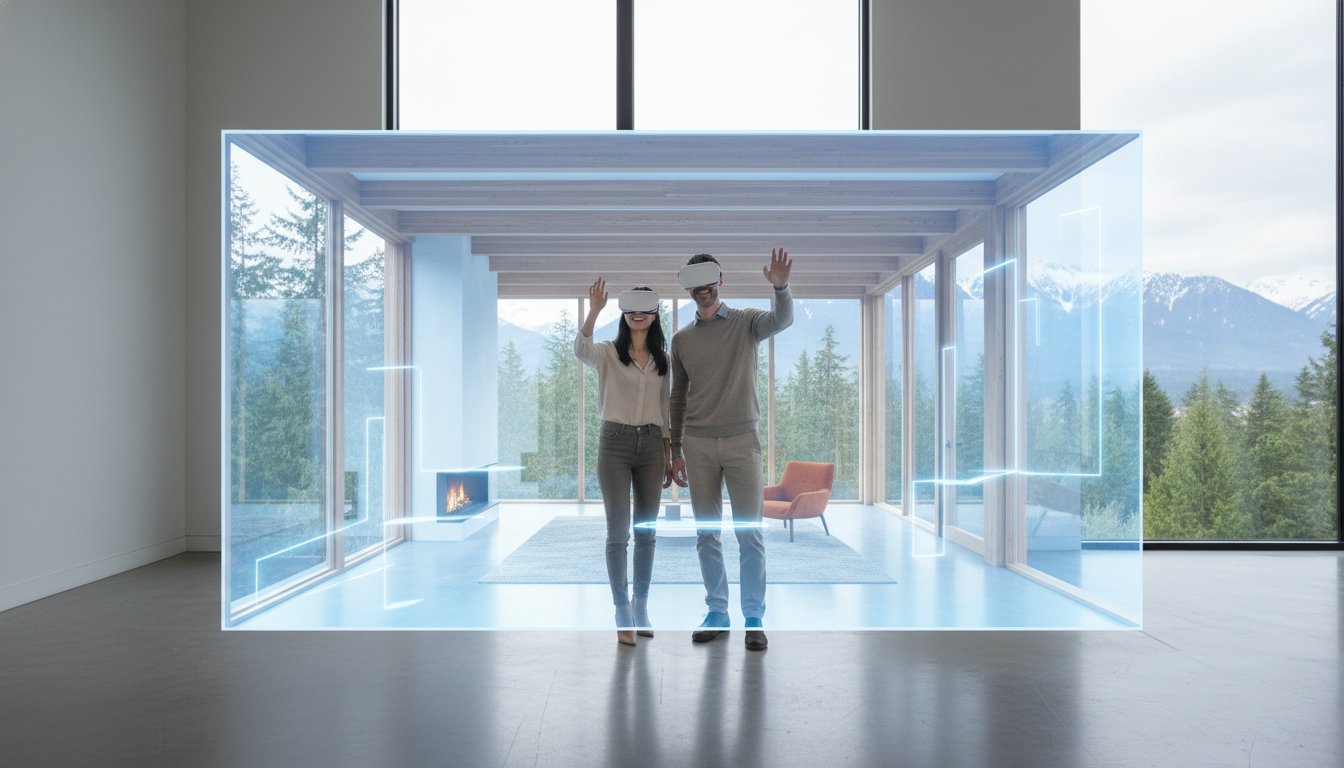
The most expensive mistake in a Vancouver custom build isn't a luxury material choice. It's a design flaw you only realize exists once the walls are already standing. Why should you risk "buyer's remorse" on your largest investment when you can walk through every room before construction even begins? If you've struggled to translate flat 2D architectural drawings into a true sense of space, you aren't alone. Most homeowners find it nearly impossible to gauge ceiling heights or natural light flow from a piece of paper.
By integrating virtual reality home design Vancouver services into your project, you can eliminate the guesswork that leads to surprise costs and construction delays. This guide will show you how to use immersive 3D VR technology to gain complete confidence in your floor plan and aesthetic. You'll discover how a digital walkthrough creates a seamless transition to the build phase, ensuring the final result is exactly what you envisioned without the stress of mid-project changes.
Key Takeaways
- Experience your future home at a 1:1 scale to finalize spatial flow and layout with absolute certainty before breaking ground.
- Learn how virtual reality home design Vancouver converts technical CAD files into immersive walkthroughs that simplify complex design decisions.
- Eliminate the risk of expensive change orders by identifying potential design conflicts in a virtual environment rather than during the build phase.
- Maximize the potential of laneway homes and multiplexes by visualizing small-space functionality and natural light in high definition.
- Ensure a seamless construction journey by integrating your 3D VR designs into a centralized project management portal for total transparency.
What is Virtual Reality Home Design and Why Does It Matter?
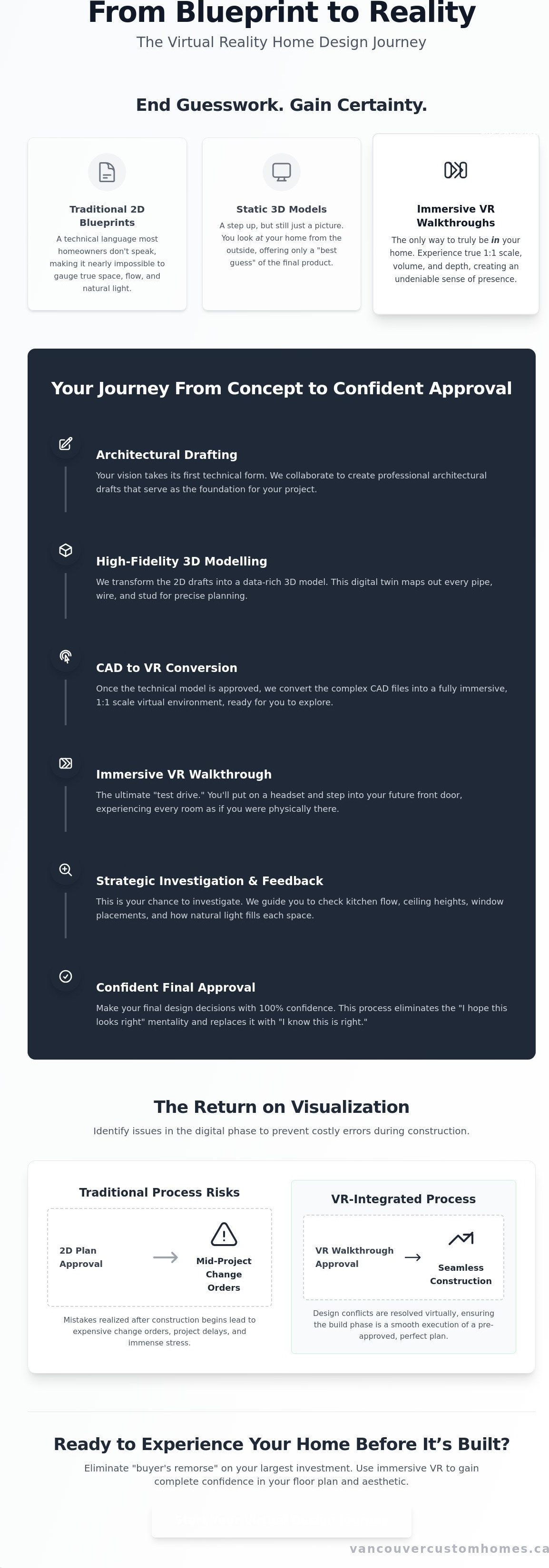
Traditional blueprints are a language that most homeowners don't speak fluently. Trying to imagine a three-dimensional life from a two-dimensional piece of paper is a recipe for anxiety. This is where virtual reality home design Vancouver changes the game. It creates a fully immersive, 1:1 scale digital environment where you don't just look at a floor plan; you inhabit it. We've moved far beyond static 3D renders that only offer a "best guess" of the final product. Today's interactive walkthroughs provide a level of clarity that was once impossible. Why should you guess about the height of your vaulted ceilings or the width of a hallway when you can experience them personally?
The shift from looking at a screen to stepping into a digital world is profound. In the past, a designer might show you a beautiful image of a kitchen. It looked great, but it didn't tell you if the distance between the island and the fridge felt cramped. VR removes this translation layer entirely. It allows you to realize the true scale of your rooms before a single nail is driven. This certainty is the cornerstone of a successful custom build. It replaces the "I hope this looks right" mentality with a definitive "I know this is right."
The Difference Between 3D Models and VR Walkthroughs
Many people confuse standard 3D models with true virtual reality. The difference is simple: 3D models are for looking at a home, while VR is for being in it. To understand What is Virtual Reality? in an architectural context, you have to look at the sense of "presence" it creates. By using specialized headsets and motion tracking, the software tricks your brain into believing you're physically standing in the space. You can turn your head to see the view from the living room window or look up to check the placement of recessed lighting. This spatial awareness is something a flat screen can't replicate. It provides a realistic perspective on volume and depth that ensures every design choice is intentional and functional.
Why Vancouver Homeowners Are Demanding VR
In the Lower Mainland, the stakes of residential construction are incredibly high. With land costs at record levels, there's no room for error or wasted space. This is why virtual reality home design Vancouver has become a standard requirement for savvy property owners. Whether you're planning a sophisticated custom home or maximizing a small lot with a laneway house, every square inch must perform. VR is particularly effective for visualizing "small space living" in multiplexes or secondary suites. It allows you to test furniture layouts and natural light flow in high definition. Knowing exactly how a compact floor plan feels helps prevent the claustrophobia that often comes from poor 2D planning. It offers the peace of mind that your investment will result in a home that's as comfortable as it is valuable.
How to Navigate the VR Design Process: A Step-by-Step Guide
Building a custom home is a linear journey, but it shouldn't be a blind one. It begins with professional architectural drafting where your initial vision takes its first technical form. We use these drafts to create a high-fidelity 3D model. This isn't just a pretty picture; it's a data-rich foundation that maps out every pipe, wire, and stud. A critical review of virtual reality in construction highlights how these BIM-enabled models are now essential for modern project management and error reduction. Once the technical model is locked, we convert the CAD files into an immersive environment. This is the moment virtual reality home design Vancouver transforms from a concept into a tangible tool for your project.
The transition from a flat drawing to a digital world happens quickly. Our team takes your approved floor plans and renders them into a 1:1 scale environment. You don't need to be a tech expert to participate. You'll simply put on a headset and step into your future front door. This phase is designed to be interactive and informative, giving you a chance to see how the sun hits your living room or how the kitchen island interacts with the dining area. It's the ultimate "test drive" for a property that hasn't been built yet.
Preparing for Your First VR Walkthrough
You should enter your first session with a clear strategy. Don't just look around; investigate the specifics. Focus on high-traffic zones and transitions between rooms. Does the kitchen flow make sense for your morning routine? Is the ceiling height in the foyer creating the architectural impact you desire? We recommend testing different furniture layouts within the headset to ensure your favourite pieces fit the scale of the room perfectly. Prepare a list of your non-negotiable "must-haves" beforehand so we can verify every detail during the session.
Making Changes in the Digital World
The true power of this technology lies in its absolute flexibility. In the digital world, moving a structural wall or widening a window is a matter of a few clicks. In the physical world, those same changes are a disaster for your budget and timeline. We use this "digital twin" to experiment with different materials, lighting scenarios, and floor plan iterations. This collaborative approach allows you to see the immediate impact of every choice you make. By refining these details now, you effectively eliminate the need for costly change orders once the framing starts. It's about achieving total certainty. If you're ready to see your vision in high definition, you can explore our custom home design options to get started.
After the walkthrough is complete and you're 100% satisfied with the experience, we finalize the design documents. These precise digital files then serve as the master blueprint for permit submission and the actual construction phase. This rigorous process ensures that the home you walked through in the headset is exactly what gets built on your Vancouver lot. It's a seamless transition from a digital dream to a physical reality.
The ROI of Visualization: Saving Costs Before Breaking Ground
Financial certainty is the most valuable asset you can have during a custom build. In a market as expensive as the Lower Mainland, a single design mistake can lead to thousands of dollars in wasted capital. Why wait until the framing is finished to realize the master bedroom feels too small or the kitchen island is misplaced? This is where the return on investment for virtual reality home design Vancouver becomes undeniable. It moves the trial-and-error phase from the construction site to the digital world, where mistakes cost nothing to fix.
Most budget overruns aren't caused by rising material costs alone. They're caused by the "I didn’t realize it would look like this" syndrome. When a homeowner sees their project in 3D for the first time after the walls are up, they often request changes. These mid-construction pivots are logistical nightmares. VR solves this by providing a definitive preview that aligns your expectations with the architectural reality. It ensures that when the first shovel hits the dirt, every decision has already been "lived in" and approved.
Eliminating the "Change Order" Headache
Change orders are the primary reason custom projects blow past their initial estimates. If you decide to move a structural wall or relocate a window after the framing is complete, you're paying for demolition, new materials, and extra labour. You're also potentially triggering a delay in your permit schedule. Using VR acts as a final sanity check for your architectural plans. It provides a level of transparency and accountability that protects your budget. When you can walk through the house virtually, you catch these issues months before they become physical problems. This proactive approach keeps the project on schedule and ensures the builder is working from a finalized, conflict-free design.
Visualizing Custom Finishes and Lighting
Vancouver's light is unique, often shifting from bright sun to heavy overcast in a matter of hours. Our VR technology simulates natural light at different times of the day, allowing you to see exactly how your interior colours will react to local conditions. You can swap flooring materials, cabinetry colours, or countertop finishes instantly within the headset. This prevents the costly mistake of ordering expensive materials that don't look as expected in your specific space. For those who want to see how expert painting can transform woodwork, cabinetsrefinishing.com provides excellent examples of high-quality finishes. We treat your 3D model as a "digital twin," a precision tool for budget management that allows for exact material ordering. This level of foresight reduces waste and ensures that your high-end finishes are a perfect match for your vision from day one.
By investing in a digital twin before construction, you aren't just buying a visual aid. You're buying insurance against the chaos of the build phase. This strategic use of technology ensures that your resources are spent on the final product rather than on fixing avoidable mistakes. It's the most efficient way to bridge the gap between a design concept and a finished home.
VR for Vancouver Specifics: Laneway Homes and Multiplexes
Vancouver's residential landscape is shifting rapidly under new provincial mandates and city zoning updates. With the push for "missing middle" housing, property owners are increasingly looking at multiplexes and laneway houses as strategic investments. However, building high-density housing on standard city lots requires surgical precision. This is why virtual reality home design Vancouver has become a critical tool for local builds. When you're dealing with strict setbacks and tight Floor Space Ratios (FSR), every millimetre counts. VR allows you to verify that your ambitious project fits within the neighbourhood fabric while respecting the privacy of your neighbours.
The complexity of modern Vancouver density means you can't rely on imagination alone. You need to see how a new structure impacts your backyard's natural light or if a window placement creates an awkward view into a neighbour's living room. VR provides a digital "dry run" that identifies these friction points months before they become permanent mistakes. It's about replacing the chaos of high-density construction with a controlled, predictable design experience.
Maximizing Laneway House Potential
A laneway home in Vancouver is typically capped at approximately 900 square feet. Making such a compact footprint feel like a grand, functional residence requires masterful window placement and clever use of volume. By using VR, you can stand inside the digital model and see exactly how the 18-foot maximum allowable height impacts the feel of the upper floor. It helps you decide if a vaulted ceiling is necessary or if a specific window orientation compromises the required 20-foot setback from the main house. If you're ready to maximize your property's value, explore the Vancouver Custom Homes laneway home services to see how we optimize every square foot of your lot.
Multiplex Design and Investor Certainty
The introduction of Bill 44 and Bill 25 has changed the game, mandating that Vancouver permit up to six units on specific lots. For investors, this level of density is a significant challenge. How do you ensure four to six units flow correctly without feeling like a maze? VR acts as a stabilizing force in this complex process. It allows you to walk through each individual unit to assess marketability, rental appeal, and tenant privacy. You can check the sightlines between balconies and common areas to ensure the layout is as functional as it is profitable. Instead of guessing how a 1.0 FSR multiplex will look, you can experience the finished product before the city even approves the development permit. If you're planning a multi-unit project, we can help you design a multiplex that balances density with high-end livability.
Beyond the Headset: Integrating VR into Your Construction Journey
Virtual reality is a revolutionary tool, but its true value is only realized when it's backed by a team that can actually build what you see. Many standalone design firms in the Lower Mainland offer beautiful renders that look stunning in a headset but lack structural logic. This creates a dangerous gap between your expectations and the finished product. To avoid this, you need a "one-roof" solution where the designers and builders work in total lockstep. Virtual reality home design Vancouver should never be a fragmented service; it must be the digital foundation for the entire construction process.
Choosing an integrated design-build firm ensures that your project doesn't stall when it moves from the screen to the site. When your builder is involved from the first digital sketch, they ensure that every architectural choice is grounded in construction reality. This unified approach eliminates the friction often found between separate architects and contractors, providing a seamless journey from your initial vision to the final walkthrough of your physical home.
Why Your Builder Should Be in the VR Room
Why wait for the framing stage to discover a structural conflict? When a builder joins you in the VR environment, they act as a lead strategist who spots potential issues before they exist. While a designer might focus on the aesthetic impact of a wide-span window, the builder is looking at the load-bearing requirements and the routing of HVAC systems. This synergy between architectural vision and construction reality is what makes a project "buildable" within your budget. It's about accountability. If your builder has walked through the digital twin and confirmed the details, they take full responsibility for delivering that exact result on-site. This collaboration prevents the technical oversights that lead to delays and ensures the transition to the build phase is fast-paced and logical.
The Vancouver Custom Homes Advantage
At Vancouver Custom Homes, we don't treat 3D VR walkthroughs as a luxury add-on. It's a standard part of our disciplined workflow. We provide every client with a high-fidelity digital twin that serves as the "source of truth" for the entire project. This isn't a static file that gathers dust; it's a dynamic tool that translates directly into our project management portal. You'll have real-time access to track your project's progress, ensuring total transparency from the moment you take off the headset until the day we hand over the keys. This integration means that the precision of the VR design is maintained through every phase of construction, from the foundation to the final finishes. It's time to replace the typical anxiety of building with controlled, predictable excitement. Start your VR home design journey with Vancouver Custom Homes today and experience the certainty of a unified design-build process.
Secure Your Custom Home Investment with Digital Precision
Building a custom home in the Lower Mainland is a significant endeavour that requires more than just a vision. It demands a strategic process that eliminates guesswork and protects your capital from the start. By leveraging virtual reality home design Vancouver, you move beyond the limitations of flat drawings and step into a world of absolute spatial certainty. You now understand how this technology prevents costly change orders while optimizing the potential of complex laneway and multiplex developments.
Why risk the anxiety of construction surprises when you can verify every detail today? Vancouver Custom Homes provides comprehensive in-house 3D VR walkthroughs as a standard part of our disciplined workflow. Our integrated approach ensures that your digital twin translates perfectly into a physical reality, all while you track progress via our transparent project management portal. It's time to replace uncertainty with controlled, predictable excitement. Book your immersive VR walkthrough with Vancouver Custom Homes and take the first step toward a seamless build experience.
Frequently Asked Questions
Do I need special equipment to view my home design in virtual reality?
You don't need to purchase any specialized hardware to experience your design. Our team provides the high-performance headsets and motion-tracking sensors required for a fully immersive walkthrough at our studio. If you prefer to view the model from your own location, we can often provide a web-based 3D link that works on your existing computer or tablet without the need for a headset.
Can VR home design help with the Vancouver building permit process?
It plays a crucial role in ensuring your architectural plans meet strict City of Vancouver requirements before submission. By using virtual reality home design Vancouver, we can verify that setbacks, height restrictions, and FSR calculations are physically accurate. This precision reduces the likelihood of city planners requesting major design revisions, which keeps your permit timeline on track and avoids costly delays.
How much does virtual reality home design cost in Vancouver?
The cost is typically integrated into the overall design-build contract rather than billed as a standalone expense. While industry rates for custom VR walkthroughs can vary based on the complexity of the home, we include this service to ensure project certainty. It's best to view this as a strategic investment that eliminates the high cost of mid-construction change orders and architectural errors.
Is it possible to make changes to the design while I am inside the VR experience?
You can request real-time adjustments to materials, colours, and lighting while wearing the headset. While structural changes like moving a load-bearing wall require an update to the underlying CAD model between sessions, many aesthetic choices can be swapped instantly. This allows you to compare different flooring or cabinetry options with immediate visual feedback, ensuring every finish is exactly what you envisioned.
Does VR visualization work for renovations or only for new custom builds?
We focus our VR visualization services on new custom home construction, laneway homes, and multiplex developments. This technology is most effective when planning a project from the ground up, as it allows for total control over the architectural footprint. It ensures that every aspect of a new high-density build is optimized for the specific lot conditions and zoning regulations found in Vancouver.
How accurate is the lighting and colour representation in a VR walkthrough?
The lighting simulation is exceptionally precise because it uses localized geospatial data to mimic Vancouver's specific sun angles. We can adjust the time of day and season to see how natural light interacts with your chosen interior colours and finishes. This ensures that the palette you select in the digital world looks exactly as you expect once the physical structure is complete.
Can I share the VR experience with my family or business partners?
We encourage you to involve key stakeholders in the walkthrough session to ensure everyone is aligned on the vision. Our system supports multiple viewers, allowing your family or investment partners to see the space simultaneously. We can also generate panoramic images or 360-degree videos from the VR model that you can easily share via email or through our project management portal. To see how these visual assets translate to professional marketing, you can discover Three Sixty Snap Inc. and their high-quality real estate media services.
How long does it take to create a VR model of my custom home design?
The initial VR environment is typically ready within a few weeks of finalizing your initial architectural drafts. The timeline depends on the complexity of the project, such as the number of units in a multiplex or the level of interior detail required. Once the base model is built, updates for design iterations can be processed rapidly to keep your project moving forward.


