

What if the most destructive part of your project was actually its most strategic foundation? For many homeowners, the cost to demolish a house in Richmond BC feels like a moving target obscured by shifting WorkSafeBC asbestos regulations and complex city permit timelines. You're right to feel cautious about the potential for budget creep before the first new brick is even laid. It’s a stage of construction that often feels more like a liability than an opportunity for growth.
This guide provides the professional reassurance you need by delivering a transparent breakdown of 2026 demolition costs and Richmond-specific salvage requirements. You'll learn how to navigate the city’s unique Green Demolition Program and manage the transition from an old lot to a custom new build without the typical contractor chaos. We’ll show you how to realize a predictable, organized start to your project by integrating demolition into a singular, unified vision for your future home.
Key Takeaways
- Understand how 2026 regulations and the rise of multiplex zoning in Richmond have shifted the focus from traditional knockdown methods to sustainable deconstruction.
- Identify the specific variables that influence the cost to demolish a house in Richmond BC, including the "Richmond Premium" and hazardous material abatement.
- Discover how the Richmond House Moving and Salvage Program can minimize your disposal fees while aligning your project with the city's green building initiatives.
- Learn to navigate critical site preparation hurdles such as tree protection bylaws and mandatory WorkSafeBC asbestos licensing to prevent project delays.
- See how an integrated design-build approach uses 3D VR walkthroughs to plan your new custom home or multiplex before the old structure is even cleared.
Understanding the Richmond Demolition Market in 2026
Richmond's residential landscape is evolving at a record pace. The 2026 market is no longer defined by simple renovations. Instead, it is defined by the strategic removal of aging structures to make way for high-density living and modern luxury. Provincial mandates and local zoning updates have accelerated the demand for multiplexes. This surge has directly impacted the cost to demolish a house in Richmond BC, as teardown demand remains high even as residential construction investment sees a broader provincial slowdown.
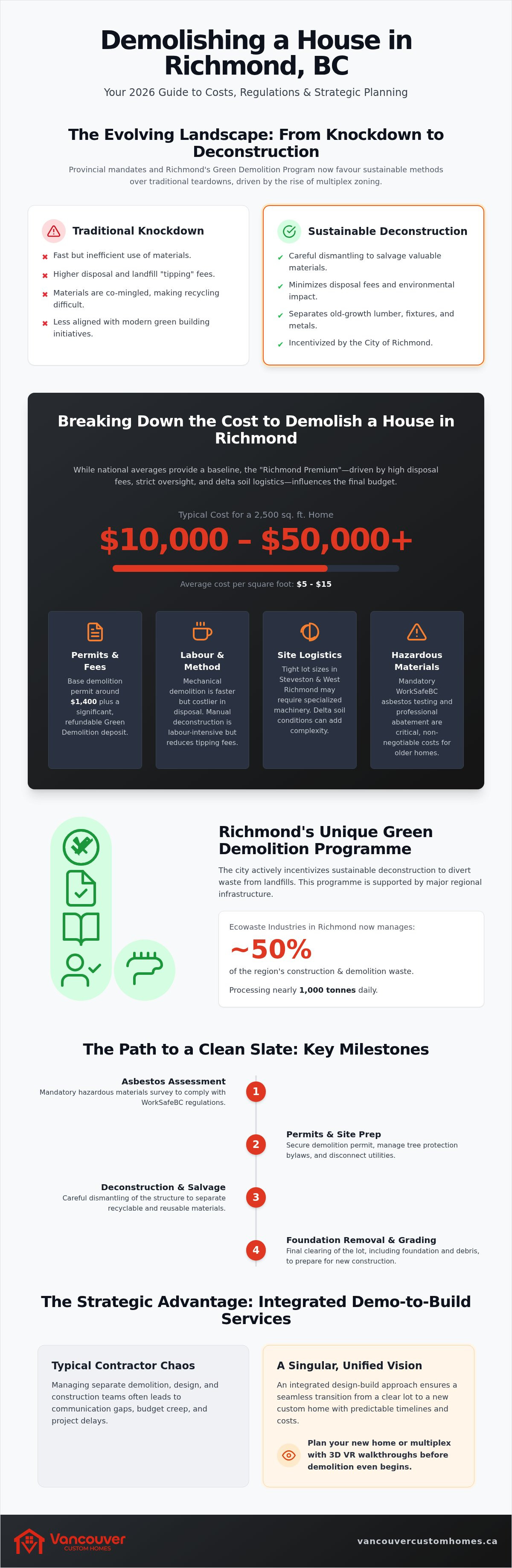
Why avoid the traditional wrecking ball? The City of Richmond now heavily incentivizes deconstruction over basic "knock-down" tactics. This process involves carefully dismantling a home to salvage materials like old-growth lumber and high-value fixtures. Various demolition methods exist; however, modern regulations and the City’s Green Demolition Program favour those that divert significant waste from landfills. In fact, Ecowaste Industries in Richmond now manages approximately 50% of the region's construction waste, processing nearly 1,000 tonnes daily. This infrastructure supports a more disciplined, organized approach to clearing your lot.
While Richmond’s bureaucracy is often more structured than Vancouver’s, it remains rigorous. Navigating the emotional transition from a family home to a construction site requires a partner who treats the process with respect. We replace the typical chaos of a teardown with a logical, step-by-step progression that prepares your property for its next chapter.
Teardown Trends in Richmond Neighbourhoods
Steveston and West Richmond remain the primary hotspots for redevelopment. These neighbourhoods feature older bungalows sitting on prime land that is now eligible for increased density. Lot sizes in these areas can be tight, often requiring specialized, smaller machinery to navigate between existing hedges and neighbouring structures. Understanding the cost to demolish a house in Richmond BC starts with recognizing these site-specific logistics. The shift toward higher-density residential builds on single-family lots is now the standard for maximizing property value.
Why Demolish? The Case for a Clean Slate
Is it better to renovate or start over? In 2026, the answer is almost always a clean slate. Trying to retrofit a 1970s home to meet current seismic and energy standards frequently costs more than a full teardown. A demolition allows you to build to a custom home construction Vancouver standard. This ensures your new property realizes its full market potential without the compromises of a legacy floor plan. It replaces the anxiety of uncovering hidden structural rot with the predictable excitement of a fresh foundation.
Breaking Down the Cost to Demolish a House in Richmond
Budgeting for a teardown requires more than just a cursory glance at national averages. While the general cost to demolish a house in Canada typically spans from $10,000 to $50,000, homeowners in this region often encounter the "Richmond Premium." This elevation in pricing is driven by high regional disposal fees, strict municipal oversight, and the logistical challenges of working on delta soil. A successful budget accounts for fixed municipal fees and the variable costs associated with your specific structure and site accessibility.
Square Footage Estimates and Labour
For a standard 2,500 square foot Richmond bungalow, industry averages for residential demolition usually fall between $5 and $15 per square foot. However, the method you choose significantly dictates the final invoice. Mechanical demolition is incredibly fast; it uses heavy machinery to clear a lot in days. While efficient, it often leads to higher disposal costs because materials are co-mingled, making recycling difficult. Conversely, manual deconstruction is labour-intensive but can lower your tipping fees by separating salvageable wood and metal. Labour shortages in the 2026 construction sector have made skilled machine operators a premium resource, so securing your timeline early is essential for cost control.
Richmond Municipal Fees and Deposits
Richmond’s bureaucracy is thorough, and its fee structure reflects a commitment to sustainability. You should expect a base demolition permit fee of approximately $1,400. Beyond the permit, the City of Richmond’s Green Demolition Program requires a significant refundable deposit. This system ensures that a high percentage of your home’s materials are diverted from landfills, a policy that aligns with Construction and demolition waste regulations set by Metro Vancouver. You must also account for:
- Utility Disconnections: Capping sewer, water, and gas lines by city-approved contractors.
- Damage Deposits: Funds held by the city to cover potential damage to sidewalks, curbs, or boulevards during the move.
- Hazardous Material Testing: Mandatory surveys to identify asbestos or lead before any structural work begins.
Managing these moving parts requires a high degree of organization. If you want to replace construction chaos with a sense of controlled excitement, consider how a disciplined project manager can streamline these municipal hurdles for you. By integrating the permit process with your initial design phase, you ensure that the site is ready exactly when the building crew is scheduled to arrive.
Richmond Unique House Moving and Salvage Program
Did you know your old house could be someone else's new beginning? The City of Richmond operates a unique House Moving and Salvage Program that redefines the standard teardown. Instead of viewing your property as waste, this initiative encourages homeowners to list their structures for 60 days to attract house-moving companies or material salvagers. This isn't just an environmental gesture. It is a calculated financial strategy. By relocating the entire structure, you effectively eliminate the primary cost to demolish a house in Richmond BC, replacing a massive expense with a potential sale or, at the very least, a free site clearing.
This program acts as a stabilizing force in your budget. It provides a structured alternative to the chaos of high-volume waste disposal. When you choose salvage over destruction, you align your project with the city’s long-term sustainability goals. It replaces the typical anxiety of rising landfill fees with a sense of controlled, predictable savings. This integrated approach ensures that every piece of your old home is valued, rather than discarded.
The Financial Benefits of Deconstruction
Deconstruction is the precise, manual alternative to the wrecking ball. While mechanical demo is fast, it generates high tipping fees at regional facilities. By choosing to salvage, you separate high-value materials such as old-growth Douglas Fir or vintage masonry. This separation allows you to qualify for municipal rebates and ensures the full return of your Green Demolition Program deposit. Sustainable practices like these are essential for modern multiplex development Vancouver standards. It turns a liability into a resource, lowering your total site preparation budget while protecting the local environment.
Logistics of Moving a Building in Richmond
Is every house a candidate for moving? Not necessarily. Relocation requires a structure with high structural integrity and a clear path to the water or a new lot. The City of Richmond facilitates this by hosting a registry where salvagers can find your property. However, you must plan for the timeline impact. The 60-day listing period required by the city can delay your build start if not integrated into your project schedule early. A disciplined strategist manages this window by aligning salvage efforts with the final design approvals. This ensures your lot is cleared exactly when your new foundation permits are ready, preventing any friction in your transition from old to new.
Navigating Permits, Abatement, and Site Preparation
Site preparation is the phase where discipline matters most. It’s the difference between a seamless transition and a stalled project. While structural removal is visible, the invisible hurdles of hazardous materials and municipal bylaws often dictate the true cost to demolish a house in Richmond BC. Proactive management in this stage replaces the typical anxiety of construction with a sense of controlled, predictable progress.
Securing the site involves more than just a perimeter fence. It requires a logical sequence of utility disconnections and neighbourly communication. You must coordinate with BC Hydro for power strikes, FortisBC for gas capping, and the City of Richmond for water and sewer isolation. Each of these steps has its own timeline. A project that is not perfectly synchronized will face idle machinery and mounting costs. Our integrated approach ensures these disconnections happen in parallel with your permit approvals, keeping the momentum steady.
The Abatement Process in 2026
Asbestos abatement is the most significant variable in any demolition budget. Since January 1, 2024, WorkSafeBC regulations mandate that all abatement contractors must be licensed and workers must be certified. If your home was built before 1990, a hazardous materials survey is a legal requirement before any work begins. The cost reality of abatement is wide. A whole-house removal can range from $2,500 for minor containment to over $30,000 for comprehensive projects. Typical costs for asbestos-containing drywall joint compound range from $20 to $45 per square foot, while vinyl floor tiles often cost between $10 and $20 per square foot. These are fixed safety protocols that cannot be bypassed.
Richmond Tree Permits and Site Constraints
Richmond Tree Protection Bylaws are among the most rigorous in British Columbia. You cannot simply clear the lot. Any tree with a diameter of 20 cm or more at breast height is protected. This requires a professional arborist report and the installation of sturdy tree protection fencing before a single excavator arrives on site. Failing to respect these boundaries results in heavy fines and immediate work stoppages that can derail your entire schedule. Managing these site constraints requires a strategist who understands how to navigate the geography of a Richmond lot without compromising the health of the local canopy.
Managing these complex layers of compliance is a full-time responsibility. To ensure your site is cleared safely and legally, you can rely on our integrated project management to handle every permit and abatement detail from start to finish.
The Strategic Advantage of Integrated Demo-to-Build Services
Why settle for a fragmented process that leaves your property as a barren dirt lot for months? Most homeowners view the teardown and the build as two separate events. This creates a dangerous gap where accountability disappears and costs escalate. When you partner with a custom home builder Richmond BC, the teardown becomes a strategic launchpad rather than a standalone chore. The cost to demolish a house in Richmond BC is an investment in your new foundation; it shouldn't be a source of unpredictable stress.
We replace the typical "construction chaos" with a "one-roof" solution. This means the same team that designs your home is the one managing the excavator. By using 3D VR walkthroughs, we allow you to visualize your new multiplex or custom estate on the exact topography of your current lot before the first wall comes down. This foresight ensures that site grading, utility locations, and tree protection zones are perfectly aligned with your future floor plan. It turns a destructive phase into a disciplined, creative start.
Seamless Design-Build Integration
Precision in the early stages prevents expensive corrections later. Our custom home design Vancouver experts use real-time data from the demolition phase to refine site planning. We coordinate permit applications for both the demolition and the new construction simultaneously. If your lot is cleared on a Tuesday, your foundation crew should be ready by Wednesday. This level of synchronization is only possible when a single strategist takes full responsibility for the timeline. It ensures your project maintains momentum from the initial rubble to the final roof installation.
Transparency Through the Client Portal
Information is the best cure for project anxiety. We provide every client with a dedicated project management portal to track every milestone of the teardown. You don't have to wonder if the asbestos has been cleared or if the city has signed off on the capping of your sewer lines. You can view your hazmat reports, permit approvals, and real-time photo updates of the lot clearing process from any device. These home builder client portal benefits create an emotional atmosphere of security. You remain fully informed and in control of the cost to demolish a house in Richmond BC without being overwhelmed by the technical minutiae. This is how modern luxury builds are managed: with absolute transparency and professional dedication.
Building Your Future on a Clean Slate
Clearing your lot is more than just a logistical hurdle; it is the first phase of a unified architectural journey. You now have the framework to manage hazardous material abatement and leverage Richmond’s unique salvage programs to your financial advantage. Understanding the total cost to demolish a house in Richmond BC is the only way to ensure your project remains on a steady, predictable path. It replaces the typical anxiety of a teardown with the confidence of a well-planned start.
We specialize in redefining Richmond residential luxury through a seamless transition from teardown to build. By utilizing integrated 3D VR design and construction, we replace the typical chaos of a construction site with the controlled excitement of a visionary guide. You deserve a partner who takes full responsibility for every permit, arborist report, and foundation strike. This "one-roof" approach ensures your vision stays intact from the first excavator strike to the final interior finish.
Ready to move from rubble to roof with total accountability? Start your Richmond custom build with a professional site assessment and gain access to our transparent project management portal. It’s time to realize the home you’ve envisioned without the industry chaos. Your new chapter begins with a disciplined, organized site.
Frequently Asked Questions
How much does a demolition permit cost in Richmond BC for 2026?
The base demolition permit fee in Richmond is approximately $1,400 for 2026. This fee covers the administrative processing and initial site inspections required by the city. It's essential to account for this as a fixed cost before factoring in variable expenses like utility capping or hazardous material disposal. While this is the base rate, additional costs may apply depending on the complexity of your specific lot and the scope of the teardown.
How long does it take to get a demolition permit from the City of Richmond?
Permit processing times in Richmond typically range from four to eight weeks, though this can vary based on current municipal volumes. If your project includes a salvage component or tree protection requirements, the timeline may extend. We integrate this waiting period into your project schedule early. This ensures that your lot is cleared exactly when your new construction team is ready to break ground, preventing costly idle time.
Do I need an asbestos report before demolishing my house in Richmond?
Yes, a professional hazardous materials survey is a legal requirement for any home built before 1990. This report identifies asbestos or lead-based paints that require specialized removal. Since January 1, 2024, all abatement contractors in British Columbia must be licensed by WorkSafeBC. This regulation ensures safety and compliance, but it is also a primary factor that influences the total cost to demolish a house in Richmond BC.
What is the Richmond Green Demolition Program deposit?
The Green Demolition Program requires a refundable deposit to ensure that a high percentage of demolition waste is diverted from landfills. This deposit is returned once you provide proof that materials like old-growth lumber or concrete have been recycled at authorized facilities. It is a disciplined system designed to promote sustainability. We manage this documentation for you to ensure your deposit is returned promptly after the site is cleared.
Can I demolish my house if there are large trees on the property?
You can, but you must strictly adhere to the Richmond Tree Protection Bylaws. Any tree with a diameter of 20 cm or more is protected and requires an arborist report and specialized fencing before work begins. Failing to protect these trees can lead to significant fines and immediate project shutdowns. We coordinate with certified arborists to ensure your lot remains compliant while maximizing the space for your new custom build.
Is deconstruction more expensive than traditional demolition in Richmond?
Manual deconstruction often involves higher upfront labour costs compared to mechanical demolition, yet it can significantly reduce your total disposal fees. By separating materials like metal and high-value wood, you avoid the heavy tipping charges associated with mixed waste. This approach also helps you secure the full return of your green demolition deposit. It is a strategic choice that balances environmental responsibility with long-term budget efficiency.
Who handles utility disconnections for a house demolition in BC?
Utility disconnections must be handled by the respective providers, including BC Hydro, FortisBC, and the City of Richmond’s water and sewer departments. You cannot proceed with a teardown until these lines are safely capped and verified. We manage this entire checklist as part of our integrated service. This prevents the "construction chaos" that occurs when utility delays stall your heavy machinery and push your timeline off track.
Can Vancouver Custom Homes manage the demolition phase of my project?
Absolutely. We provide a "one-roof" solution that manages your project from the initial site assessment through to the final build. By handling the demolition phase, we ensure that the cost to demolish a house in Richmond BC is fully integrated into your total construction budget. You gain access to our project management portal, providing real-time updates and peace of mind as we transition your property into a modern custom home.


