
What if you could bypass the multi-year rezoning queue and immediately unlock double the density on a standard residential lot? Most investors realize that a multiplex as a real estate investment in Vancouver represents the city's most significant housing shift in decades, yet many still hesitate. You have likely felt the same anxiety over opaque permit timelines, rising labour costs, and the looming BC Home Flipping Tax. It is a valid concern because a project that looks good on paper can quickly dissolve into construction chaos without a disciplined, transparent strategy.
This 2026 guide is designed to replace that uncertainty with professional reassurance. You will discover how to capitalize on the City of Vancouver’s recent fee overhauls, including the June 2026 elimination of density bonus contributions, to maximize your return on investment. We will explore how an integrated design-build approach and 3D VR walkthroughs can eliminate transparency gaps and ensure your final product commands premium market rates. From navigating specific R1-1 zoning requirements to securing high-yield rental income through CMHC MLI Select, we are providing the roadmap for a seamless, high-end development process that prioritizes your peace of mind.
Key Takeaways
- Learn how Vancouver's R1-1 zoning and provincial mandates allow you to build up to eight units on a single lot without the traditional rezoning headache.
- Master the essential financial metrics required to evaluate a multiplex as a real estate investment in Vancouver; this includes projecting Gross Development Value for strata-titled units.
- Discover why the integrated design-build model is the only way to eliminate construction chaos and ensure total accountability for your project's budget.
- See how 3D VR walkthroughs allow you to perfect your floor plans and market your units to premium tenants or buyers before the foundation is even poured.
- Understand how to navigate the 2026 municipal fee landscape to capitalize on reduced development costs and maximize your net yields.
Why Multiplexes are Vancouver’s Premier Real Estate Investment in 2026
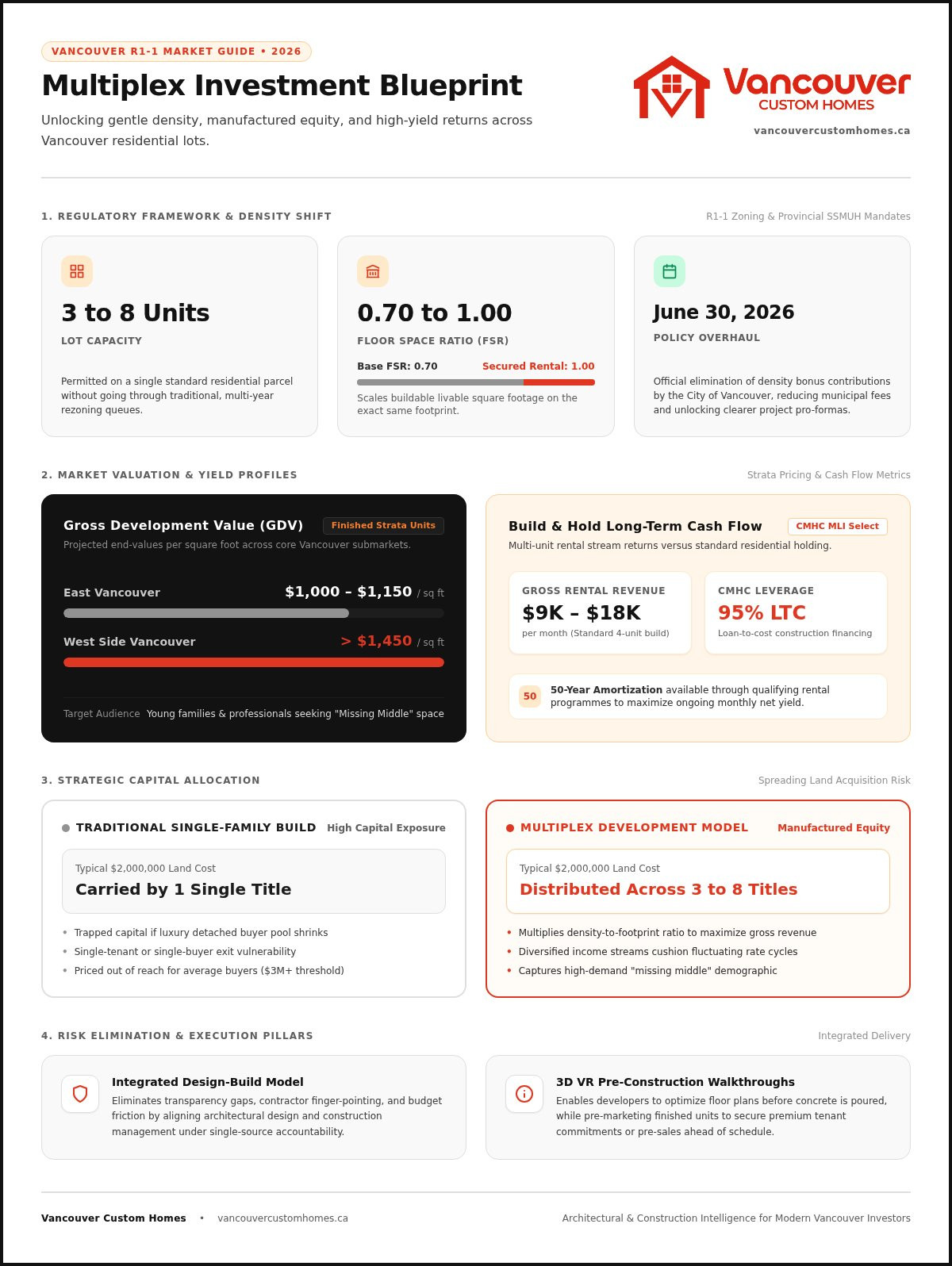
The 2026 real estate market has undergone a fundamental transformation. For decades, investors focused on luxury single-family builds or speculative land holding, but the city's R1-1 zoning framework has effectively ended that era. Today, choosing a multiplex as a real estate investment in Vancouver is the most efficient way to manufacture equity. By allowing three to eight units on standard residential lots, the city has created a sophisticated gold rush for those who understand how to leverage density. This shift is not just about housing; it's about maximizing the utility of every square foot of Vancouver dirt.
Demand for high-end multi-unit housing is currently outpacing supply at an unprecedented rate. Professional tenants and young families are moving away from cramped downtown towers, yet they remain priced out of $3 million detached homes. This has created a massive inventory shortage for missing middle housing typologies. Multiplexes fill this void by offering the privacy and square footage of a traditional house with the modern efficiency of a strata. Because these units appeal to a broader demographic, they maintain their value and rental demand even when interest rate environments fluctuate, providing a level of market resilience that luxury mansions simply cannot match.
The Evolution of Vancouver Residential Density
Vancouver's journey toward density started with modest experiments like laneway houses and secondary suites. By 2026, these "gentle density" trials have matured into a robust landscape of four-plexes and six-unit secured rental builds. The primary difference now is predictability. Following the June 30, 2026, elimination of burdensome density bonus contributions, the financial path for these projects is clearer than ever. Investors are increasingly moving toward a "build and hold" strategy. With CMHC MLI Select offering 50-year amortizations and 95% loan-to-cost financing, the long-term cash flow from a well-managed multiplex often outweighs the quick profit of a strata sale.
Maximizing Land Value Through Strategic Development
Financial success in the current market depends on how effectively you split your land cost. A custom single-family home on a $2 million lot carries significant risk; if the luxury buyer pool shrinks, your capital is trapped. In contrast, a multiplex as a real estate investment in Vancouver spreads that initial land acquisition cost across multiple titles or rental streams. Under R1-1 regulations, you can achieve a base Floor Space Ratio (FSR) of 0.70, which can scale up to 1.00 for qualifying rental developments. This increased FSR allows you to build more livable square footage on the same footprint, directly boosting your Gross Development Value. Multiplexes transform a single land parcel into a diversified asset class by multiplying the density-to-footprint ratio for the modern investor.
Calculating ROI: Key Financial Metrics for Vancouver Multiplexes
A successful multiplex as a real estate investment in Vancouver requires a shift in perspective from simple land appreciation to manufactured equity. Many investors make the mistake of focusing solely on the acquisition price of the lot. While the purchase price is your largest initial outlay, your true ROI is determined by how efficiently you manage the spread between total development costs and the Gross Development Value (GDV). GDV represents the projected final sale price of your strata units or the capitalized value of your rental stream. In the 2026 market, finished strata units in East Vancouver are commanding between $1,000 and $1,150 per square foot, while West Side projects often exceed $1,450 per square foot. Understanding these numbers before you break ground is the difference between a high-yield asset and a financial burden.
Rental yields also offer a compelling narrative for the "build and hold" investor. A standard four-unit build can generate between $9,000 and $18,000 in gross monthly income, far outpacing the returns of a traditional single-family home with a basement suite. To ensure these projections hold up, you must consult the City of Vancouver's R1-1 housing guidelines to confirm your specific lot's density potential. Chaos is the silent killer of investor margins; every month of delay in the permitting or construction phase adds thousands in carrying costs that erode your bottom line.
Hard Costs vs. Soft Costs in 2026
Accurate budgeting in Metro Vancouver requires a granular understanding of current market rates. Hard costs for multiplex construction currently range from $350 to $550 per square foot, with a typical average landing between $400 and $500. However, the soft costs often catch investors off guard. You must budget between $120,000 and $250,000 for architectural, engineering, and municipal fees before construction financing is even released. This includes the new Amenity Cost Charge (ACC) of $2.32 per square foot and regional Development Cost Charges (DCCs) frozen at $21,941 per unit. Maintaining a disciplined contingency fund is no longer optional; it is a requirement for stabilizing your project against inflationary pressures.
The ROI of Integrated Design-Build
Fragmented project management is the primary cause of budget overruns. When your architect and builder operate in silos, design-budget disconnects are inevitable. Choosing an integrated model ensures that every design choice is vetted against real-world construction costs from day one. This unified approach can shave months off your timeline, significantly reducing interest payments on your construction loan. You can learn more about this process by exploring Custom Home Design Vancouver: Bridging the Gap Between Vision and Build. By aligning your vision with a single integrated design-build partner, you replace the typical anxiety of construction with a predictable, high-yield outcome.
Navigating the R1-1 Zoning and BC’s SSMUH Regulations
Vancouver's R1-1 (Residential Inclusive) district schedule is the engine behind the city's housing evolution. While British Columbia’s Small-Scale Multi-Unit Housing (SSMUH) legislation, strengthened by Bill 25, sets the provincial floor for density, R1-1 is the specific framework you must master. It allows for as-of-right development, meaning you don't need a lengthy rezoning process if your project meets the criteria. However, density isn't a guarantee; it's earned through compliance. A multiplex as a real estate investment in Vancouver requires a lot that meets specific physical prerequisites. For a standard three to four-unit build, you need a minimum area of 306 m2 (roughly 3,294 sq. ft.) and a frontage of at least 32.8 feet. If you're aiming for six strata units or eight rental units, your lot must be at least 557 m2 (6,000 sq. ft.) with a 50-foot frontage.
Don't fall for the "pre-approved" plan myth. While the city offers standardized concepts, every lot in Vancouver has unique constraints. Whether it's a heritage tree, a specific utility easement, or a non-standard lane access, a "one-size-fits-all" plan often leads to expensive delays. You need a custom design that respects setbacks and the mandatory 6.1-metre courtyard separation while maximizing your buildable area. Relying on a generic blueprint is the fastest way to encounter mid-project stop-work orders or utility friction.
Zoning Constraints and Opportunity Areas
While Vancouver is the primary focus, savvy investors are looking at surrounding municipalities like Burnaby, Richmond, and North Vancouver. These areas are adopting similar density frameworks to align with provincial mandates. Success in these zones depends on navigating local tree protection bylaws and height restrictions that vary by block. Staying ahead of the multiplex development Vancouver trend means identifying lots with rear lane access or double street frontage, as these are significantly easier to service for multi-unit utilities and BC Hydro pad-mounted transformer placements.
The Permit Process: From Application to Occupancy
Permitting in 2026 is faster than in previous years, but it isn't instant. For a fully compliant R1-1 application, you should expect three to six months for a development permit and another two to four months for a building permit. The most common cause of permit rejection is uncoordinated drawings or failure to account for BC Hydro overhead clearance regulations. By using a single-source design-build partner, you ensure that every technical detail, from rainwater detention tanks to pad-mounted transformers, is addressed before the application hits the city's desk. This integrated approach eliminates the back-and-forth that kills project momentum and investor margins.
Mitigating Risk: Why Integrated Design-Build is Non-Negotiable for Investors
Why do so many high-potential projects in Metro Vancouver stall before the foundation is even poured? Usually, it is a breakdown in communication between the architect and the builder. In a fragmented model, the investor sits in the middle of a costly blame game. If the design exceeds the budget, the architect blames the builder's rates; the builder blames the architect's impractical specs. Choosing a multiplex as a real estate investment in Vancouver is too capital-intensive to leave to chance. You need a single point of accountability where the design is vetted against real-world costs from day one.
Accountability is the backbone of a successful build. When you operate under a fragmented model, you are essentially managing multiple separate businesses, each with their own interests. An integrated design-build firm takes full responsibility for the entire project lifecycle. This "one-roof" solution ensures that the high-end architectural vision you approved is actually buildable within your financial parameters. It eliminates the risk of mid-construction revisions that can cost tens of thousands of dollars in labour and material delays. By aligning design and construction under a single lead strategist, you replace traditional industry ambiguity with professional certainty.
Eliminating Construction Chaos
Transparency is the only effective antidote to the anxiety of a large-scale development. In 2026, modern investors expect real-time data, not vague monthly updates. Using a home builder client portal allows you to track every milestone, from permit approval to the final interior finish. This technology eliminates the "construction chaos" that typically plagues multi-unit builds. When you can see your budget, schedule, and site photos in one secure location, the emotional stress of the project disappears. You stay in control of your investment without being overwhelmed by the technical minutiae of the job site.
The Design-Build Efficiency Advantage
Efficiency in a multiplex project is won during the design phase, not on the construction site. Value engineering allows us to identify cost-saving opportunities in the structural or mechanical plans before they are finalized. For example, coordinating utility easements and BC Hydro clearances during the initial drawings prevents the stop-work orders that frequently derail uncoordinated projects. This integrated approach significantly shortens the feedback loop. When the builder is in the room during the design phase, feasibility is guaranteed. This streamlined workflow protects your margins and ensures your product is ready for market on schedule. If you are ready to secure your portfolio's future, you can start your multiplex project today with a partner who prioritizes your peace of mind.
Realizing Your Investment with Vancouver Custom Homes
Success is not just about finishing a build; it's about realizing the maximum market value of your property. While the technical details of zoning and construction are critical, your ultimate exit strategy depends on the desirability of the finished units. A multiplex as a real estate investment in Vancouver is a high-stakes venture that requires a polished final product to attract premium residents. We bridge the gap between architectural theory and market reality by ensuring every square foot is optimized for both functionality and aesthetic appeal.
3D VR Walkthroughs: The Investor’s Secret Weapon
Traditional 2D blueprints often fail to convey the true feeling of a home, which can lead to expensive changes late in the construction phase. Our 3D VR walkthroughs allow you to experience the space before a single nail is driven. You can walk through the kitchens, check the sightlines from the living rooms, and adjust interior finishes in the digital world to maximize market appeal. This technology is also a powerful marketing tool. It allows you to begin the pre-sale or pre-rental process of your units while the site is still being excavated. By showing potential tenants a photorealistic version of their future home, you secure your cash flow and reduce the risk of vacancy or buyer's remorse upon completion.
The Vancouver Custom Homes Professional Standard
Our expertise extends across the entire Metro Vancouver region. Whether you are developing a multiplex in Burnaby, Richmond, or Coquitlam, our team understands the local nuances that impact your bottom line. We handle the logistical complexities of custom home construction Vancouver by maintaining a strict commitment to transparency and accountability. We act as your visionary guide, providing a "one-roof" solution that simplifies the most complex systems into a structured, predictable experience. This disciplined approach ensures that your multiplex as a real estate investment in Vancouver delivers the high-yield results your portfolio requires. We invite you to book a discovery session today to explore how we can transform your potential lot into a high-performance asset.
Secure Your Portfolio’s Future in Vancouver’s New Housing Landscape
Vancouver’s housing market doesn't wait for the hesitant. The combination of R1-1 zoning flexibility and the recent elimination of density bonus contributions makes a multiplex as a real estate investment in Vancouver a cornerstone for any 2026 portfolio. You now understand how the right financial metrics and a deep grasp of municipal regulations can transform a standard lot into a high-yield asset. Success isn't just about the land; it's about the precision of your execution.
We replace the typical anxiety of construction with controlled, predictable excitement. By utilizing our dedicated project management portal and immersive 3D VR walkthroughs, you maintain total oversight from initial design to final occupancy. Our expertise across Metro Vancouver, including Richmond, Burnaby, and Coquitlam, ensures your project complies with local bylaws while maximizing market appeal. Don't let your investment potential be stifled by fragmented management or construction chaos.
Start your multiplex investment journey with a professional consultation and build with the confidence of a visionary guide. Your vision deserves a seamless path to realization.
Frequently Asked Questions
Is a multiplex a better investment than a laneway home in Vancouver?
A multiplex offers significantly higher density and revenue potential than a laneway home. While a laneway home adds a single secondary unit to an existing property, a multiplex as a real estate investment in Vancouver allows you to replace a single detached house with up to eight units. This strategy maximizes land value by creating multiple titles or rental streams. It's the preferred choice for investors looking to manufacture equity rather than just adding incremental value.
What is the average cost to build a multiplex in Vancouver in 2026?
Construction costs in Metro Vancouver are influenced by site complexity, material selection, and current labour rates. Investors should budget for both hard construction costs and soft costs, including architectural design and municipal fees. These figures vary based on the level of high-end finishes required for your target market. We recommend a detailed feasibility study to establish a precise budget tailored to your specific lot and investment goals before breaking ground.
How many units can I legally build on a standard 33-foot lot?
Under the City of Vancouver’s R1-1 zoning, you can legally build three to four units on a standard 33-foot lot, provided it meets the minimum area of 306 square metres. Larger lots with at least 50 feet of frontage can accommodate up to six strata units or eight secured rental units. Every lot has unique constraints; therefore, you should always verify your specific site requirements during the initial design phase to ensure total compliance.
Does the BC Home Flipping Tax apply to multiplex developments?
The BC Home Flipping Tax applies to any property sold within two years of acquisition, including new multiplex developments. If you sell within the first 365 days, profits are taxed at 20 percent, sliding to zero by day 730. While bona fide builders can often qualify for exemptions, you must properly register your project within 90 days of completion. It's a critical factor for investors planning a build and sell strategy in 2026.
What is the typical ROI for a multiplex development in Metro Vancouver?
ROI varies depending on whether you choose to sell or hold. Strata-titled units in a multiplex as a real estate investment in Vancouver currently sell for $1,000 to $1,450 per square foot, depending on the neighbourhood. For those pursuing a rental strategy, a three to four-unit build can generate gross monthly income between $9,000 and $18,000. High-yield rental income and significant capital gains make this a premier strategy for maximizing returns.
How do I finance a multiplex construction project?
Most investors utilize CMHC MLI Select financing for multi-unit projects. This program offers up to 95 percent loan-to-cost and amortization periods up to 50 years for projects that meet specific affordability or energy efficiency scores. Traditional construction financing is also available, but the CMHC path significantly lowers debt servicing requirements. Securing professional design and visualization early in the process helps present a stronger case to lenders when seeking high-leverage products.
Can I live in one unit and rent out the others in a multiplex?
Living in one unit while renting the others is an excellent strategy for both primary residents and investors. This house-hacking approach allows you to offset your mortgage with high-end rental income from the other suites. Since multiplexes are designed as independent homes rather than basement suites, you maintain privacy and a high standard of living. It's a smart way to enter the Vancouver market while building long-term equity through a multi-unit asset.
How long does the entire multiplex building process take from design to completion?
The entire journey from initial design to final occupancy typically takes between 18 and 30 months. The permitting phase, including development and building permits, usually spans five to ten months if your drawings are fully compliant. Construction follows for another 12 to 18 months, depending on the complexity of the build. Using an integrated design-build model and a project management portal helps keep the schedule tight and avoids the delays common in fragmented builds.


